

Audio
With guests Drs. Tina Phan and Elisa Sottile
Transitioning from residency to academic medicine can feel exciting, overwhelming, and full of hidden expectations. In this episode, our esteemed guest Drs. Tina Phan and Elisa Sottile share practical strategies for building sustainable careers as clinician educators. They discuss using Ikigai to identify meaningful work, Schlossberg’s Transition Theory to navigate career transitions, the importance of mentorship networks, recognizing the hidden curriculum of academic medicine, and applying job crafting to rediscover purpose at work and prevent burnout. Whether you’re just beginning your career or reassessing your current role, this episode provides practical frameworks for building a long, meaningful, and flourishing career.
Claim CME for this episode at curbsiders.vcuhealth.org!
Website | Instagram | Twitter | Subscribe | Patreon | CME!| Youtube
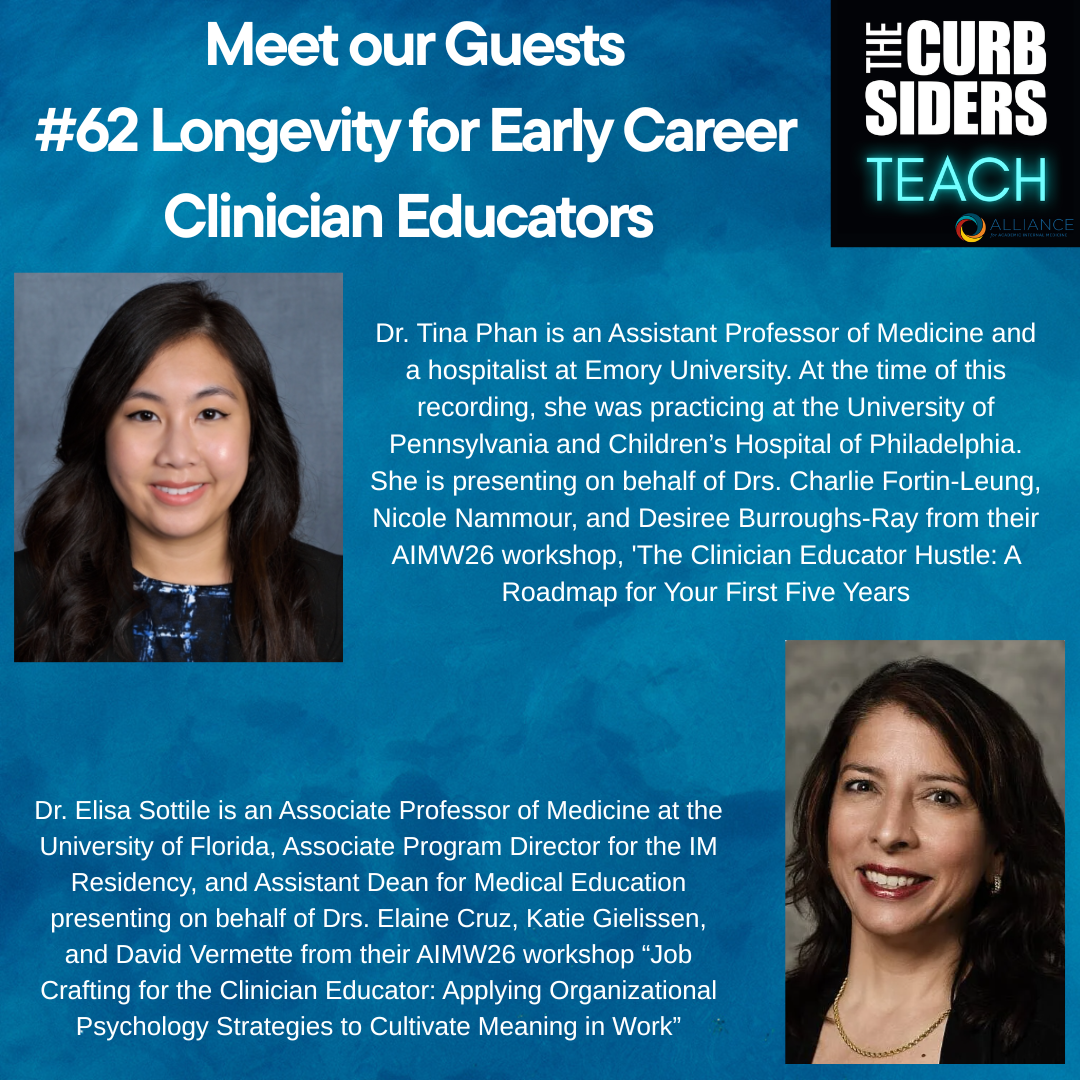
Meet our Guests:
Dr. Tina Phan is an Assistant Professor of Medicine and a hospitalist at Emory University. At the time of this recording, she was practicing at the University of Pennsylvania and Children’s Hospital of Philadelphia. She is presenting on behalf of Drs. Charlie Fortin-Leung, Nicole Nammour, and Desiree Burroughs-Ray from their AIMW26 workshop, “The Clinician Educator Hustle: A Roadmap for Your First Five Years.”
Dr. Elisa Sottile is an Associate Professor of Medicine at the University of Florida, Associate Program Director for the IM Residency, and Assistant Dean for Medical Education presenting on behalf of Drs. Elaine Cruz, Katie Gielissen, and David Vermette from their AIMW26 workshop “Job Crafting for the Clinician Educator: Applying Organizational Psychology Strategies to Cultivate Meaning in Work.”
Supported in Partnership with Alliance for Academic Internal Medicine
CME Partner: VCU Health CE

The Curbsiders are partnering with VCU Health Continuing Education to offer continuing education credits for physicians and other healthcare professionals. Visit curbsiders.vcuhealth.org and search for this episode to claim credit. See info sheet for further directions. Note: A VCU Health CloudCME account is required in order to seek credit.
Show Segments
- Intro, disclaimer, guest bio
- Guests one-liner/ passion outside of medicine
- Guests’s highlights of AIMW26 and motivations to present their workshops
- Using Ikigai
- Schlossberg’s Transition Theory to navigate career transitions
- Importance of Mentorship networks
- Recognizing the hidden curriculum of academic medicine
- Applying job crafting to rediscover purpose and prevent burnout
- Outro
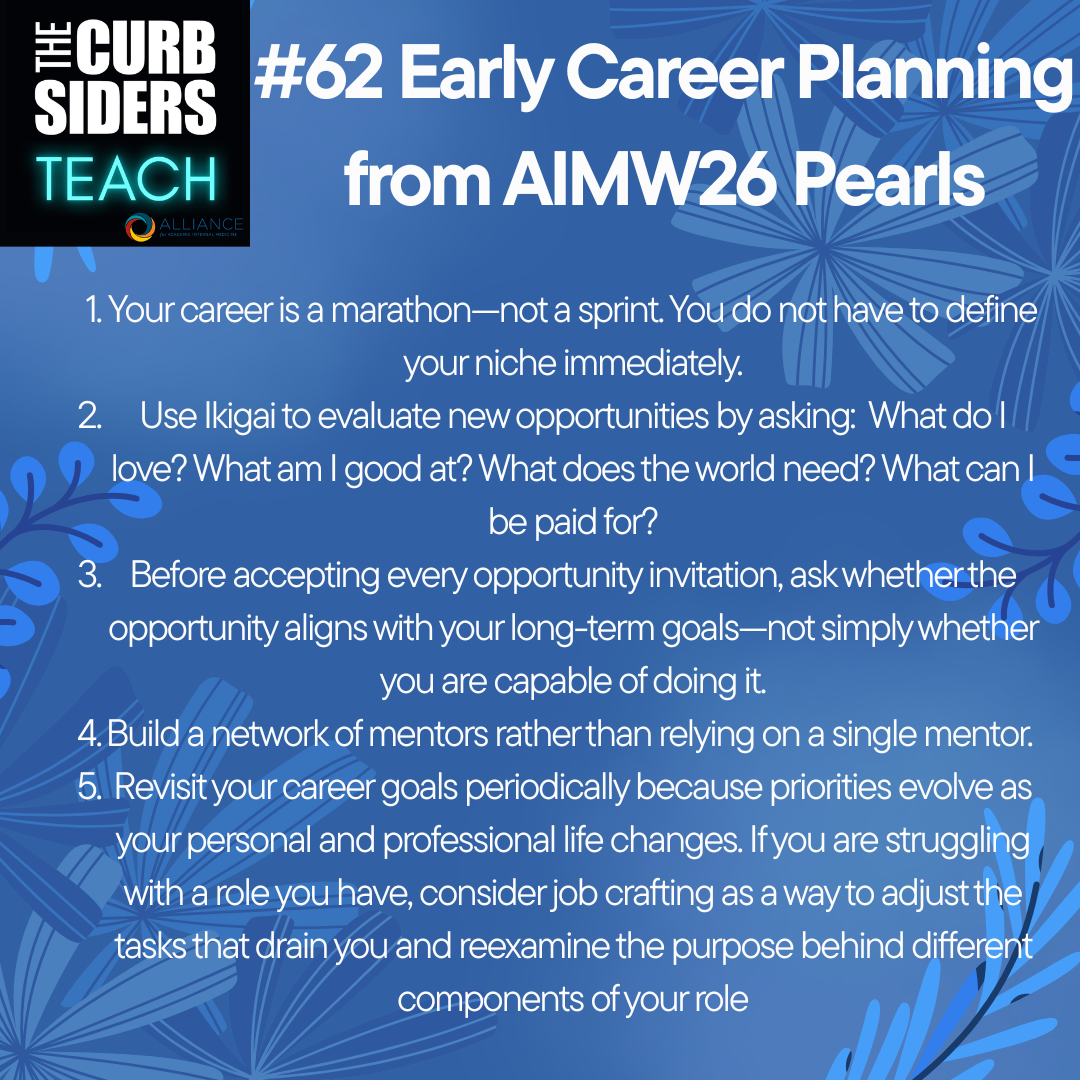
Early Career Planning for Clinician Educators Pearls
- Your career is a marathon—not a sprint. You do not have to define your niche immediately after residency.
- Use Ikigai to evaluate new opportunities by asking:
- What do I love?
- What am I good at?
- What does the world need?
- What can I be paid for?
- Before accepting every opportunity invitation, ask whether the opportunity aligns with your long-term goals—not simply whether you are capable of doing it.
- Build a network of mentors rather than relying on a single mentor. Different mentors serve different purposes.
- Revisit your career goals periodically because priorities evolve as your personal and professional life changes. If you are struggling with a role you have, consider job crafting as a way to adjust the tasks that drain you and reexamine the purpose behind different components of your role
Early Career Planning for Clinician Educators Notes
Tina highlights that our priorities change throughout our academic careers. What we think might be most important when leaving residency may shift, for example with parenthood.
Ikigai is a framework for thinking about prioritizing your energies. Ikigai is a Japanese concept looking at the intersections between what you’re good at, what you love, what the world needs, and what can make you money. As an early clinician educator, you will likely receive many opportunities to volunteer to be engaged in a variety of opportunities. Using the Ikigai format can help prioritize which of those to say yes to. Reevaluate your ikigai over time.
For very early clinicians in academic medicine, appreciate that you don’t have a full picture of what the opportunities are. Take time to explore different roles to find out what brings joy and remember that your main role is a clinician. Many of us in medicine are driven to get to the next step and constantly compare ourselves to others, and we need to trust that the process of ongoing discernment will happen over time. Academic medicine is a marathon, not a sprint.
Times of transition and even just ongoing work involve a lot of moving parts that require an efficient approach. To promote efficiency, the Pomodoro Technique recommends setting a cycle of 25 minutes of uninterrupted work with a 5 minute break, and then cycle through that. Put your phone on ‘do not disturb’ and turn off email notifications. Break down your to do list and address item by item.
Tina details Schlossberg’s transition theory, which suggests that successful transition involves accounting for and balancing the 4 S’s, self, situation, support, and strategies. Both Tina and Elisa reflect about how helpful mentorship networks were for them.
Elisa speaks on the hidden curriculum that can exist in many academic institutions and the benefit of understanding it but also the courage to go against such unspoken rules when the occasion arises.
Elisa discusses what it means to have flourishing at work and describes how one can employ job crafting when roles at work are draining to break down the role into its different components. Through this approach you can adjust the tasks that drain you and reexamine the purpose behind different components of your role to prevent burnout. Below is a more in-depth review of many of these concepts.
Early Career Success Begins With Reflection
Many residents enter academic medicine knowing they enjoy teaching but without a clear vision of what their long-term career should look like. The guests emphasize that uncertainty is normal. Rather than rushing toward a predefined niche, early career faculty should spend time reflecting on the clinical and educational activities that consistently bring them energy and fulfillment.
Rather than comparing yourself to colleagues, define success on your own terms. Academic careers evolve over decades, allowing interests and leadership roles to change over time.
Ikigai Helps Align Passion With Career Longevity
The Japanese concept of Ikigai provides a practical framework for evaluating career opportunities.
The four intersecting domains include:
- What you love
- What you are good at
- What the world needs
- What you can be paid for
Academic medicine presents countless committees, projects, and leadership opportunities. Without intentional selection, saying “yes” to everything may ultimately contribute to burnout. While there may be times when one contributes to their academic community by taking on tasks or roles that may not directly or immediately bring joy to ensure progress for their immediate academic team, revisiting one’s Ikigai periodically allows clinician educators to ensure that their work continues to align with evolving values and life priorities.
Productivity Requires Protecting Attention
New faculty often underestimate the administrative burden of transitioning into practice.
One practical strategy discussed is the Pomodoro Technique:
- 25 minutes of uninterrupted work
- 5 minute break
- Repeat several cycles before taking a longer break
The guests also recommend eliminating unnecessary interruptions by closing email or the electronic health record during focused work sessions and establishing clear communication expectations with clinical teams about when immediate responses are truly necessary.
Schlossberg’s Transition Theory Provides a Framework for Major Career Changes
Major transitions—including becoming an attending, changing institutions, or assuming leadership positions—can be understood using Schlossberg’s Four S’s:
- Situation
- Self
- Support
- Strategies
Rather than viewing transitions as purely logistical events, this framework encourages structured reflection about available resources, coping mechanisms, personal strengths, and support systems. The framework can be revisited repeatedly throughout one’s career as new transitions arise.
Learn the Hidden Curriculum Without Losing Yourself
Every institution has an informal culture that extends beyond written policies.
Early faculty should spend time observing:
- how leadership decisions are made
- which activities are valued
- how successful educators build visibility
- what opportunities tend to lead toward leadership
However, understanding the hidden curriculum does not mean blindly conforming to it. The guests encourage clinician educators to maintain their educational values while thoughtfully adapting to institutional culture.
Mentorship Should Be Intentional and Diverse
Rather than searching for one perfect mentor, clinician educators benefit from cultivating a diverse mentoring network.
Potential mentors may provide:
- career guidance
- sponsorship
- emotional support
- institutional knowledge
- leadership advice
- research collaboration
Some of the most valuable mentors may come from outside one’s department—or even outside medicine entirely. Professional societies also provide opportunities to build lasting mentorship relationships beyond one’s home institution.
Job Crafting Can Restore Meaning and Prevent Burnout
Flourishing involves more than avoiding burnout. It includes purpose, relationships, physical and mental health, and meaningful work.
Rather than abandoning a role immediately when dissatisfaction develops, clinician educators can engage in job crafting, including:
Task crafting
- modifying specific responsibilities
Relational crafting
- strengthening meaningful workplace relationships
Cognitive crafting
- reframing how one thinks about aspects of the work
These strategies may help restore meaning before major career changes become necessary.
Protect Your Well-being Throughout Your Career
As life outside of work evolves, guests intuit that clinician educators need to mindfully and iteratively balance and re-balance professional and personal responsibilities. Additionally, both guests emphasize that flourishing requires attention to life outside work.
Strategies include:
- advocating for support at work and at home
- asking for help
- protecting time with family
- recognizing when stepping away from a role is appropriate
- openly discussing mental health to reduce stigma
Career sustainability depends on flourishing across all domains of life—not simply professional achievement.
Take Home Points
Drs. Tina Phan and Elisa Sottile remind clinician educators that meaningful careers are intentionally built over time. Rather than chasing every opportunity, they encourage educators to identify work aligned with their values, cultivate diverse mentorship networks, revisit career priorities regularly, and protect time for both professional and personal flourishing. Career longevity depends not only on productivity, but on maintaining purpose, relationships, and well-being throughout every stage of academic medicine.
Links
- Stay tuned for ChangeMedEd AMA grant for a web platform with asynchronous AI-coaching
- Coming soon: Tina’s CoreIM episode with a thrombocytopenia framework
- Power of manifestation
Goal
Listeners will learn approaches to successfully navigate the first first few years of a clinician educator career with an eye towards a meaningful and thriving career.
Learning objectives
After listening to this episode listeners will be able to …
- Discuss the concept of Ikigai and how it can be used to reflect about career passions and goals
- Identify strategies to time manage, navigate career transitions, and create a supportive institutional culture
- Review what it means to flourish in the workplace as a clinician-educator and how the job-crafting model can be used to pursue flourishing
Disclosures
Drs Phan and Sottile report no relevant financial disclosures. The Curbsiders report no relevant financial disclosures.
Citation
Cheng MKW, Heublein M, Phan T, Sottile E, Kryzhanovskaya E. “#62 Planning for Longevity and Meaning: Early Career Planning for Clinician Educators from AIMW26. The Curbsiders Teach Podcast. https://thecurbsiders.com/teach. July 16, 2026.
Episode Credits
Producers: Molly Heublein MD, Mike KW Cheng MD, MAEd, and Era Kryzhanovskaya MD
Show notes & Infographics: Era Kryzhanovskaya, MD
Hosts: Mike KW Cheng MD, MAEd and Molly Heublein MD
Editor: Era Kryzhanovskaya MD, Mike KW Cheng MD, MAEd, Molly Heublein MD
Peer Reviewer: Keith Dickerson, MD
Guests: Dr. Tina Phan, Dr. Elisa Sottile
Technical support: Podpaste
Theme Music: MorsyMusic
CME Partner

The Curbsiders are partnering with VCU Health Continuing Education to offer continuing education credits for physicians and other healthcare professionals. Visit curbsiders.vcuhealth.org and search for this episode to claim credit.
Contact Us
Got feedback? Suggest a Teach topic. Recommend a guest. Tell us what you think.
We love hearing from you.
Join our Patreon!

Yes, you can now join our exclusive community of core faculty at Kashlak Memorial Hospital along with all the perks:
- Bundle & Save with the top CME tier!
- All episodes Ad-Free, including the entire back catalog!
- Twice-monthly bonus episodes: Ask me Anything (AMA) with Matt & Paul, Recaps, and more!
- Access to Kashlak's Discord Server!
- Advance Notice of Curbsiders Events!
- Exclusive Curbsiders' Merch!
