

Audio
Video
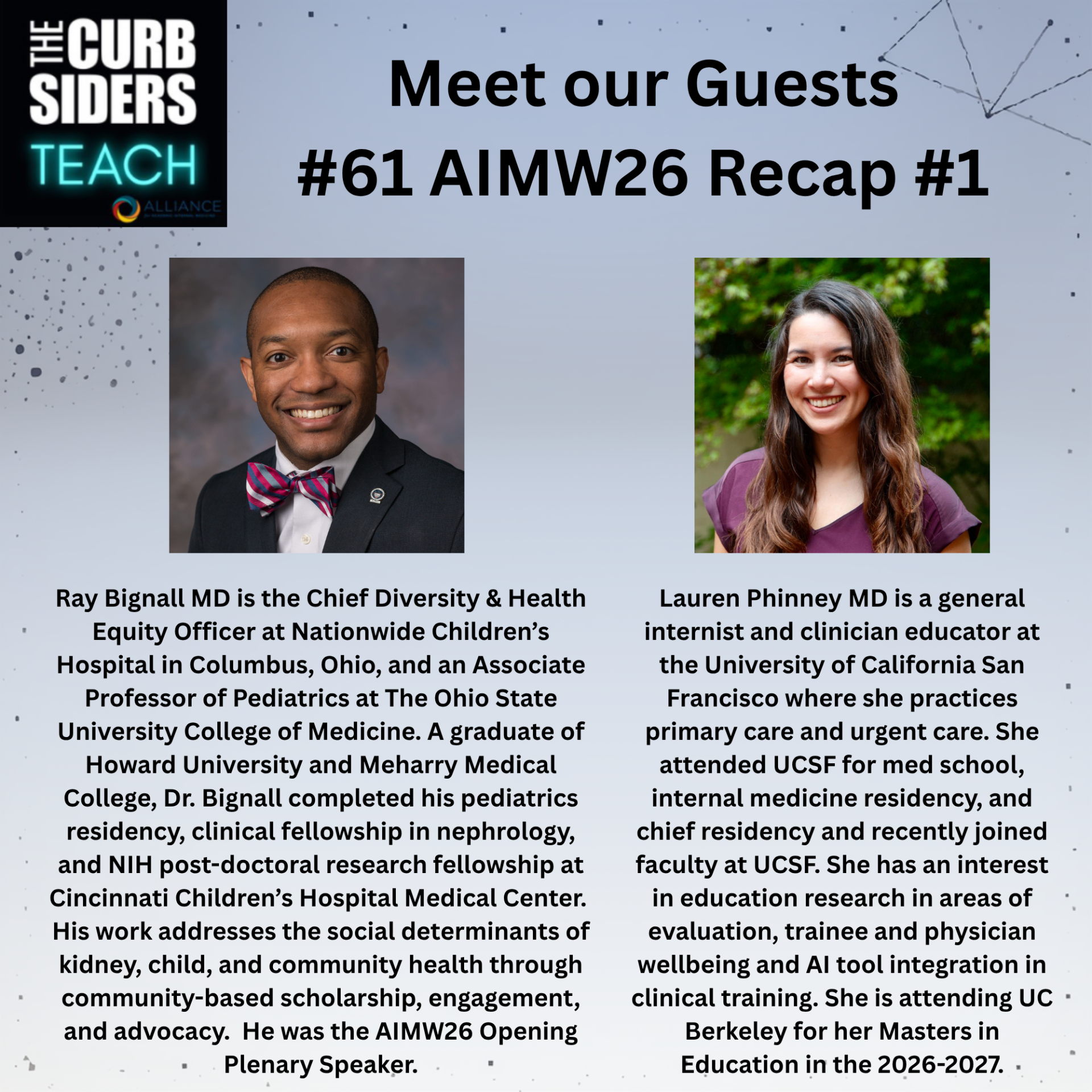
With Guests Drs. Ray Bignall and Lauren Phinney
Come on the adventure with Drs. Ray Bignall and Lauren Phinney as we discuss the highlights from the first day of the AIMW26 Conference, the Opening Plenary, and the mesmerizing educational sessions.
Website | Instagram | Twitter | Subscribe | Patreon | Youtube
Meet our Guests:
Dr. Lauren Phinney is a general internist and clinician educator at the University of California San Francisco where she practices primary care and urgent care. She attended UCSF for medical school, internal medicine residency, and chief residency and recently joined faculty in the UCSF Health Division of General Internal Medicine. She has an interest in education research in areas of evaluation, trainee and physician wellbeing and now AI tool integration in clinical training. She is attending UC Berkeley for her Masters in Education in the 2026-2027 academic year.
Dr. Ray Bignall is the Chief Diversity and Health Equity Officer at Nationwide Children’s Hospital in Columbus, Ohio, and an Associate Professor of Pediatrics at The Ohio State University College of Medicine. A graduate of Howard University and Meharry Medical College, Dr. Bignall completed his pediatrics residency, clinical fellowship in nephrology, and NIH post-doctoral research fellowship at Cincinnati Children’s Hospital Medical Center. Dr. Bignall’s work addresses the social determinants of kidney, child, and community health through community-based scholarship, engagement, and advocacy. He was the 2026 AIMW Opening Plenary Speaker, and his talk was titled, “Do you see what I see? 5 Lessons I’ve learned about mentorship as a Black Man in a White Coat.”
Supported in Partnership with Alliance for Academic Internal Medicine
Show Segments
- Intro, disclaimer, guest bio
- Guest one-liner
- Experience at AIMW26 thus far
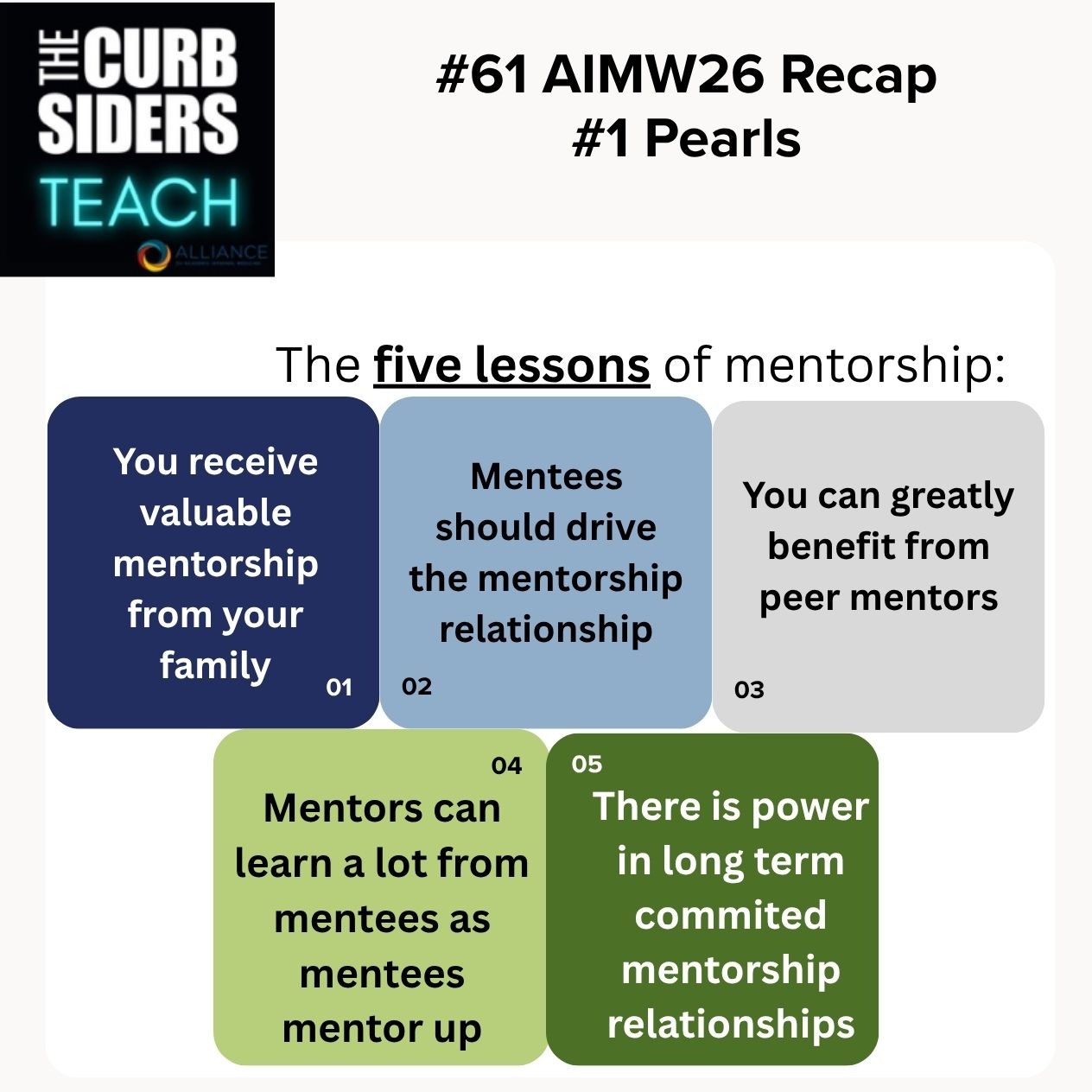
- The five lessons of mentorship
- Mentorship is a network
- The importance of sharing and reflecting on mentee stories
- Different avenues to set up mentor relationships
- Bridging the generational gap in academic medicine
- Best practices for generative AI and LLMS
- The hidden tax of volunteerism in medical education
AIMW26 Recap #1 Pearls
- The five lesions of mentorship:
- You receive valuable mentorship from your family
- Mentees should drive the mentorship relationship
- You can benefit greatly from peer mentors
- Mentors can learn a lot from mentees as they mentor up
- There is power in long term committed mentorship relationships
- Mentorship should be done through a network of mentors each bringing unique strengths.
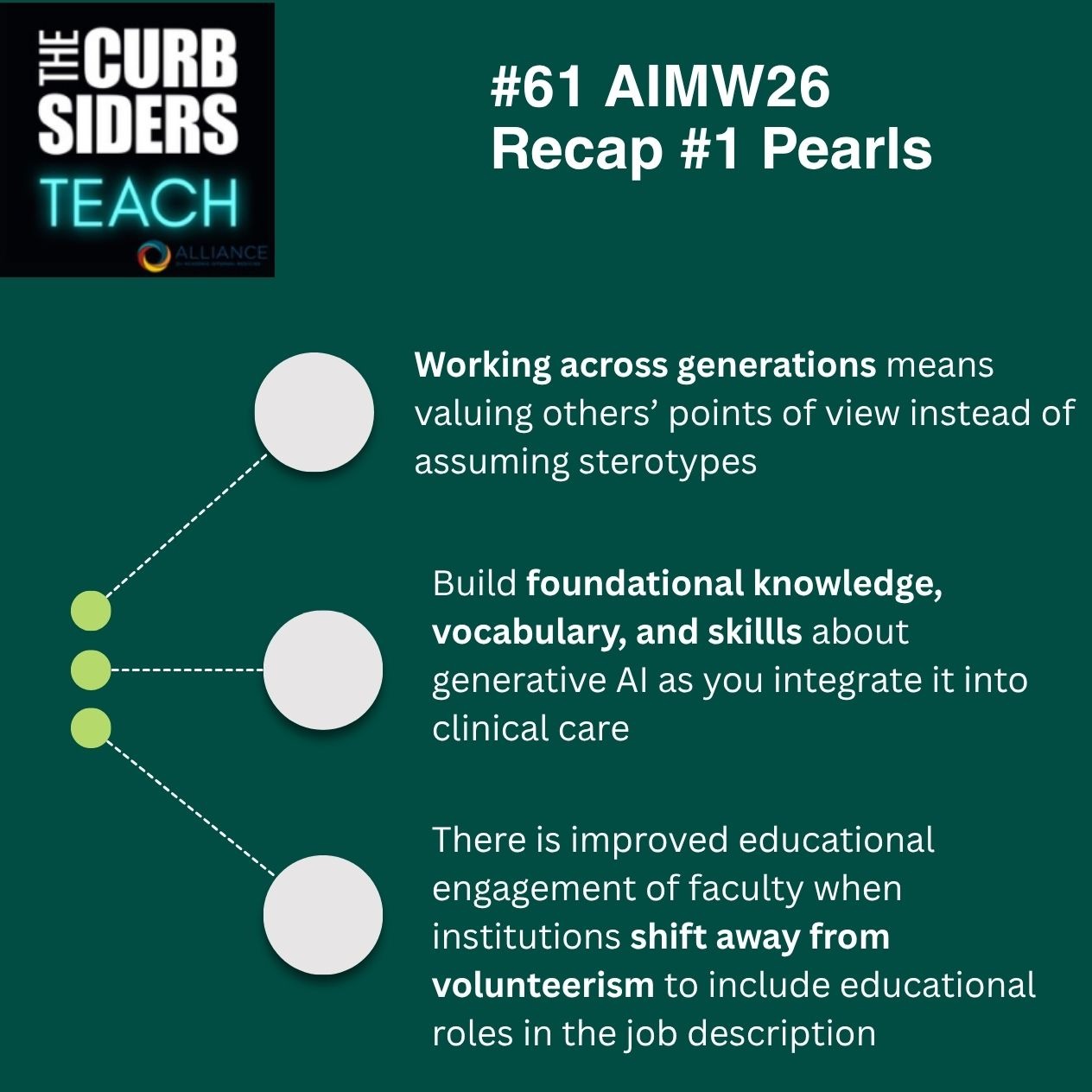
- Working across generations means valuing others’ individual points of view instead of assuming stereotypes.
- Build foundational knowledge, vocabulary, and critical appraisal skills about generative AI as you integrate it into clinical care.
- There is improved educational engagement of faculty when institutions shift away from volunteerism to incorporating educational roles into the job description.
AIMW26 Recap #1 Show Notes
Do You See What I See? 5 Lessons I’ve Learned About Mentorship as a Black Man in a White Coat by Ray Bignall MD, FAAP, FASN
Dr. Bignall details five powerful lessons from his opening plenary session about mentorship and the many forms it can take throughout a career and a lifetime. The conversation begins with the idea of “mentoring an unseen future,” reflecting on the profound influence of family members who invest in future generations through sacrifice, example, and encouragement. Drawing from personal experiences with academically accomplished parents and an immigrant grandmother whose hard work created opportunities for her family, the discussion highlights how mentorship often starts long before we recognize it. Dr. Bignall also emphasizes the importance of centering the mentee, ensuring that mentorship relationships are driven by the needs, goals, and growth of the learner rather than the interests of the mentor.
He continues with the often-overlooked value of peer mentorship, celebrating the colleagues and friends who provide accountability, support, and role modeling throughout medical training and professional life (Cree-Green 2020). Next he examines the concept of reverse mentoring or mentoring up, where mentors learn meaningful lessons from their mentees and mentees can proactive steer their mentorship relationship, creating a two-way exchange of knowledge and perspective (Manuel 2021). Finally, Dr. Bignall explores the power of long-term commitment in mentorship, arguing that the strongest mentoring relationships evolve over time, much like family relationships, deepening through shared experiences, mutual growth, and enduring connection.
Dr. Phinney highlights how attending the conference and reuniting with different peers allowed her to resonate with the power of peer mentorship relationships and that she valued how Dr. Bignall highlighted his mentees stories and voices in the plenary and shared how he’s learned from their interactions. Dr. Cheng and Dr. Kryzhanovskaya note the value of having a network of mentors or a mentor “map” or “tree” where each mentor brings unique strengths to guide the mentee, referencing Dr. Bignall’s prior The Curbsiders Teach Episode #46.
Dr. Bignall reflects on the different ways in which he met mentees organically and while there are limits to formal mentorship programs that pair mentors and mentees together by design as they may not always create the natural chemistry and genuineness that characterize the strongest mentoring relationships, they can be helpful for those who do not find it easy to connect organically.
Bridging the Gap: Gen X Faculty, Millennial Chiefs, and Gen Z Residents in Academic Medicine by Jake T. Hillyer MD, Carolyn Hofmeister MD, and Elle Maureen Newcome MD.
Dr. Phinney reviews the concept of “onlyness“—recognizing and valuing the unique experiences and perspectives that shape how each individual views the world, rather than relying on generational stereotypes. The workshop highlights how senior faculty may draw from decades of navigating major changes in medicine and education, while younger physicians often advocate for issues such as fair compensation, educational debt, and work-life sustainability in response to today’s economic realities. The overarching takeaway is that when generational differences create tension or misunderstanding, approaching these moments with curiosity about the experiences that have shaped another person’s unique perspective can foster empathy, improve communication, and strengthen collaboration across all levels of academic medicine. Dr. Newcome elaborates more on the concepts from this workshop in The Curbsiders Teach Episode #59.
Byte-Sized Learning: Curriculum Building and Best Practices for Generative AI and Large Language Model (Use among Internal Medicine Residents) by Gordon James Farley MD, Janae K. Heath MD, and Daniel Lai MD.
Dr. Phinney shared how the standing-room-only workshop underscored both the excitement and uncertainty surrounding AI in health professions education: while nearly everyone reported that their trainees are already using AI tools, very few programs have formal curricula or competencies in place.
The presenters proposed four key domains for AI education:
- Developing foundational knowledge of AI and large language models
- Addressing ethical considerations such as consent and patient privacy
- Building skills to critically evaluate AI-generated outputs for accuracy and bias
- Thoughtfully integrating AI into clinical practice without sacrificing core clinical competencies.
Practical teaching strategies included comparing outputs from different AI platforms, discussing prompt engineering during clinical precepting, and modeling responsible AI use with learners. The workshop emphasized that AI is already reshaping medical education and practice, and rather than ignoring it, educators have an opportunity to proactively equip trainees with the knowledge, skills, and judgment needed to use these tools effectively and responsibly (Gordon 2024, Boscardin 2025, Gin 2025).
Dr. Bignall emphasized that while AI tools can be useful and exciting, we should always, always be on guard for how these human-engineered systems can contain bias and can be harmful for some vulnerable or marginalized populations inside and outside the hospital whom we serve. Dr. Kryzhanovskaya adds that we should always look out for those who are not “at the table” and whose voice is missing whenever new opportunities and new technologies arise. Dr. Bignall further elaborates on the importance of identifying and addressing disparities in healthcare systems, framing this work not as an indictment of institutions but as an act of courage and commitment to improvement. Just as healthcare organizations routinely measure outcomes like infection rates to enhance patient safety, examining inequities allows us to recognize where systems may be failing certain populations and take meaningful action to improve care.
The Hidden Tax: Ending the Volunteer Era in Medical Education by Shobhina G. Chheda MD, MPH, FACP and Aashish K. Didwania MD.
Dr. Phinney discussed this plenary session that explored the often-uncompensated work performed by clinician educators and the need to shift from a culture of volunteerism to one of professionalism. The discussion highlighted innovative approaches such as Educational Value Units (EVUs) to recognize and quantify educational contributions, with evidence suggesting that providing compensation for such educational contributions improves faculty engagement, completion of educational responsibilities, and scholarly productivity. Speakers also shared practical strategies for advocating for protected time and resources, including using structured communication frameworks like SBAR, typically used in other clinical scenarios, to clearly articulate institutional needs, proposed solutions, and the support required for success (Muller 2018). Ultimately, the session emphasized that valuing and investing in educator work is essential to reducing burnout and attrition among clinician educators while sustaining excellence in medical education.
SBAR: Situation, Background, Assessment and Recommendation for Negotiations
- Situation: describe your situation
- Background: provide relevant data
- Assessment: offer an assessment of how you could help/be of service
- Recommendation: give a recommendation of how they could help you help them
Dr. Kryzhanovskaya affirms the importance of matching the job description such that what educators are assigned to do is what one is actually compensated for doing to avoid attrition (Chang 2023).
Links/Plugs:
Goal
Listeners will learn frameworks to improve clinician educator skills from various plenary sessions and workshops at AIMW26
Learning objectives
After listening to this episode listeners will…
- Describe five important lessons for mentorship
- Explain the concept of onlyness related to educating across generations
- Name the four key domains for AI education
- Recognize the benefits of shifting from volunteerism to professionalism and the value of the SBAR approach to negotiate this shift
Disclosures
Drs. Bignall and Phinney report no relevant financial disclosures. The Curbsiders report no relevant financial disclosures.
Citation
Cheng MKW, Kryzhanovskaya E, Heublein M, Phinney L, Bignall R . “#61AIMW26 Recap #1: Pearls and (Educational) Practice Changing Knowledge from the first day of the Alliance for Academic Internal Medicine Conference.” The Curbsiders Teach Podcast. https://thecurbsiders.com/teach. June 25, 2026.
Episode Credits
Producer, Writer, Graphics: Mike KW Cheng MD, MAEd
Hosts: Era Kryzhanovskaya MD, Mike KW Cheng MD, MAEd
Editors: Era Kryzhanovskaya MD, Mike KW Cheng MD, MAEd, and Molly Heublein MD
Reviewer: Era Kryzhanovskaya MD
Guests: O. N. Ray Bignall II, MD, FAAP, FASN and Lauren Phinney, MD
Technical support: Podpaste
Theme Music: MorsyMusic
CME Partner

The Curbsiders are partnering with VCU Health Continuing Education to offer continuing education credits for physicians and other healthcare professionals. Visit curbsiders.vcuhealth.org and search for this episode to claim credit.
Contact Us
Got feedback? Suggest a Teach topic. Recommend a guest. Tell us what you think.
We love hearing from you.
Join our Patreon!

Yes, you can now join our exclusive community of core faculty at Kashlak Memorial Hospital along with all the perks:
- Bundle & Save with the top CME tier!
- All episodes Ad-Free, including the entire back catalog!
- Twice-monthly bonus episodes: Ask me Anything (AMA) with Matt & Paul, Recaps, and more!
- Access to Kashlak's Discord Server!
- Advance Notice of Curbsiders Events!
- Exclusive Curbsiders' Merch!
