

Audio
Video
Transcript available via YouTube
Get ready to transform how you think about Morbidity and Mortality (M&M) conferences! In this episode, Drs. John Erickson and Matthew Clark from Maine Medical Center share their powerful approach to coaching residents, fostering psychological safety, and using M&Ms as a springboard for growth—not shame. Whether you’re planning your first M&M or rethinking your program’s approach, this conversation is packed with insights you won’t want to miss!
Claim CME for this episode at curbsiders.vcuhealth.org!
Website | Instagram | Twitter | Subscribe | Patreon | CME!| Youtube
Meet our Guests:


John Erickson, MD is a hospitalist at Maine Health, Maine Medical Center. He went to medical school at George Washington University School of Medicine, completed residency at the Strong Memorial Hospital. He was the Associate Program Director for the Maine Medical Center Internal Medicine Residency, and his academic interests include bedside teaching and strategies to facilitate learning along the continuum of an individual’s career. He was pivotal in the development of the hospitalist track, developed the resident coaching program, and continues to help with supervision of the Morbidity and Mortality Conference series for medical residents.
Matthew Clark, DO is a hospitalist at Maine Health, Maine Medical Center, Portland, and he is also an associate program director for the internal Medicine residency. His interests include medical education, leadership in medicine, and exploring uncertainty in medicine. He finds joy working with residents on the wards in the classroom, and of course, prepping for Morbidity and Mortality Conferences (M&Ms). He is proud and humble to be a part of the residents’ journey towards realizing their own why in medicine.

Show Segments
- Intro, guest bio
- 7:23 Reflecting on mistakes in medicine
- 12:50 Background on M&M conferences
- 13:24: Case from Kashlack Memorial
- 14:19 Benefits of M&M conferences
- 20:18 Creating a culture of psychological safety
- 25:23 Planning M&M conferences, coaching residents on planning M&M conferences
- 31:40 M&M curriculum for residents
- 41:17 Quality improvement tools and frameworks
- 45:05 Navigating difficult conversations
- 48:30 Structure of M&M
- 52:23 Turning M&M learning points into systemic change
- 57:43 Takeaways
- Outros
Morbidity and Mortality Conference Pearls
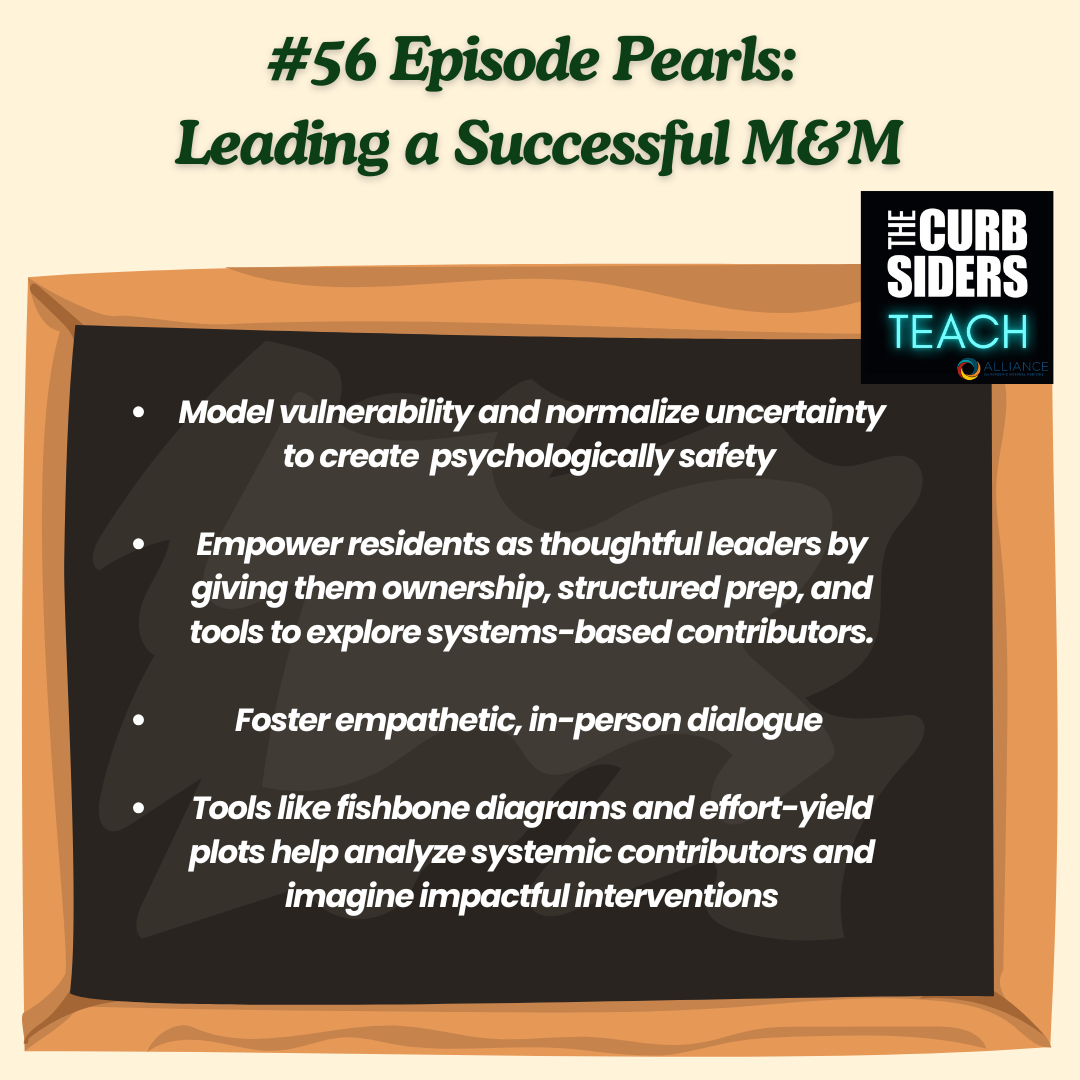
- Starting an M&M with the acknowledgment that medicine is inherently uncertain helps create a psychologically safe environment. Faculty modeling vulnerability sets the tone that mistakes are part of learning, not individual failings.
- Encourage residents to consider how different stakeholders (e.g., peers, faculty, risk management) might perceive the patient case. Anticipating questions and reactions helps presenters frame the discussion with sensitivity and insight.
- Giving senior residents ownership over M&M planning, with coaching and structured prep time, transforms the session into a meaningful leadership and reflective practice opportunity.
- In-person M&Ms foster richer, more empathetic discussions than virtual ones. Set aside 15–20 minutes for open dialogue, and have senior faculty facilitators redirect if the conversation becomes shame-inducing or unproductive.
- Tools like fishbone diagrams and effort-yield plots help residents analyze systemic contributors and imagine impactful interventions—shifting the focus from blame to learning and improvement.
Morbidity and Mortality (M&M) Show Notes
Benefits of M&M conferences
Dr. Clark and Dr. Erickson highlight that Morbidity and Mortality (M&M) conferences allow the presenter to create a thoughtful learning experience, share vulnerability around cases that stuck with them, and process the uncertainty of working in medicine. It removes the silence from shame providers can feel about challenging clinical cases (Brene Brown). This inspired them to incorporate clinical debriefs into academic half days in which senior residents can come discuss challenging cases that stuck with them.
Creating a culture of growth and safety
It is important to normalize the inevitability of mistakes and to emphasize that errors in medicine are rarely due to solely one person’s actions. It is also important for faculty to model a culture in which mistakes are normalized and a part of a physician’s career. Dr. Clark and Dr. Erickson suggest starting the M&M with a disclaimer that medicine is difficult and comes with a lot of uncertainty (De Vos 2023; Brook 2024).
Planning for an M&M conference
Consider the various layers of the M&M conference as concentric spheres: the presenter, the audience, the systems.
M&M conferences are typically designed and delivered by chief residents. However, at Maine Medical Center, third-year Internal Medicine residents have the unique opportunity to lead an M&M as part of their capstone project. This curriculum starts with a dedicated M&M preparation week early in third year. The resident is paired with a faculty member to support them in crafting the M&M, while providing the resident with structure but also autonomy to build the case as they see fit.
The resident also meets with institutional leaders to learn new perspectives on the cases – if their case is more harm reduction or quality improvement focused, they meet with leaders in quality and safety. They may also meet with risk management representatives to hear their perspectives on the case. If their case is more clinically focused, they would meet with leaders in the relevant departments. Residents also work on Institute for Healthcare Improvement modules and relevant readings over the course of the week. Some cases are presented previously at root cause analysis (RCA) or other case reviews, but residents are encouraged to provide their own spin and perspective on the case when presenting the M&M.
The resident then crafts a clinical timeline to present the case narrative. The resident is guided to highlight 3-4 main discussion points- something tangible for the audience to leave the presentation with. Typically, one is clinically focused, then the other two are processes and systems and maybe specific to the institution. They are also coached on questions they may ask the audience to help them reflect on the case. There is also an opportunity to do a mock M&M with the faculty coach and receive feedback.
When preparing the resident for the conference, encourage them to think through the stakeholders how each of them may receive or respond to the talk, especially given how sensitive the topics may be. Empower residents with the autonomy to invite their own attendees. The audience is typically made up of residents, faculty, leadership in the department, and representatives for risk management or someone from the ethics department. Residents can also consider involving individuals from departments in which the case occurred. For example, if the case occurred in the ICU, consider inviting an intensivist.
Dr. Erickson and Dr. Clark recommend in person M&Ms. During virtual conferences, it can be challenging for the presenter to hear a “faceless voice” providing thoughts on the zoom platform, and virtual platforms are not as effective at promoting a safe culture. M&M conferences are meant to be interactive, and it is recommended to account for at least 15-20 minutes of conversation during a 60 minute session. It is also important to remind residents that given there is often only 40 to 60 minutes for each case, it is okay to focus on the most salient points of the case.
Quality Improvement Frameworks
It can be helpful to review quality improvement resources and frameworks with residents to frame the discussion. There are several QI resources; some clinicians suggest the fishbone diagram as an organized tool that residents can use when exploring the various factors that contributed to the outcomes described in their case (Kumah 2024). The Health Care Matrix is one option that offers a structured template to consider aims for improvement and ACGME core competencies (Quinn 2007). Another potential QI-related component is an effort-yield plot, in which residents are asked to imagine if they could go back in time and implement an intervention, what effort might they implement, and what would the effort and yield be of that effort? Lastly, cost of hospitalization can be interesting to analyze, if relevant (Beaulieu-Jones 2023)
The M&M in Three Acts
The M&M can be split into 3 major sections:
Act 1: Setting the Scene (10-15 minutes). The faculty introduce the resident and set the tone for the M+M. The resident sets the scene for the case, highlights why the case stuck with them, and shares some themes that will recur in the presentation.
Act 2: Unfolding the Clinical Narrative (20-25 minutes). The core of the presentation, when the resident puts the audience in the shoes of the primary team and explains the case. This is where they will include the discussion questions they prepared.
Act 3: Wrap up (10-15 minutes). This section often starts with a fishbone diagram or other quality improvement tool. The key points are driven home and the case is summarized.

Creating systemic changes
Following an M&M, it is not necessary to be prescriptive about the action items of a case and who should tackle them. Instead, M&Ms are a way to spark discussion around a certain topic. Often, audience members who work in certain departments in which the case took place step up to create changes suggested during the discussion.
Navigating difficult conversations
There are times when pointed questions are raised in the audience that can create shame or sadness in the audience. During these scenarios, it is important that senior faculty facilitators help to redirect the discussion.
Resources for Educators
- First, Do No Harm-A Career-Long Struggle With Iatrogenesis (Elmunzer 2025)
- A Systems Approach to Morbidity and Mortality Conference (Reed 2010)
Take home points
Consider your objectives and goals for the M&M before starting to plan. When coaching residents on planning M&Ms, balance autonomy in case selection and presentation with support in navigating challenging audience questions and planning reflection questions. Normalize failure and mistakes in medicine in order to support trainees’ growth and create a culture of psychological safety. Involve important stakeholders and hospital administration in order to ensure that the lessons learned from the case can be translated into change.
Links
- Book: Red Rising series by Pierce Brown
- Book: No Ordinary Time: Franklin and Eleanor Roosevelt: The Home Front in World War II by Doris Kearns Goodwin
- First, Do No Harm-A Career-Long Struggle With Iatrogenesis (Elmunzer 2025)
- A Systems Approach to Morbidity and Mortality Conference (Reed 2010)
Goal
Listeners will appreciate the value of promoting psychological safety when conducting M&M conferences and learn strategies to coach trainees on preparing successful M&M conferences.
Learning objectives
After listening to this episode listeners will…
- List components of an effective M&M structure and presentation.
- Review tips on supporting residents to reflect on meaningful patient cases and prepare an M&M.
- Discuss strategies to promote psychological safety and growth mindset during M&M conferences.
Disclosures
Dr. Erickson has no relevant financial disclosures. Dr. Clark has no relevant financial disclosures. The Curbsiders report no relevant financial disclosures.
Citation
Heublein M, Clark, M, Erickson J, Patel, K, Kryzhanovskaya E. #56 To Err is Human: Best Practices for Leading Morbidity and Mortality Conferences. The Curbsiders Teach Podcast. https://thecurbsiders.com/teach. July 30, 2025.
Episode Credits
Producer CME: Molly Heublein MD
Hosts, editors: Era Kryzhanovskaya MD, Molly Heublein MD
Script, show notes, infographics: Karishma Patel MD
Technical Support: Podpaste
Guest: John Erickson MD, Matthew Clark DO
Theme Music: MorsyMusic
CME Partner

The Curbsiders are partnering with VCU Health Continuing Education to offer continuing education credits for physicians and other healthcare professionals. Visit curbsiders.vcuhealth.org and search for this episode to claim credit.
Contact Us
Got feedback? Suggest a Teach topic. Recommend a guest. Tell us what you think.
We love hearing from you.
Join our Patreon!

Yes, you can now join our exclusive community of core faculty at Kashlak Memorial Hospital along with all the perks:
- Bundle & Save with the top CME tier!
- All episodes Ad-Free, including the entire back catalog!
- Twice-monthly bonus episodes: Ask me Anything (AMA) with Matt & Paul, Recaps, and more!
- Access to Kashlak's Discord Server!
- Advance Notice of Curbsiders Events!
- Exclusive Curbsiders' Merch!
