

Audio
Video
Transcript available via YouTube
Join us as we learn a practical approach to teaching the basics of evidence based medicine on the wards or in clinic with Nicholas Maldonado MD, FACEP. He talks us through the 5As framework, with a deeper dive into how to help our learners ask clinical questions and acquire the answers they are seeking in the medical literature using the 5S pyramid.
Claim CME for this episode at curbsiders.vcuhealth.org!
Website | Instagram | Twitter | Subscribe | Patreon | Free CME!| Youtube
Meet our Guest:
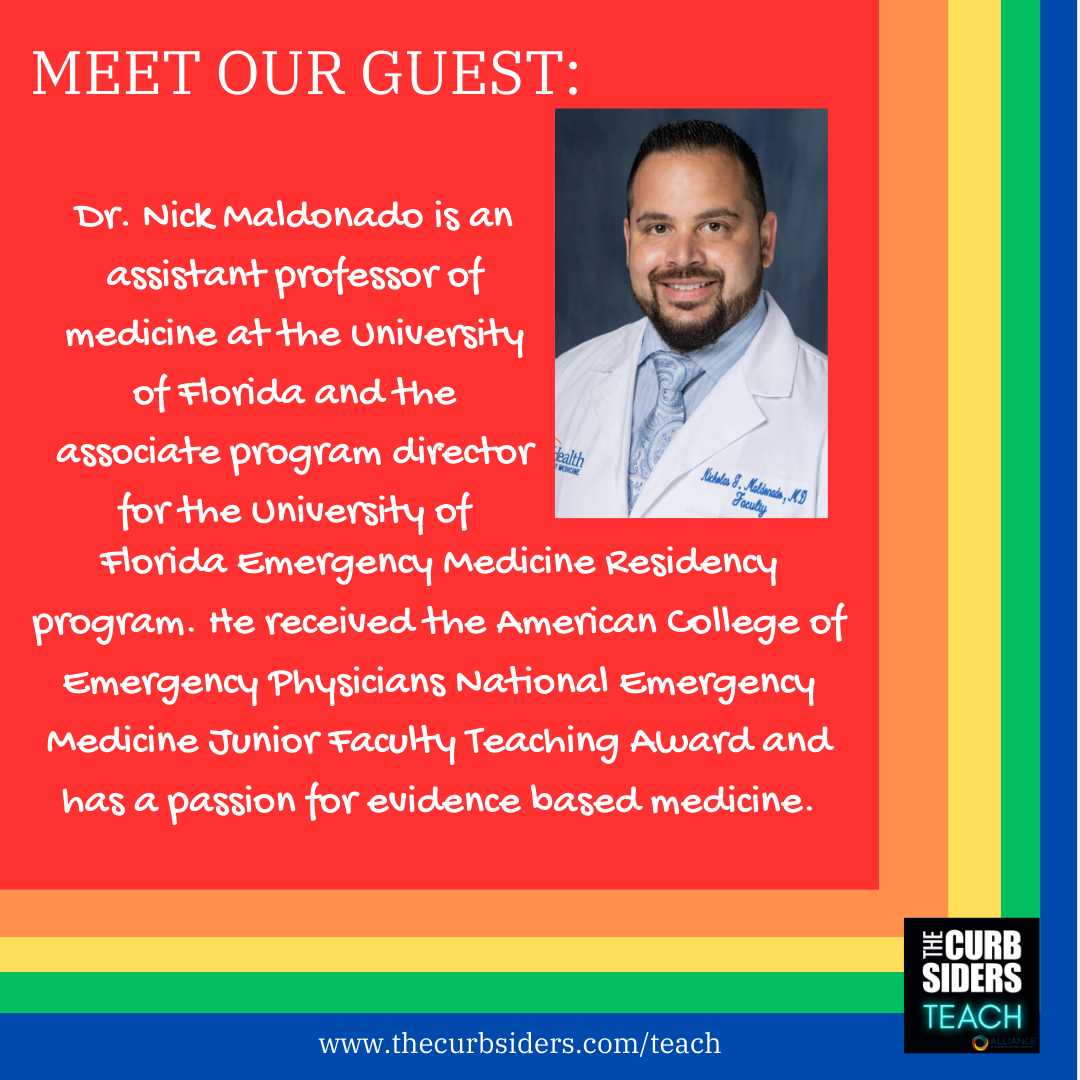
Dr. Nick Maldonado is an assistant professor of medicine at the University of Florida and the associate program director for the University of Florida Emergency Medicine Residency program. He received the American College of Emergency Physicians National Emergency Medicine Junior Faculty Teaching Award and has a passion for evidence based medicine.

Show Segments
- 0:00 Intro, guest bio, get to know you questions
- 5:10 case and Introduction to EBM
- 8:36 the 5 As
- 11:50 1st A- Ask: Navigating Clinical Questions
- 14:30 PICO
- 17:30 2nd A- Acquire using the 5S pyramid
- 32:22 3rd A- Appraise
- 36:30 Apply
- 38:34 Act
- 39:50 Teaching EBM at the bedside, case example
- 47:40 Take home points/Outro
Evidence Based Medicine Pearls
- EBM is more than critical appraisal, you can simplify your EBM teaching to focus on foundational skills.
- To organize the process of EBM, use the 5As: Ask, Acquire, Appraise, Apply, and Act.
- Assess learners’ knowledge before diving into complex topics; and choose 1 or 2 of the As to focus on teaching during a clinical encounter.
- Emphasize critical appraisal in formal settings like journal clubs.
- Guide learners to higher levels of pre-appraised evidence (top of the 5S pyramid) such as guidelines and synopses.

Evidence Based Practice Notes
What is Evidence Based Medicine?
Evidence based practice (EBP) or evidence based medicine (EBM) involves integrating the best available research evidence with clinical expertise and patient values to make informed decisions about patient care. Often when people think about evidence based medicine, they think about critical appraisal. But critical appraisal is just one piece. Evidence-Based Medicine—An Oral History is a great article Dr. Maldonado recommends on the history of this topic (BMJ 2014).
The goal of teaching EBM is to help us be curious, lifelong learners who can question where information is coming from. Evidence based medicine is an ACGME core competency for physicians, so something we should regularly be instilling in our learners, and this takes deliberate practice. If we can teach our learners how to use the skills of EBM, as opposed to just telling the learner the answer to their question from the most recent randomized controlled trial, they will learn the skills they need to be able to find the necessary information in the future.
The 5As of Evidence Based Practice
Asking the right question
Acquiring the information
Appraisal- this doesn’t have to be a full journal club, we can use pre-appraised resources
Apply- how does this fit with my specific patient/population
Act- involve the patient and share the options, weigh values/risks/benefits. This doesn’t have to happen for all patients for standard care, but when there are options or controversies, understanding patients’ values and goals and communicating options becomes important (from The Jama User’s Guide to Evidence Based Clinical Practice).
Asking the Right Question
As educators, we can be guides to help our learners navigate finding answers based on the types of questions that they’re asking. There are two main categories of questions: background questions and foreground questions.
Background questions seek to answer a question of general knowledge, for example, what is acute coronary syndrome? You’re not going to start delving into the details behind antiplatelet trials on acute coronary syndrome until the learner understands the foundation of what is acute coronary syndrome. For background questions, you might refer your learner to more of a foundational resource, such as UptoDate, DynaMed, a textbook like Harrison’s, or a narrative review article.
Foreground questions are specific and focused, for example, in this patient presenting to the hospital with severe community acquired pneumonia, do steroids improve mortality? These focused questions come with a lot of previous foundational knowledge.
PICO helps with crafting a focused question and then querying it. When a learner asks a question, helping them structure and specify their question will ultimately make it easier to find a relevant article to help answer the question and develop skills as independent clinicians.
Patient population (will this information apply to my specific patient)
Intervention (intervention or treatment)
Comparator (often placebo or standard of care)
Outcome (think of an outcome that is clinically valuable or patient centered) (Davies 2011)
Acquiring using the 5S Pyramid Model
The 5S pyramid model is a helpful hierarchy to find the best resource to answer your question. The 5S pyramid aids evidence-based medicine by prioritizing preappraised, systematically organized information, with higher levels like systematic reviews and meta-analyses being more dependable because they gather and evaluate many studies, making evidence interpretation more reliable. Start at the top to find the highest level of evidence and then move down if you can’t find your answer at the upper levels (ACP Journal Club 2006).
Systems: prompts, order sets, computerized decision support in the electronic health record
Summaries: evidence based textbooks, practice guidelines: Guideline Central, individual professional organizations or societies
Synopsis: pre appraised commentaries or synopses: Journal Watch, ACP Journal Club, EM Systematic Review Snapshots
Synthesis: meta analysis or systematic review: Cochrane
Studies: original research: RTCs, cohort studies, case controlled studies, case reports.

Try a federated search– a search engine of search engines- basically it can look at multiple databases simultaneously to get the level of evidence you are seeking.
Dr. Maldonado suggests these resources:
- Trip Database is a great site where you can actually feed in your PICO question and limit it to certain levels of evidence.
- Accessss from McMaster University
- Epistemonikos
- SumSearch2
Apply
Apply refers to thinking critically about the summation of a patient’s unique aspects and their particular clinical condition–how the research applies to them specifically. In what clinical circumstances might I apply this to my current or next patient encounter based on the evidence that’s in front of me? In what clinical situation would I not prescribe this intervention to a patient?
Act
The Act phase refers to having an open conversation with the patient or family regarding what interventions are available to them. This does not necessarily need to happen if there is a clear standard of care, but in situations where multiple options may exist or there is a specific aspect of the patient situation that may suggest a newer treatment could be a good option, this becomes important.
Tips for Teaching EBM in Practice
Dr. Maldonado recommends not over-complicating things. Many learners are still working on how to craft good questions and where to find answers to those questions. Don’t assume that those are skills that learners have mastered already. Crafting questions is a great starting point for incorporating evidence based medicine at the bedside, and that alone is also highly valuable to your learners.
If a learner asks a foreground question, consider getting a quick needs assessment to ensure they have a good, solid foundation to be able to understand the results. You can’t assume what everyone knows. For example, around the community acquired pneumonia, ask the learner some open ended questions to get a better sense of their knowledge: How do we classify pneumonias? How might treatment differ for community acquired pneumonia compared to other types of pneumonias? You mentioned steroids, but how else do we treat this? So how might we risk-stratify patients based on severity of illness?
Limit yourself to maybe one or two of the As. Dr. Maldonado integrates this into his busy shifts by saying Choose one or two cases today, and I want you to come up with a clinical question. Give me a foreground question that’s in a PICO framework. Then let’s query the literature, and I want you to find tonight the best available evidence. Tomorrow when I’m on shift with you, we’ll share notes as a way to focus on Ask and Acquire.
Save critical appraisal for journal club. That could be your program’s formal journal club, or maybe find a time in your small group on service in the afternoon to appraise the article they found that night for 20-30 minutes.
Ask open ended questions to help learners embrace variability and think critically about taking the summation of a patient’s clinical condition and their unique aspects to highlight the Apply step. If a learner asks about steroids for community acquired pneumonia for example, ask, tell me a little bit about your experience with using steroids or when you’ve seen it. This can help the educator normalize variability. Learners are going to have attendings who do different things with different interpretations of literature and different patient applications.
Dr. Maldonado recommends teaching learners to consider how much they can trust the sources and the results. Teach learners to think about how to question obtained information, where is it coming from, and is it up to date? Say your learner finds a guideline that answers their question. You don’t have to stop there with your learner. You could say, let’s see why certain recommendations were made. And then you can go to the primary source and start to understand the studies that are the basis of recommendations. Sometimes guidelines are no longer up to date, newer important trials have come out (Malick 2008).
As an educator, Dr. Maldonado recommends that we be well versed in where to find resources along that 5S pyramid and be able to explain why one would want to start at a particular level.
A Practice Case:
Your learner asks if you should give steroids to a patient presenting to the emergency department with pneumonia.
Even before getting into EBM/the 5As, Dr. Maldonado would say, that’s a really interesting question. Tell me a little bit more about your experience with steroids. That can help garner interest and help you, the educator, understand the learner’s context.
Then start assessing background knowledge first, to see if the learner is ready to answer that specific clinical question. If the learner has enough background knowledge, help form a foreground question to answer the question posed. Let’s try to craft a really specific clinical question for this patient. First, I want to ask you, have you ever heard of the PICO framework?
If the learner isn’t familiar with PICO, then you could have a great conversation around why PICO is important and how you can frame questions using PICO. This could be your teaching point.
If the learner is familiar with PICO, then great, have them craft a clinical question using the PICO format. Students can do this at variable levels. Help edit the question to be very specific. There are different types of conditions, different practice settings, different types of steroids, and different outcomes. You could say, I noticed that you use this as an outcome. Tell me, are there any other important outcomes that you might be interested in? Or, you mentioned community acquired pneumonia, would this change our question if we were to ask this about COVID-19 pneumonia, is that different?
Next step is to help the learner look for the best available evidence to answer this specific focused clinical question. Where would you go or what would you look for if you were to answer this question? If the learner says, I’m going to go to PubMed and I’m going to type this in, Dr. Maldonado sometimes will have them do that. Ask how many queries did you get? What group of people or organizations may have already looked deeply into this question before? What does it mean when people get together and review prior studies? Where would you find that? And then they might say, Oh, a guideline.
So, what resources have you ever seen to look for guidelines? That could be the teaching point. Let me show you where I look when I look for guidelines. Here’s a great resource, you know? Let me show you where I look specifically for infectious disease guidelines such as the Infectious Disease Society of America (IDSA) website.
There is a lot you can talk about and teach without delving into nitty gritty details about study designs, surrogate outcomes, and cofounders. This is all still evidence based medicine basics that you want to help your learners master.
Take Home Points:
Our goal is to train learners to be free independent thinkers. We want them to be thoughtful consumers of the medical literature, to be able to find the best available evidence and have great communication with patients to allow them to make the best decisions for their patients’ care.
The five As is a nice framework when applying evidence based medicine to patient care. So remember: ask, acquire, appraise, apply, and act.
Don’t over complicate things. Many learners are still learning to craft good questions and where to find answers to those questions–so that stage alone is a great starting point when you want to incorporate the basics of EBM principles into bedside rounds.
Sharing knowledge and clinical pearls is important to what we do, but imparting onto students practical and readily applicable skills is even more impactful than spewing facts that they’ll probably not remember anyways. View your role as a guide. And if you inspire your learners to want to learn more, you did your job.
Resources to Learn More:
McMaster Guide to EBM
JAMA User’s Guides to the Medical Literature
Links
- Chick Corea Jazz Pianist
- From Strength to Strength: Finding Success, Happiness, and Deep Purpose in the Second Half of Life book by Arthur C. Brooks
Goal
Listeners will appreciate the way to teach two evidence-based clinical practice principles (ask and acquire) at the bedside.
Learning objectives
After listening to this episode listeners will…
- Define the two main types of clinical questions.
- Describe a framework for helping learners identify and craft clinical questions to query.
- List resources for answering clinical questions.
- Employ the 5S pyramid model of evidence based medicine resources when helping learners answer clinical questions.
Disclosures
Dr. Maldonado reports no relevant financial disclosures. The Curbsiders report no relevant financial disclosures.
Citation
Chaiklin C, Maldonado N, Heublein M, Kryzhanovskaya E, Dickerson K, Kopp Z. “#37 Evidence Based Medicine The Curbsiders Teach Podcast. https://thecurbsiders.com/teach. May 1, 2024.
Episode Credits
Producer/ Script: Charlotte Chaiklin MD
Show notes/CME/Graphics: Molly Heublein MD
Hosts: Charlotte Chaiklin, Era Kryzhanovskaya MD, Molly Heublein MD
Peer Reviewer: Zoe Kopp MD and Keith Dickerson MD
Guest: Nicholas Maldonado MD, FACEP
Technical support: Podpaste
Theme Music: MorsyMusic
CME Partner

The Curbsiders are partnering with VCU Health Continuing Education to offer continuing education credits for physicians and other healthcare professionals. Visit curbsiders.vcuhealth.org and search for this episode to claim credit.
Contact Us
Got feedback? Suggest a Teach topic. Recommend a guest. Tell us what you think.
We love hearing from you.
Join our Patreon!

Yes, you can now join our exclusive community of core faculty at Kashlak Memorial Hospital along with all the perks:
- Bundle & Save with the top CME tier!
- All episodes Ad-Free, including the entire back catalog!
- Twice-monthly bonus episodes: Ask me Anything (AMA) with Matt & Paul, Recaps, and more!
- Access to Kashlak's Discord Server!
- Advance Notice of Curbsiders Events!
- Exclusive Curbsiders' Merch!
