

Audio
Video
Transcript available via YouTube
Separating Signal from Hype
Patients bring us lists. Greens powders, magnesium for everything, vitamin D “for immunity,” fish oil, creatine, curcumin… so how do we separate signals from hype without becoming the office that just says “no” to everything? In this home-grown deep dive, we build a practical, patient-centered framework for evaluating any supplement, then pressure-test it against the products patients actually take. Learn a five-question approach to any supplement, how to judge product quality in an industry the FDA does not pre-approve, and where the evidence actually lands on greens powders and multivitamins, magnesium, creatine, vitamin D, fish oil (and why cod liver oil is not the same thing), turmeric/curcumin, and glucosamine/chondroitin.
Claim CME for this episode at curbsiders.vcuhealth.org!
Patreon | Episodes | Subscribe | Spotify | YouTube | Newsletter | Contact | Swag! | CME
Show Segments
- Intro
- Ask These Five Questions: A Framework for Any Supplement
- Supplement Quality and Regulation
- Greens Powders and Multivitamins
- Magnesium
- Creatine
- Vitamin D
- Fish Oil and Cod Liver Oil
- Turmeric and Curcumin
- Glucosamine and Chondroitin
- Simplifying the Regimen
- Take-Home Points
Disclosures
The Curbsiders report no relevant financial disclosures.
CME Partner: VCU Health CE

The Curbsiders are partnering with VCU Health Continuing Education to offer continuing education credits for physicians and other healthcare professionals. Visit curbsiders.vcuhealth.org and search for this episode to claim credit.
Pearls
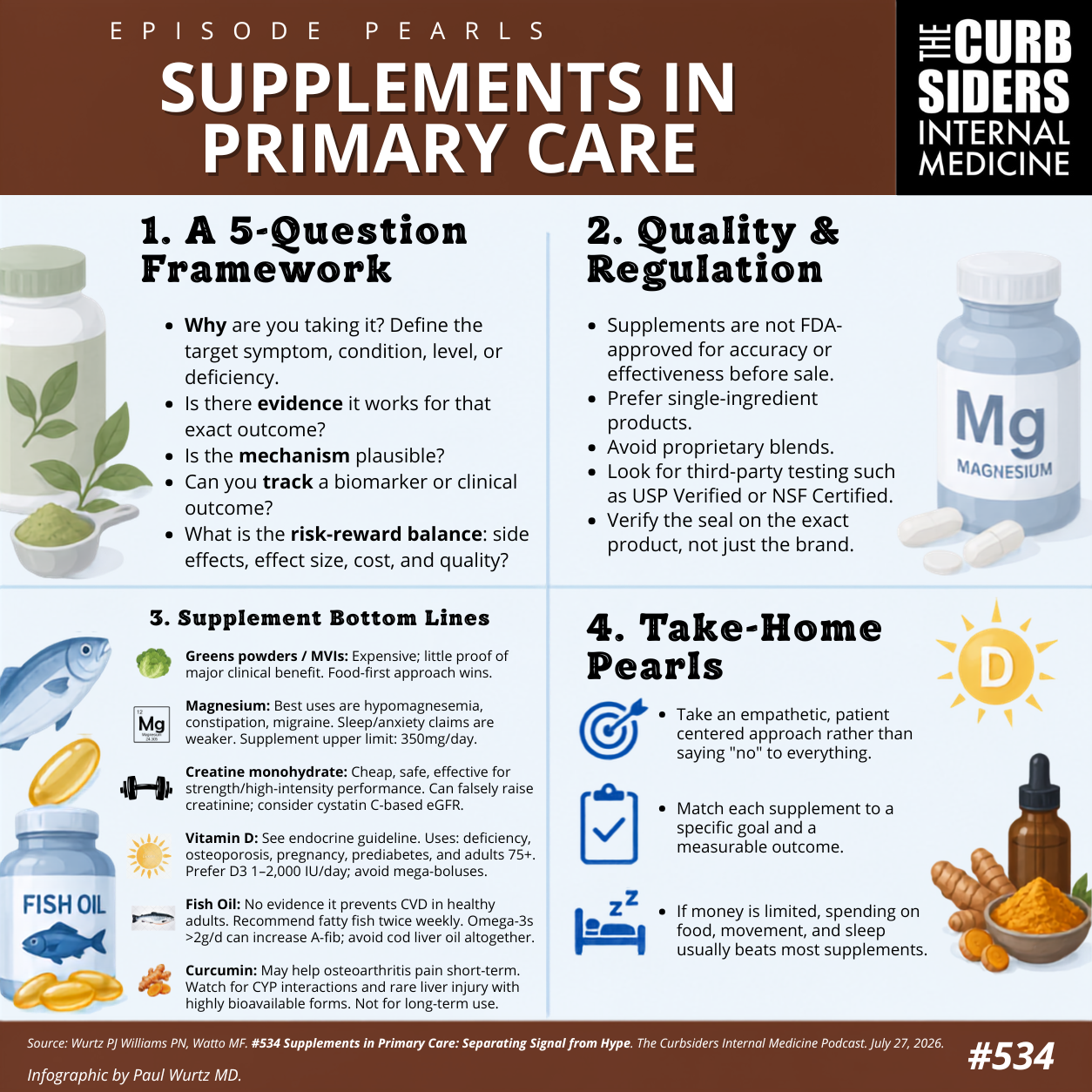
- Before endorsing any supplement, ask five questions: Why are you taking it (target symptom, condition, level, or deficiency)? Is there evidence it works for that outcome? Is there a plausible mechanism? Is there a biomarker or clinical outcome you can track? And what is the balance of risk to reward, including side effects, effect size, cost, and product quality?
- Supplements are not FDA-approved for accuracy or effectiveness before sale. Steer patients toward single-ingredient products, away from proprietary blends, and toward reputable third-party testing (USP Verified, NSF Certified). Verify the seal on the specific product, not just the brand.
- Greens powders like AG1 are expensive multivitamin-and-probiotic powders. The only human trials are small and manufacturer-funded, showing favorable shifts in gut bacteria but no improvement in digestive quality of life. A multivitamin plus a fiber supplement achieves the equivalent for a fraction of the cost.
- Multivitamins do not prevent cardiovascular disease or cancer and do not reduce mortality (USPSTF “I” statement). A food-first approach wins; taking an MVI to “cover your bases” is a reasonable leap of faith, not a proven intervention.
- Higher dietary magnesium is a marker of diet quality, but that does not mean chronic supplementation helps most people. The best-supported uses are hypomagnesemia repletion, chronic idiopathic constipation, and migraine prophylaxis. Anxiety and sleep claims outrun the evidence.
- Magnesium glycinate and L-threonate carry more hype than data. Organic salts absorb better than oxide, but no head-to-head trials show better clinical outcomes. The upper limit from supplements is 350 mg/day.
- Creatine monohydrate is cheap, safe, and effective for strength and high-intensity performance, with promising cognitive signals (especially in older adults and sleep deprivation). Because creatine can falsely raise serum creatinine, check a cystatin C–based eGFR.
- Vitamin D is not a panacea: no CVD, cancer, or mortality benefit in generally healthy adults. Reserve supplementation for osteoporosis, deficiency, prediabetes, pregnancy, and empiric use in adults 75+. Prefer D3 1,000–2,000 IU daily over mega-boluses, which increase fall risk.
- Fish oil supplements do not prevent cardiovascular disease in healthy people – recommend non-fried fatty fish twice weekly instead. Icosapent ethyl helps secondary prevention (REDUCE-IT), but omega-3s above 2 g/day raise atrial fibrillation risk by about 1% (NNH ~100). Cod liver oil is not fish oil – watch for vitamin A and D overload.
- Curcumin may match NSAIDs for osteoarthritis pain in short trials, but highly bioavailable formulations carry rare liver-failure risk and multiple CYP interactions (warfarin, tacrolimus, chemotherapy).
Supplements in Primary Care Show Notes
Why This Matters
The dietary supplement industry is enormous, largely unregulated at the point of efficacy, and increasingly driven by podcasters and influencers rather than clinical trials. Patients rarely ask permission before starting a supplement – they arrive already taking a list. Our job is not to reflexively dismiss these products, but to help patients think clearly: what are they trying to achieve, does the supplement plausibly do that, and is it worth the money and the risk (expert opinion).
A useful and slightly humbling starting point: users of supplements tend to have higher intake of nutrients from food in the first place (Bailey 2011). In other words, the people most likely to take supplements are often those who need them least.
Ask These Five Questions About Any Supplement:
Rather than memorizing a verdict for every product, anchor the conversation on a repeatable framework. For any supplement, ask:
- Why are you taking it? What is the target symptom, condition, level, or deficiency?
- Is there evidence it works for that specific desired outcome?
- Do we understand the mechanism of action?
- Is there a biomarker or clinical outcome you can track to know whether it is having the desired effect?
- What is the balance of risk to reward – potential side effects, the magnitude of the effect, cost, and product quality?
This framework does most of the work in a supplement visit. It reframes the discussion away from “good vs. bad” and toward whether a specific product serves a specific goal for a specific patient (expert opinion).
Supplement Quality and Regulation
Supplement quality varies enormously. Unlike prescription medications, supplements are not approved by the FDA for accuracy or effectiveness before they are sold. That places the burden of quality control on the clinician and patient (expert opinion)
Matt Watto’s Practical Buying Advice
- Choose single-ingredient products.
- Avoid proprietary blends.
- Look for reputable third-party testing, and verify the seal on the exact product package.
Common third-party seals include USP Verified, NSF Certified (and NSF Certified for Sport), Informed Choice/Informed Sport, BSCG Certified Drug Free, and ConsumerLab.com. In general, these programs may test whether the product contains the listed ingredients in the stated amounts, whether it is free of harmful levels of contaminants, and whether it is manufactured to quality standards. USP Verified and standard NSF Certified are strong general quality signals; NSF Certified for Sport, Informed Sport, and BSCG Certified Drug Free are especially relevant for athletes because they screen for banned substances. Two cautions: third-party testing does not prove a supplement is effective for a medical condition, and certification may apply only to specific products from a manufacturer – not the entire brand – so verify the seal on the exact product label or certification website.
Clinician Resources
Free databases include the Memorial Sloan Kettering (MSKCC) integrative medicine site and the NIH Office of Dietary Supplements. Paid, clinician-friendly options include ConsumerLab and Examine (expert opinion).
Greens Powders and Multivitamins (MVIs)
Greens Powders (AG1) – Bottom Line
AG1 (formerly Athletic Greens) is, functionally, an expensive multivitamin-and-probiotic powder that runs about $100 per month. Small human clinical trials – both with a high risk of bias – found that it may help people reach the Estimated Average Requirement (EAR) for certain vitamins and minerals, and that it favorably increases some gut bacterial species without affecting digestive quality of life, stool frequency, or consistency. Taking a multivitamin plus a fiber supplement can achieve equivalent results for a fraction of the cost (expert opinion).
A PubMed search for “AG1” yields only a handful of results, of which just two are human trials. The company’s own science page leans heavily on preclinical or observational work focused on surrogate endpoints and biomarkers rather than clinical outcomes (AG1 scientific research page).
- Gonzalez 2026 – randomized, double-blind crossover trial (n=20) in healthy adults in their 20s taking AG1 or placebo for two weeks, with a two-week washout. Result: an increase in certain favorable gut bacteria without any change in gut-related quality of life and no serious side effects. Participants met more EARs for 16 prespecified nutrients (mostly vitamins A, C, and E), but the confidence intervals overlapped with placebo. High risk of bias – manufacturer-funded, with multiple authors employed by AG1.
- Monica 2024 – four-week randomized, double-blind trial of AG1 vs placebo (n=30) assessing digestive quality of life and the microbiome. Result: neither treatment negatively affected digestive quality-of-life scores, bowel frequency, or stool consistency. AG1 again shifted gut bacteria favorably, but did not improve quality-of-life scores, stool frequency, or consistency. High risk of bias – manufacturer-funded, with some authors employed by AG1.
Worth a mention for context: AG1 is heavily celebrity-backed and its founder stepped down as CEO in 2024 amid criminal scrutiny reported in the press. None of that changes the biology, but it is a useful reminder that marketing muscle and evidence are not the same thing (expert opinion, https://newsroom.co.nz/2024/10/31/kiwi-ceo-of-billion-dollar-supplements-firm-quits-amid-criminal-scrutiny).
Scott Carney’s YouTube channel has great coverage of the AG1 story (“The Junk Science of Athletic Greens”).
Multivitamins – Bottom Line
Recommend a food-first approach. It is okay to take a multivitamin to “cover your bases,” but understand that this is a leap of faith. MVI use does not prevent cardiovascular disease or cancer, and does not improve survival. Based on current evidence, there is low certainty that MVI use delays cognitive decline, though it is reasonable to try for those who do not mind another pill (expert opinion).
Multivitamins are the most commonly used dietary supplement in the U.S. (about one-third of adults), yet large randomized trials and meta-analyses consistently show no cardiovascular or cancer benefit in generally healthy adults, and the USPSTF issued an “I” (insufficient evidence) statement for CVD and cancer prevention (USPSTF 2022; Loftfield 2024). The USPSTF specifically recommends against beta carotene or vitamin E for CVD and cancer prevention. One important exception: for women of reproductive age, folic acid 400 mcg/day has proven benefit for neural tube defect prevention.
MVI Cautions
- For premenopausal women, MVIs contain extra iron and folate, and should not contain vitamin A as retinol, which is teratogenic, and can be hepatotoxic at mega doses >50,000 units (Rogovik 2010).
- High dose Vitamin B6 (>100 mg/day) supplementation has been associated with peripheral, sensory neuropathy in multiple studies (Muhamad 2023).
- High dose B3 (niacin) has been associated with hepatotoxicity, especially the sustained release formulation (Niacin NIH site).
MVIs and Cognition
COSMOS-Mind (Baker 2023), a 2×2 factorial RCT of cocoa extract and/or MVI in over 2,000 adults (average age 73), found a statistical improvement in global cognition, executive function, and episodic memory in the MVI group over three years – but the confidence intervals overlap and the clinical significance is uncertain, and all groups improved (likely from learning the test). The authors’ own “imprecise yardstick” suggested MVI slowed cognitive aging by about 1.8 years, while urging more work. Notably, the Physician’s Health Study II cognitive substudy (Grodstein 2013) of nearly 6,000 highly educated older men found no MVI effect on global cognition.
MVIs Safety
Multivitamins are generally regarded as safe, but watch for polypharmacy with supplements that contain overlapping ingredients. Calcium can cause constipation and increase kidney stone risk; iron overload is a theoretical concern in men and postmenopausal women. Separate MVIs from levothyroxine and bisphosphonates to prevent poor absorption, and remember that vitamin K–containing MVIs may interfere with warfarin and INR.
Magnesium
Bottom Line on Magnesium
A higher intake of magnesium is a marker of diet quality and is associated with improved clinical outcomes (less heart disease and diabetes, better blood pressure, and better bone health). There are plausible mechanisms behind these associations, but it is a mistake to conclude that chronic supplementation is necessary or improves outcomes for most Americans. Supplementing makes sense for those at risk (chronic PPI or diuretic use, or alcohol use disorder) or those with conditions like migraine or chronic constipation who want to try something “more natural.” Magnesium glycinate and L-threonate carry more hype than evidence and cost more, so they are reasonable for those who can afford them, knowing the benefits over cheaper versions are unproven or marginal.
What Is It and How Much
Magnesium is a cofactor in more than 300 enzyme systems (energy production, DNA/RNA synthesis, ion transport), so it affects nerve conduction, muscle contraction, and heart rhythm. It is also an NMDA antagonist and GABA agonist (Knobbe 2023), which fuels beliefs about sleep and anxiety. The RDA is roughly 400 mg for adult males, 320 mg for adult females, and 350 mg in pregnancy, but the upper limit specifically from supplements is 350 mg/day. About half of the U.S. population consumes less than the estimated average requirement (Costello 2016), but clinically important deficiency is uncommon in healthy adults – so the popular claim that “50% of Americans are magnesium deficient” is misleading. In general, organic salts (citrate, glycinate, gluconate, lactate) have higher bioavailability than inorganic salts like oxide and carbonate (Pardo 2021).
Best Supported Indications
- Hypomagnesemia repletion – a clear indication for acute supplementation.
- Chronic idiopathic constipation – magnesium oxide 500 mg one to three times daily is included in AGA guidelines (Chang 2023). Magnesium is an osmotic laxative.
- Migraine prophylaxis – 300 mg twice daily has been suggested (Schurks 2008) and is included in ANA guidelines as “probably effective” (Holland 2012); one small crossover study found magnesium oxide 500 mg daily comparable to valproate (Karimi 2021)
Less Convincing Indications
- Anxiety: mechanisms are plausible (NMDA antagonism, GABAergic activity), but clinical evidence is lacking. A large Norwegian cohort found no correlation between magnesium intake and anxiety (Jacka 2009); a systematic review called for more evidence (Lakhan 2010); and an unblinded crossover trial that lacked a placebo showed reductions in PHQ-9 and GAD-7 that are heavily biased (Tarleton 2017).
- Sleep: the 2025 VA/DoD guidelines concluded evidence is insufficient to recommend magnesium for chronic insomnia (very low confidence). A systematic review (Mah 2021) found only three small, high-risk-of-bias studies and estimated magnesium might reduce sleep latency by roughly 12–17 minutes, of uncertain clinical benefit. Notably, magnesium depletion is associated with sleep apnea, but not insomnia or restless legs (Luo 2024).
- Nocturnal leg cramps: no convincing benefit (Cochrane 2020); magnesium oxide 520 mg elemental daily was no better than placebo over four weeks (Roguin Maor 2017).
A Word on Glycinate and Threonate
The hype exceeds the evidence. A PubMed search for “magnesium glycinate” yields only a few human studies, including a negative bone-turnover/glycemic study (Dall 2023), a small BP-reduction study (Cheung 2022), and a 12-patient crossover suggesting better absorption in some (Schuette 1994). Organic salts do absorb better than oxide (Pardo 2021), but we lack head-to-head trials showing better outcomes. Magnesium-L-threonate, promoted for memory, is summarized by ConsumerLab as “mixed and…modest, at best.” The hype traces to a rat study (Slutsky 2010); human data are limited (Liu 2016), and an RCT (n=50 per arm) found a statistically significant but tiny effect on the NIH Total Cognition Composite (2.6 points on a 130-point scale) with no improvement in sleep (Lopresti 2026).
Magnesium Safety
- Diarrhea (dose- and formulation-dependent).
- PPIs can cause hypomagnesemia via renal wasting – supplementation alone may fail, so consider stopping the PPI.
- Loop and thiazide diuretics increase magnesium loss.
- Chronic kidney disease: accumulation risk with eGFR <30 mL/min.
- Alcohol use disorder increases hypomagnesemia risk from renal and GI losses and poor intake.
Creatine
Bottom Line on Creatine
Creatine works by supporting cellular energy production. It has modest effects on lean mass (1–3 kg, some of it water weight) and is not directly anabolic, but it has clear benefits for muscle strength and performance in short, high-intensity exercise (think CrossFit or sprints), with no utility in endurance sports. It also appears to benefit cognition, possibly more so in older adults, with early-phase work in Alzheimer’s disease and promising data for cognitive performance during sleep deprivation. One clinical pearl: check a cystatin C–based eGFR in patients taking creatine, because supplementation can falsely elevate serum creatinine.
What It Is
Creatine is a non-essential amino acid produced in the body (about 1 g/day in the kidneys and liver) and found in muscle, heart, and brain. Animal products supply roughly 2 g per pound. It is metabolized to creatinine, but direct renal toxicity has not been proven and a recent meta-analysis found no reduction in eGFR (Naeini 2025). Monohydrate is the most common, most affordable form and is non-inferior to pricier versions. A typical regimen is 5–7 days of loading at 20 g/day (5 g four times daily) followed by 3–5 g/day maintenance; loading is optional. Major guidelines make no sex-specific recommendations.
Why Might You Take Creatine?
Strength and performance: a joint position statement (Academy of Nutrition and Dietetics, Dietitians of Canada, ACSM) supports creatine for high-intensity exercise with short recovery and training capacity (Thomas 2016), with little role in endurance sports. Vegetarians may respond particularly well since creatine is not available from plants (Burke 2003). Lean mass: meta-analyses in older adults or those with chronic disease show improved sit-to-stand performance, muscle function, and about 1 kg of lean mass, especially with resistance training (Davies 2024, Devries 2014, Choi 2021).
Cognition and memory: results are mixed. The largest crossover RCT (n=123) found only a non-significant signal on backward digit span (Sandkuhler 2023). A meta-analysis of 8 RCTs found a small overall effect on memory (SMD 0.29) but a large effect in adults 66–76 (SMD 0.88) versus essentially none in younger subjects (Prokopidis 2023). An earlier review found improvements in short-term memory and reasoning with conflicting results elsewhere (Avgerinos 2019).
Alzheimer’s disease: mouse models show enhanced cognition and reduced AD biomarkers, and a single-arm pilot of 20 g/day for 8 weeks in 20 patients raised brain creatine 11% with statistical improvements in several cognitive measures (Smith 2025). Larger trials are needed.
Sleep deprivation: a systematic review of small controlled studies using 20 g/day for 7 days or a single 0.35 g/kg dose before a night of sleep deprivation found promising results for cognition, psychomotor function, and mood (Williams 2026).
Creatine Safety
Creatine is generally regarded as safe and has been studied extensively for decades. GI upset is the most common side effect. Remember the cystatin C pearl for eGFR.
Vitamin D
Bottom Line on Vitamin D
Vitamin D has a reputation as a panacea given its roles in bone health, immunity, inflammation, neuromuscular function, and glucose metabolism. But well-done trials failed to show reductions in CVD or cancer with supplementation, and in meta-analysis, calcium and vitamin D do not reduce falls or fractures in community-dwelling adults. Guidelines do recommend supplementation for osteoporosis (as an adjunct to bone-preserving therapy), vitamin D deficiency, prediabetes, pregnancy, and empirically in adults over 75 (associated with reduced mortality). Target levels of 30–50 ng/mL are supported by guidelines, and experts favor D3 at 1,000–2,000 IU daily over mega-doses (e.g., 50,000 IU), which are associated with increased fall risk.
What Is It?
Vitamin D is a fat-soluble vitamin made in skin from UV exposure and hydroxylated in the liver and kidneys to its active form. Dietary sources include fatty fish, UV-exposed mushrooms, fish liver oils, egg yolks, and fortified foods. Absorption improves with fat. Vitamin K2 is often co-administered on the theory that vitamin D increases vitamin K–dependent proteins that direct calcium into bone and away from vessels (Ballagooijen 2017) – but this is a mechanistic rationale, not an outcome-proven benefit (see below).
Target Levels and Dosing
Assay standardization for 25(OH)D remains a barrier to firm conclusions. The Food and Nutrition Board considers ≥20 ng/mL sufficient for most people, while major endocrine societies target ≥30 ng/mL (range 30–50 ng/mL; Endocrine Society 2024, AACE 2020). The 2020 AACE guidelines suggest repletion with D3 5,000 IU daily for 8–12 weeks, then 1,000–2,000 IU daily maintenance, with higher doses for obesity or malabsorption. AACE cautions against bolus dosing due to increased fall risk (Bischoff-Ferrari 2016, Sanders 2010).
Why Might You Take Vitamin D?
- Empiric supplementation: For adults ≤74, the Endocrine Society recommends against routine testing and against empiric supplementation. For adults ≥75, it recommends empiric supplementation (averaging ~900 IU/day equivalent) for potential mortality benefit, without routine testing (Endocrine Society 2024).
- Osteoporosis: calcium and vitamin D are standard adjunctive therapy.
- Prediabetes: for high-risk patients, the Endocrine Society recommends supplementation (average ~3,500 IU/day equivalent); an accompanying review found reduced diabetes incidence and small drops in fasting glucose and 2-hr OGTT, but no significant A1c reduction (Shah 2024).
- Pregnancy: empiric supplementation via fortified foods, prenatal vitamins, or supplements (average ~2,500 IU/day), without routine testing (Endocrine Society 2024).
- Deficiency and bone disease: check levels in disorders of calcium or in bone diseases like osteoporosis; treat rickets/osteomalacia.
Does Adding Vitamin K2 Help?
The K2 rationale is mechanistic and theoretical. There is no strong clinical-outcome evidence that adding K2 to vitamin D meaningfully improves bone or cardiovascular endpoints in typical patients, so it is reasonable to view combination D3/K2 products as marketing-forward rather than evidence-mandated (expert opinion).
Unsupported Uses and Safety
Vitamin D supplementation has not been shown to prevent heart disease or cancer (Manson 2019; a small possible reduction in advanced cancer on secondary analysis, Chandler 2023), reduce mortality, boost immune function, or prevent fractures and falls in healthy adults (Masse 2026). In a VITAL substudy, most adults were already replete and saw no fracture benefit (LeBoff 2022). Safety concerns include hypercalcemia, kidney stones (increased with vitamin D and calcium; USPSTF 2018), and increased falls with bolus dosing.
Fish Oil and Cod Liver Oil
Bottom Line on Fish Oil
Eating non-fried fatty fish at least twice per week as part of a healthy diet may reduce cardiovascular disease and stroke risk. However, we lack reliable evidence that fish oil supplements prevent heart disease or stroke in healthy people. Icosapent ethyl lowers recurrent MACE when added to a statin for secondary prevention (Bhatt 2016). Importantly, fish oil above 2 g/day and icosapent ethyl increase the absolute risk of atrial fibrillation over placebo by about 1% (number needed to harm ~100).
What Is It and the Omega-3 Index
Omega-3s (EPA, DHA from animals; ALA from plants) and omega-6s are the major polyunsaturated fatty acids. ALA and linoleic acid are essential; the liver converts ALA to EPA/DHA only in small amounts, so dietary intake matters. The omega-3 index (O3I) measures EPA+DHA in red-cell membranes as a percentage of total fatty acids and serves as a surrogate for tissue levels. The U.S. average is 3–5%, roughly half of typical Japanese levels.
Why Might You Take Fish Oil?
- Targeting an O3I above 8%: the O3I is inversely associated with cardiac mortality (Harris 2004); test-maker analyses estimate raising 4%→8% could lower fatal CHD risk by ~30% (Harris 2017). Two fatty-fish meals/week provide ~250 mg/day EPA+DHA but may not reach 8% without supplementing ~1,100–1,300 mg/day (McDonnell 2019).
- Severe hypertriglyceridemia: prescription EPA/DHA 4 g/day or icosapent ethyl (Virani 2021).
- Cardiovascular disease: large trials for primary and secondary prevention found no MACE reduction with ~1,000 mg/day or higher – VITAL (Manson 2019), (ASCEND 2018), and OMEMI, which showed no benefit but increased atrial fibrillation (Kalstad 2021).
- Brain health: observational data associate higher omega-3 intake with less cognitive decline; RCT meta-analyses suggest improved cognitive/executive function but no proven dementia reduction (Shahinfar 2025, Wan Suh 2024, Wei 2023).
- Cancer: no reduction in incidence (Manson 2019).
Fish Oil Safety
Supplemental doses above 2 g/day of omega-3 (or total >3 g/day) are not recommended unless prescribed. Atrial fibrillation risk increases with supplementation, seen repeatedly in RCTs and even in patients without CVD (about a 1.2% absolute increase; Zhang 2022). Bleeding risk rises above 3 g/day EPA+DHA or with icosapent ethyl plus antithrombotics (Cai 2024). GI “fishy burps” and diarrhea are common, and high doses may theoretically dampen immune responses (Fenton 2013).
Cod Liver Oil Is Not Fish Oil
Cod liver oil is a substantial source of omega-3s but also of vitamins A and D, so beware of overdosing on A and D when combining it with other supplements. There is no evidence fermented cod liver oil is better, and pregnant women should avoid cod liver oil because it may contain vitamin A as retinol.
Turmeric and Curcumin
Bottom Line on Curcumin
Turmeric contains curcuminoids, with curcumin the most studied. In some trials, curcumin has similar efficacy to NSAIDs for osteoarthritis pain and has been studied as an add-on to mesalamine for ulcerative colitis. Smaller studies suggest possible benefit for indigestion, rheumatoid arthritis, seasonal allergies, and depression. It carries potential drug interactions – especially with certain cancer agents – and highly bioavailable formulations have been linked to rare but serious liver failure, particularly with long-term use.
Culinary Spice vs. Concentrated Supplement
This distinction matters for the patient taking curcumin with black pepper for knee pain. Clinical trials typically use 500–2,000 mg of curcuminoids per day (often 500 mg two to three times daily), whereas one level teaspoon of turmeric powder (~1 gram) provides only about 35 mg of curcuminoids. Culinary turmeric is essentially food and is safe; concentrated, highly bioavailable extracts (often boosted with piperine from black pepper) deliver drug-like doses and carry the drug-like risks – including the rare hepatotoxicity and CYP interactions (expert opinion). Take with a fatty meal to improve absorption.
Where the Evidence Is Strongest
- Osteoarthritis: multiple meta-analyses show pain and function improvement comparable to NSAIDs with fewer adverse events, though studies are short and heterogeneous with moderate risk of bias (Wang 2021, Zhang 2025, Bideshki 2024). Topical efficacy for knee pain is unclear.
- Ulcerative colitis: curcumin added to mesalamine has been studied in mild-to-moderate disease (Lang 2015).
- Fatty liver: possible modest benefit; a meta-analysis found reduced ALT and AST (Goodarzi 2019).
Curcumin Interactions and Safety
Conventional oral turmeric/curcumin is likely safe for up to 2–3 months, but highly bioavailable forms may harm the liver. Turmeric inhibits or enhances multiple CYP enzymes: it may lessen the effect of NSAIDs and acetaminophen, increase bleeding risk with warfarin, raise tacrolimus levels, and lessen the effect of certain chemotherapy agents. Common side effects include nausea, reflux, and altered bowel habits.
Simplifying the Regimen
Returning to a patient with the seven-supplement list, the framework lets us triage rather than dismiss (expert opinion):
- Creatine monohydrate: keep. It aligns with his new strength training, is cheap and safe, and evidence supports it. Check a cystatin C–based eGFR.
- Magnesium glycinate: reasonable for constipation, and low-risk for a sleep trial – but the glycinate premium buys unproven benefit over cheaper salts. Magnesium oxide would be an evidence-aligned, lower-cost option for constipation.
- Vitamin D3 with K2: justified only if he is deficient or has a qualifying indication; the K2 addition is theory, not proven benefit.
- Fish oil and cod liver oil: food-first. Supplements do not prevent CVD in healthy people, and omega-3s add atrial fibrillation risk. Cod liver oil also risks stacking vitamin A and D. Reasonable to stop both in favor of fatty fish twice weekly.
- Multivitamin: optional “cover your bases” leap of faith; fine to continue or stop.
- Curcumin with black pepper: a reasonable short-term trial for knee OA, monitoring for GI effects, interactions, and — with highly bioavailable products — liver safety.
A useful closing frame: if a patient has only $30 a month to spend on their health, that money almost always does more toward food, movement, and sleep than toward most supplements (expert opinion).
Goal
Listeners will develop a practical, patient-centered approach to evaluating dietary supplements.
Learning objectives
- Elicit a complete supplement history and identify the specific outcome a patient hopes to achieve.
- Apply a five-question framework to evaluate the evidence, mechanism, measurable outcomes, risks, cost, and product quality of a supplement.
- Explain how dietary supplements are regulated and help patients identify credible third-party product testing.
- Counsel patients on greens powders and multivitamins using evidence from clinical outcomes rather than marketing claims or surrogate endpoints.
- Recommend magnesium selectively for evidence-supported indications while avoiding unsafe dosing, drug interactions, and use in patients at risk for hypermagnesemia.
Citation
Wurtz PJ, Williams PN, Watto MF. “Supplements in Primary Care: Separating Signal from Hype.” The Curbsiders Internal Medicine Podcast. thecurbsiders.com/category/curbsiders-podcast July 27, 2026.
Episode Sponsors
FIGS
Curbsiders listeners can get 15% off. Just go to WearFIGS.com and use code FIGSRX.
Panacea Financial
Visit Panacea.Legal/curb to schedule your free consultation.
Continuing Education Company
Visit CMEmeeting.org/curbsiders and use promo code Curb30 for 30% off all online courses and webcasts.
Episode Credits
Writer and Producer, Show Notes, Cover Art, Infographic: Paul Wurtz MD.
Hosts: Matthew Watto MD, FACP; Paul Williams MD, FACP
Reviewer: Sai S Achi MD, MBA, FACP
Showrunners: Matthew Watto MD, FACP; Paul Williams MD, FACP
Technical Production: PodPaste
CME Partner

The Curbsiders are partnering with VCU Health Continuing Education to offer continuing education credits for physicians and other healthcare professionals. Visit curbsiders.vcuhealth.org and search for this episode to claim credit.
Contact Us
Got feedback? Suggest a Curbsiders topic. Recommend a guest. Tell us what you think.
We love hearing from you.
Join our Patreon!

Yes, you can now join our exclusive community of core faculty at Kashlak Memorial Hospital along with all the perks:
- Bundle & Save with the top CME tier!
- All episodes Ad-Free, including the entire back catalog!
- Twice-monthly bonus episodes: Ask me Anything (AMA) with Matt & Paul, Recaps, and more!
- Access to Kashlak's Discord Server!
- Advance Notice of Curbsiders Events!
- Exclusive Curbsiders' Merch!
