

Audio
Video
Transcript available via YouTube
Caring for patients using mitragynine-derived substances
Familiarize yourself with the differences in mitragynine-derived compounds. Understand how to identify and manage kratom use disorder and withdrawal from mitragynine-derived compounds. We’re joined by Dr. Jonathan Tanawan (Profile).
Claim CME for this episode at curbsiders.vcuhealth.org!
By listening to this episode and completing CME, this can be used to count towards the new DEA 8-hr requirement on substance use disorders education.
Episodes | Subscribe | Spotify | iTunes | CurbsidersAddictionMed@gmail.com | CME!

The Curbsiders Addiction Medicine Podcast are proud to partner with The American College of Addiction Medicine (ACAAM) to bring you this mini-series. ACAAM’s membership has grown to include a strong and expanding community of addiction medicine specialists, fellows, and trainees dedicated to advancing the field. Membership provides access to a wide range of educational resources, professional development, and a national network of colleagues. Learn more about ACAAM Membership here.
Show Segments
- Intro, disclaimer, guest bio
- Guest one-liner, Picks of the Week*
- Case from Kashlak; Definitions
- Pharmacology of kratom and other mitragynine-based compounds
- How to take a mitragynine-specific substance use history
- Defining a use disorder
- Withdrawal from kratom
- Managing a use disorder with MOUD
- Legal landscape and regulation
- Outro
Kratom Pearls
Legislation around and regulation of kratom and other mitragynine-based products vary from state to state. As of July 1st, 2026, the DEA announced its intent to temporarily schedule 7-OH and related substances as Schedule I substances (DEA, 2026).
Kratom generally has lower potency at the mu-opioid receptor (MOR) as compared to the semisynthetic mitragynine-derived products such as 7-OH and MP, which share MOR activity similar to or greater than that of morphine.
Kratom and other mitragynine-based products are available in a range of formulations, including teas, pills, drinks, and other consumables. They may be marketed in a range of ways.
Patients using these products may experience withdrawal syndromes similar to traditional opioid withdrawal, which can be measured with withdrawal scales such as SOWS and COWS
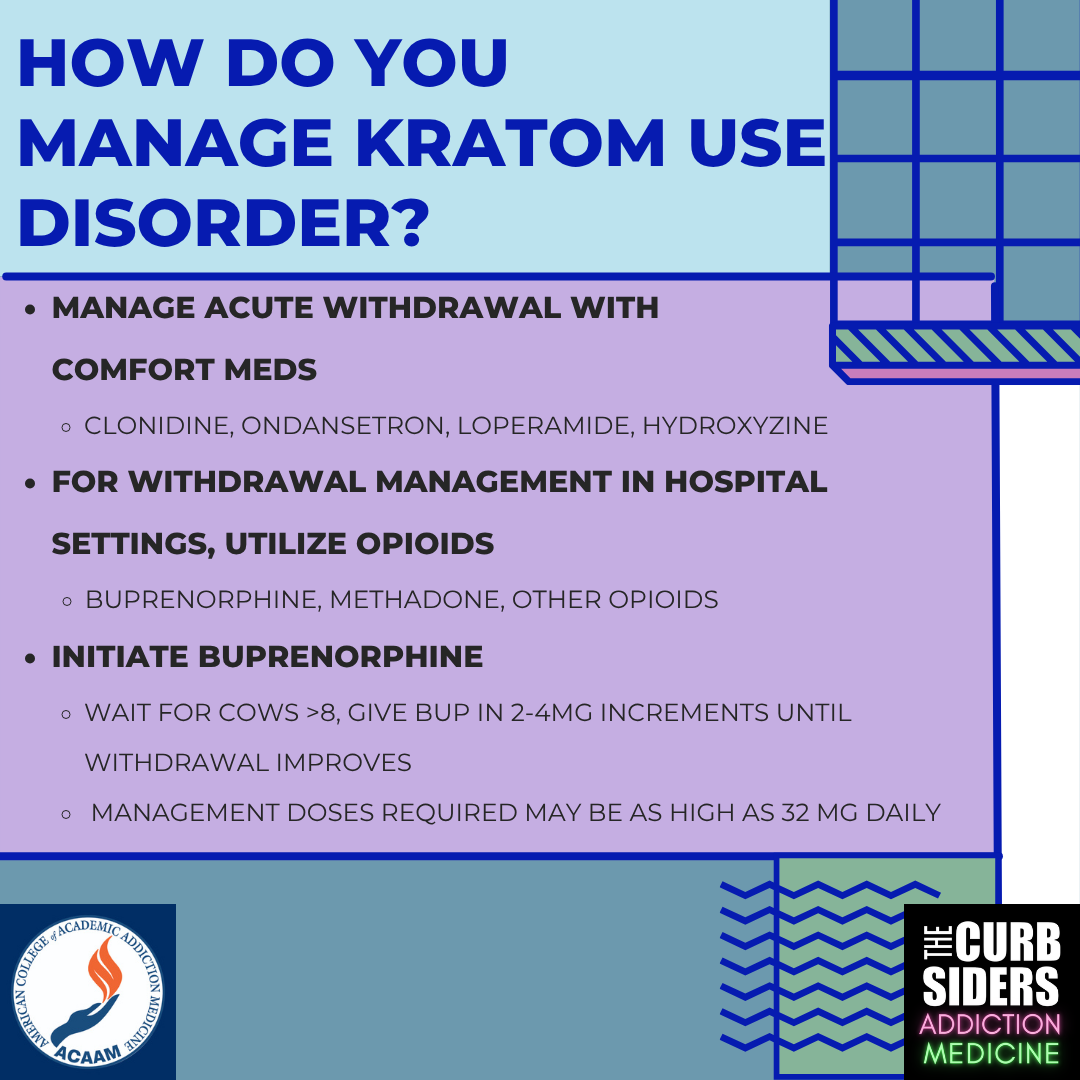
We can use medications such as buprenorphine to manage withdrawal in the outpatient setting, along with traditional comfort medications such as clonidine, ondansetron, loperamide, etc., and in the inpatient setting, we can also use methadone and other full opioid agonists to treat withdrawal.
While kratom/mitragynine does not have an official use disorder definition in the DSM-5, expert opinion and practice are to utilize the general use disorder criteria to identify patients with kratom use disorder.
Patients who are found to meet kratom use disorder criteria may benefit from management with medications for opioid use disorder (MOUD), such as buprenorphine.
Initiation of buprenorphine can generally follow a more “standard” approach, with starting doses of 2-4 mg. Maintenance doses for patients using higher-potency mitragynine-based products are likely to be in the range of 16-32 mg total daily dose.
What’s the Tea on Kratom – Notes
Mitragynine-based compounds
Mitragynine-based compounds are substances that are ultimately derived from the kratom plant (Mitragyna Speciosa). Kratom is a plant native to Southeast Asia and is a relative of the coffee plant. The use of leaves is traditional in Southeast Asian cultures (Veltri 2019).
Pharmacology
The active compounds in the Kratom leaf include mitragynine and its derivatives. Mitragynine itself weakly binds the mu-opioid receptor (MOR) and can act as a partial α-adrenergic and serotonergic agonist as well (Sharma 2025) (Matsumoto 1996). There are many other alkaloids found in the Kratom leaf, beyond mitragynine; the most abundant are speciociliatine, speciogynine, paynantheine, and corynantheidine. These other major alkaloids also have activity at opioid, adrenergic, and serotonergic receptors (Leon 2021). Metabolism of mitragynine produces 7-hydroxymytragynine (7-OH), a highly selective MOR agonist with higher binding affinity than morphine (Chiang 2025). Other semi-synthetic mitragynine-derived alkaloids include mitragynine pseudoindoxyl, which exhibits additional agonism at the MOR. All of these mitragynine-derived alkaloids have MOR activity as well as activity at the kappa and delta opioid receptors (Obeng 2021).
Use patterns in the U.S.
Since the early 2000s, kratom use in the US has increased, with the range of kratom and mitragynine-based products available to the consumer expanding. These can include anything from kratom powders and teas to drinks, pills, and other consumables that have 7-OH, mitragynine pseudoindoxyl, and other mitragynine-derived compounds as their main active ingredient, with increasing doses contained in these products. Typically, products are available in smoke shops, gas stations, convenience stores, and online. Estimates of use prevalence based on US national surveys were as high as over 9% (Grundmann 2025), with other estimations from the 2019 survey on National Survey on Drug Use and Health being closer to 0.9% (Palamar 2021).
Legal Landscape
As of July 1, 2026, the Drug Enforcement Administration (DEA) has announced its intention to place 7-OH and similar products in Schedule I, which, if implemented, would make 7-OH-containing products illegal nationwide. Of note, this intention for scheduling does not include kratom leaf and kratom leaf products and the trace amounts of 7-OH naturally occurring in these. As these products have gained popularity, states have been regulating them on a state-by-state basis prior to this announcement. As of January 2026, 30 states had some regulation of kratom and its components, with 6 states banning kratom (Prozialeck 2016) (Legislative Analysis and Public Policy Association 2026). The legal status of these compounds will continue to evolve; the current DEA status can be checked here.
Use, Use Disorders, Withdrawal, and Intoxication
Defining a kratom use disorder
While there is no DSM-5-defined kratom-specific use disorder, it is the expert opinion of Drs Tanawan, Huxley-Reicher, and Chan that we can use SUD criteria from the DSM-5 to apply to the use of kratom and other mitragynine-derived products, particularly as these molecules share activity at the MOR and generally act similarly to opioids. Use of the DSM5 criteria to define a kratom use disorder has been demonstrated in case reports (Swart 2024) and in online cross-sectional samples of kratom and kava users (Hill 2025; Smith 2024; Rogers 2024), with estimates of use disorder among populations using kratom around 25% (Hill 2024).
Taking a kratom/7-OH use history
As Dr. Tanawan explains, a good history is key to caring for patients using kratom and other mitragynine-derived products. This history should meet the patient where they are and include questions about the products they use, their use patterns, the amounts used, and their impact on their lives. Specifically, Dr. Tanawan mentions asking about what patients think the products they are using contain, product names, where they are obtaining the product, and an understanding of the frequency of use and underlying reasons for use of kratom and mitragynine-based products, which in samples of people using kratom products can vary widely (Smith 2024). Additional information that should be assessed includes other concurrent substance use and perceived impact on responsibilities and relationships, as well as patient-specific goals around their use.
Managing acute withdrawal
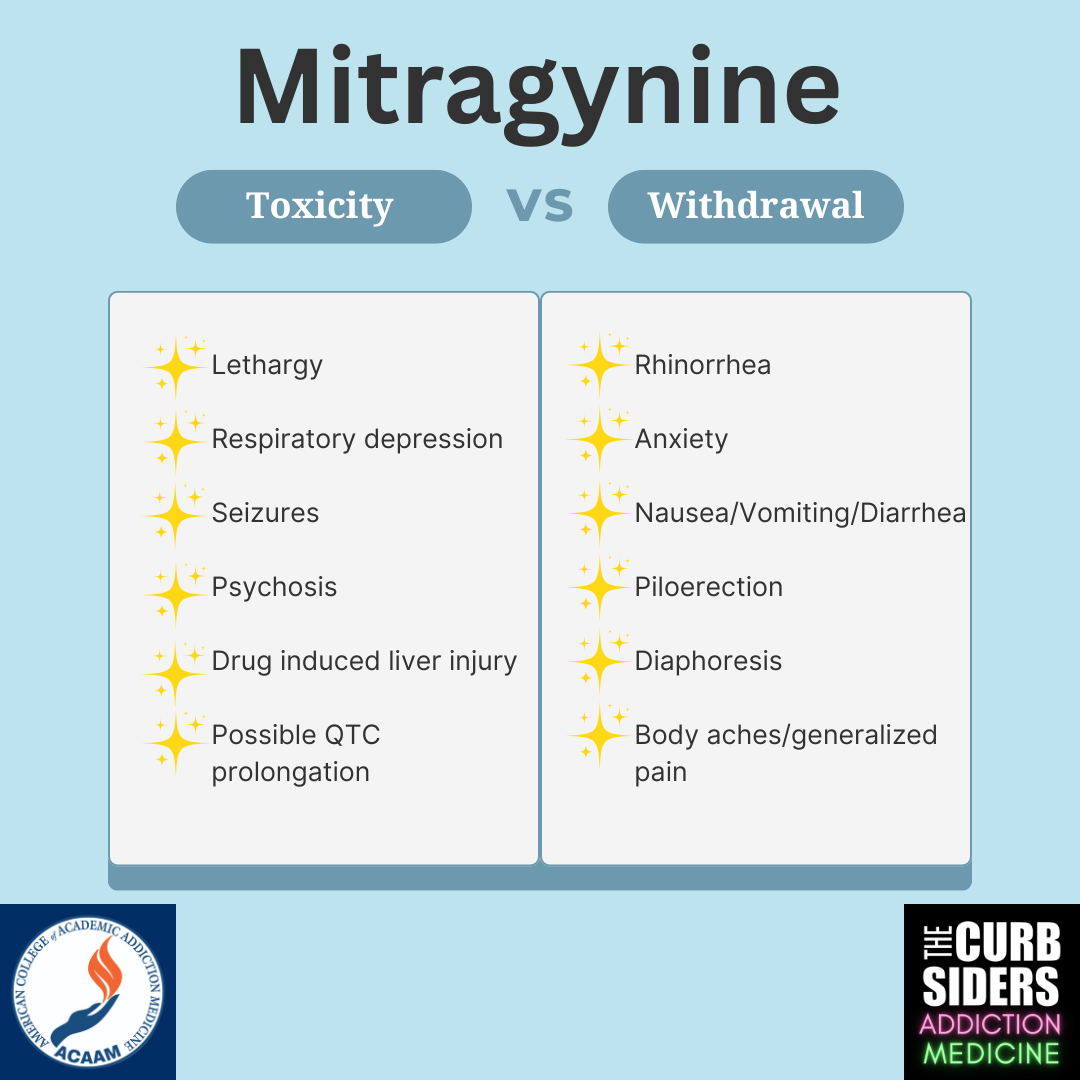
Just as with opioids, kratom and other mitragynine-based products can lead to physical dependence and withdrawal. These symptoms present similarly to traditional opioid withdrawal, and use of opioid withdrawal scores such as the Clinical Opiate Withdrawal Scale (COWS) and the Subjective Opiate Withdrawal Scale (SOWS) remains relevant to the management of acute withdrawal. Severity of withdrawal seems to be related to dose and frequency of use, as with other opioids (Rogers 2024). Withdrawal in the outpatient setting can be managed much like withdrawal from other opioids, with opioid agonists such as buprenorphine (Wightman 2025) and other comfort medications such as clonidine, ondansetron, loperamide, etc. In the inpatient setting, other opioid agonists, such as methadone and other short-acting opioid agonists, can also be used to manage acute withdrawal symptoms (Hendler 2026) (Curbsiders #498). Buprenorphine, methadone, and clonidine have all been shown to mitigate mitragynine withdrawal symptoms in rats (Hassan 2021).
Managing kratom use disorder
While there are no randomized controlled trials to answer the question of how we manage kratom use disorder, there are case reports and case series describing the management of kratom/mitragynine use disorders with buprenorphine (Hendler 2026)(Arhin 2023)(Broyan 2022) (Schmul 2020) and methadone (Sherrick 2026). The ability to manage kratom use disorder with methadone in an opioid treatment program may vary based on the patient’s SUD history, program, and state; long-term management with buprenorphine products is more common – in one survey of experts, 89.5% reported using buprenorphine (Stancu 2021).
Various strategies for initiation of buprenorphine for patients with kratom use disorder have been described, including more “standard” buprenorphine initiations (Schmul 2020) (Broyan 2022) (Lybik 2026) and low-dose initiations (Curbsiders Addiction Medicine #22) (Hendler 2026) (Fenske 2026). As with the initiation of buprenorphine for patients using high-potency synthetic opioids, there is theoretical concern for precipitated withdrawal, particularly with 7-OH and mitragynine pseudoindoxyl products due to the lipophilic nature of these products (Kong 2017).
In his expert opinion, Dr. Tanawan advises recommending to patients that they wait as long as possible (maybe as long as > 24 hours since last use) before starting buprenorphine initiation to mitigate any risk of precipitated withdrawal. Once patients are experiencing objective withdrawal symptoms, with increasing COWS/SOWS scores (COWS score of 8 or greater), Dr. Tanawan has patients initiate with 2-4 mg of buprenorphine, with instructions that they may continue taking additional 2- 4 mg doses as needed to manage withdrawal symptoms, a “standard” buprenorphine initiation (ASAM, 2020). On day 2, patients should plan to take the total buprenorphine taken on day 1 and may take an additional 2- 4 mg as needed to manage withdrawal, and likewise on day 3. We expect total buprenorphine doses to reach the total doses a patient will need for management by day 2-3. Expected ranges of total buprenorphine doses needed to manage withdrawal symptoms will vary from patient to patient, likely dependent on use patterns and potency of products used. Management doses described in case reports range from 8-32 mg total daily dose. Dr. Tanawan recommends frequent visits (telehealth or in person) at the start of therapy to adjust doses as needed. Additionally, he recommends comfort medications, such as clonidine and trazodone, to help mitigate the longer-term withdrawal symptoms from kratom. Also of note, there are some case reports of the use of long-acting injectable buprenorphine for the management of kratom use disorder (Swart 2024).
As with the management of other substance use disorders, the duration of therapy requires partnership with the patient and their own treatment goals. Dr. Tanawan discusses that, in his experience, many patients with kratom use disorder don’t necessarily identify with this, and so he finds, with more frequency, patients wanting to taper off buprenorphine relatively quickly.
Dr. Tanawan also recommends the use of behavioral interventions such as motivational interviewing to partner with patients and enhance the management of their kratom use disorder.
Managing acute overdose
Toxicity from kratom and other mitragynine-derived products is not clearly defined and is possible from a variety of the alkaloid’s receptor activities, including agonism at the mu-opioid receptor, causing opioid overdose-like toxicity, serotonergic activity, etc. (McCurdy 2024). Case reports of possible overdose death secondary to mitragynine have been described (Mata 2023). While the respiratory depression risk from mitragynine and mitragynine-derived products is theoretically lower than that of other molecules with mu-opioid receptor activity due to the lack of activation of the beta-arrestin pathway, it is still possible and has been described in animal models (McCurdy 2024). There are also case reports of naloxone, a mu-opioid receptor antagonist, being used to reverse mitragynine toxicity (Overbeek 2019).
Links
- SAMHSA treatment locator (website)
Goal
Listeners will expand their understanding of substances and investigate what Kratom and 7-OH are and how to care for folks who are using them
Learning objectives
After listening to this episode listeners will…
- Describe the pharmacology of mitragynine-derived compounds, including the differences in potency and receptor activity between kratom leaf, 7-hydroxymitragynine (7-OH), and newer semi-synthetic derivatives such as mitragynine pseudoindoxyl (MP).
- Distinguish kratom disorder from other substance use disorders
- Develop a buprenorphine initiation plan for a patient presenting with kratom/7-OH withdrawal.
Disclosures
Dr. Jonathan Tanawan reports no relevant financial disclosures. The Curbsiders report no relevant financial disclosures.
Citation
Huxley-Reicher Z, Tanawan J, Sonada K, Chan CA “#513 What’s the tea on Kratom?” The Curbsiders Addiction Medicine Podcast.https://thecurbsiders.com/addiction July 20th, 2026.
Episode Sponsors
Freed
Go to freed.ai and use code FREED50 for fifty dollars off your first month.
FIGS
Curbsiders listeners can get 15% off. Just go to WearFIGS.com and use code FIGSRX.
Continuing Education Company
Visit CMEmeeting.org/curbsiders and use promo code Curb30 for 30% off all online courses and webcasts.
Episode Credits
Written and Produced, with Show Notes, Infographic, and Cover Art by Zina Huxley-Reicher, MD
Hosts: Carolyn Chan, MD. MHS and Zina Huxley-Reicher, MD
Reviewer: Kento Sonoda, MD, MPH
Showrunner: Carolyn Chan, MD, MHS
Technical Production: PodPaste
Guest: Jonathan Tanawan, MD
CME Partner

The Curbsiders are partnering with VCU Health Continuing Education to offer continuing education credits for physicians and other healthcare professionals. Visit curbsiders.vcuhealth.org and search for this episode to claim credit.
Contact Us
Got feedback? Suggest an Addiction Medicine topic. Recommend a guest. Tell us what you think.
We love hearing from you.
Join our Patreon!

Yes, you can now join our exclusive community of core faculty at Kashlak Memorial Hospital along with all the perks:
- Bundle & Save with the top CME tier!
- All episodes Ad-Free, including the entire back catalog!
- Twice-monthly bonus episodes: Ask me Anything (AMA) with Matt & Paul, Recaps, and more!
- Access to Kashlak's Discord Server!
- Advance Notice of Curbsiders Events!
- Exclusive Curbsiders' Merch!
