

Audio
Video
Transcript available via YouTube
Get confident supporting your patients with infertility in primary care! We cover who needs a workup, how to evaluate both partners, and when to refer—plus tips on coding, counseling, and emotional support. Reproductive endocrinologist Dr. Brindha Bavan shares practical insights to empower PCPs on the front lines of fertility care.
Claim CME for this episode at curbsiders.vcuhealth.org!
Patreon | Episodes | Subscribe | Spotify | YouTube | Newsletter | Contact | Swag! | CME
Show Segments
- Intro
- Case from Kashlak
- Definitions of infertility
- Male factor infertility evaluation
- History
- Semen analysis
- lifestyle
- Female factor infertility evaluation
- Anatomical approach
- Basic testing
- More advanced testing
- Unexplained infertility treatment
- Success of infertility treatments
- Financial impact/advocacy
- Oocyte preservation
- Outro
Disclosures
Dr. Brindha Bavan reports no relevant financial disclosures. The Curbsiders report no relevant financial disclosures.
Infertility Pearls
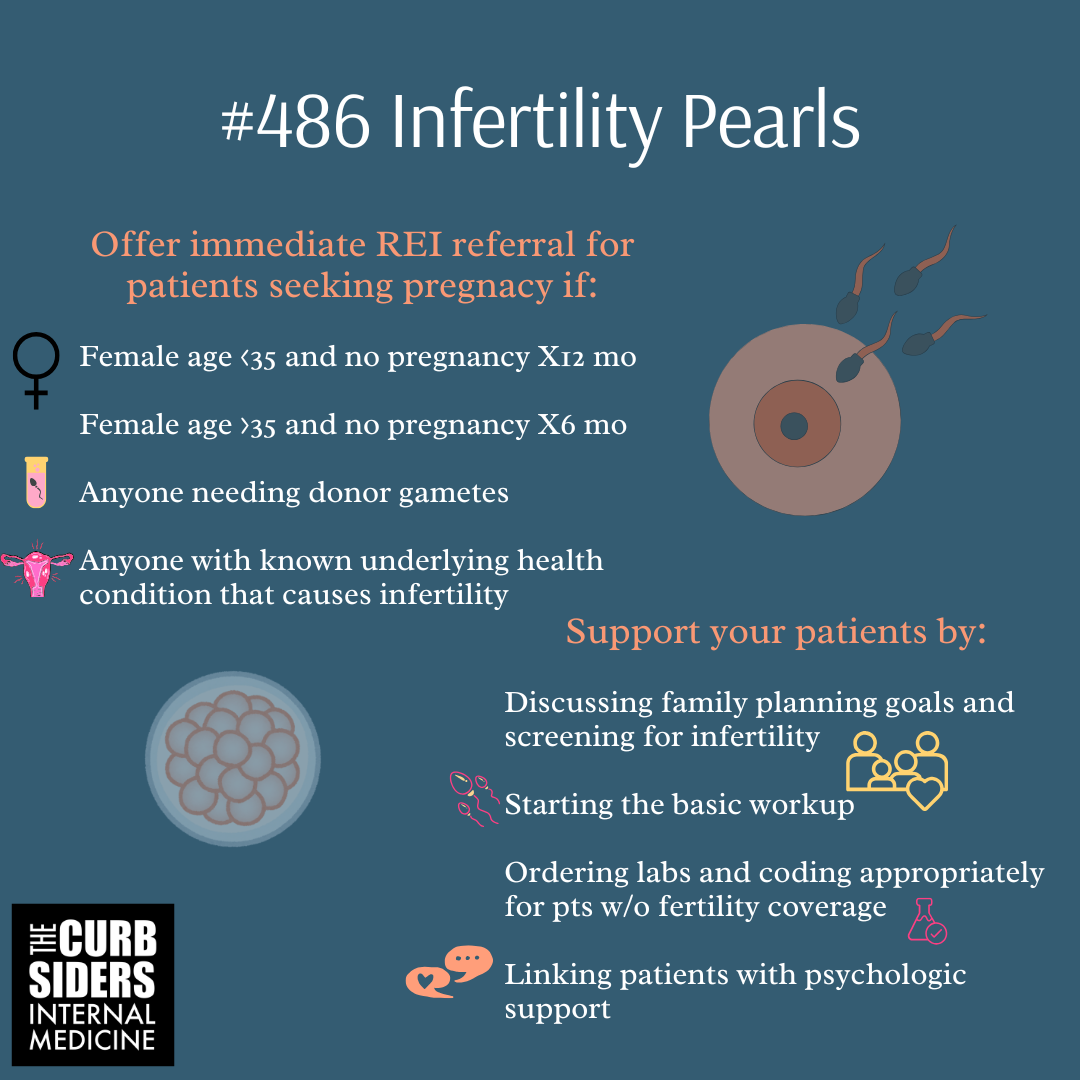
- The definition of infertility is not just the traditional one of 12 or more months of unprotected heterosexual intercourse without achieving pregnancy in women under age 35 or for 6 or more months in a woman age 35 or older. PCPs should be aware that patients who have underlying medical conditions that impact fertility (PCOS, endometriosis, sexual dysfunction) should not be held to these timelines and should get sooner evaluation. And patients who require donor gametes/embryos also qualify as having infertility sooner.
- PCPs can help our patients and our colleagues in reproductive endocrinology and infertility (REI) by talking early with patients about their family planning goals and beginning basic workups
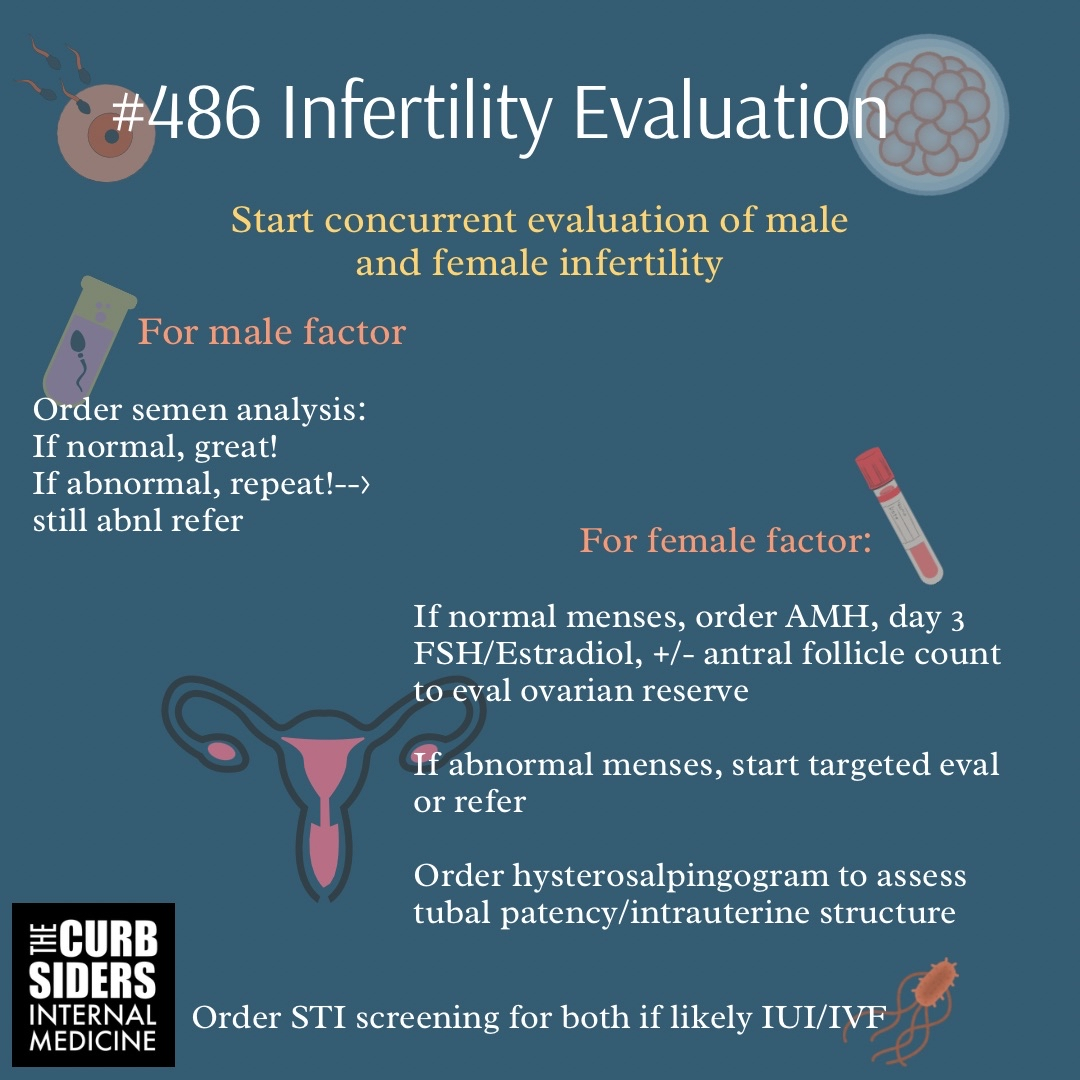
- Order male infertility evaluations (semen analysis, if everything is within the normal range, you’re ok) and female infertility evaluation (AMH, day 3 FSH/estradiol, hysterosalpingogram) concurrently to assess for cause of infertility.
- The infertility journey can be a financially and emotionally challenging time for our patients- be there to support their mental health as PCP and be aware that many labs may be covered by insurance if you order them with non-fertility related codes but may need to be paid out of pocket if the fertility specialist orders them (depending on insurance coverage)
Definitions:
American Society of Reproductive Medicine 2023 statement expanded the definition of infertility to include all of the following:
- The classic 12 or more months of unprotected heterosexual intercourse without achieving pregnancy in women under age 35 or for 6 or more months in a woman over age 35.
- Patients with a known underlying medical condition that may reduce fertility should be offered more immediate evaluation and should not be held to this timeline. This includes any underlying conditions including anovulatory/oligoovulatory conditions like PCOS or mosaic turner’s syndrome and sexual dysfunction conditions such as vaginismus or ejaculatory dysfunction.
- Anyone with the need for donor gametes or embryos also meet criteria for infertility, to encourage that everyone, no matter their sexual orientation background or their partnership status, is allowed help with assisted reproductive technologies to build their families
Infertility is common (1 in 6 to 1 in 8 couples) (Nugent 2024) and can feel very isolating and emotional for people experiencing it.
Evaluation of Infertility
Disclaimer: while our case is a cis-gender couple and we use “male” and “female” infertility in this discussion, we want to recognize that nonbinary or trans patients may also present with infertility
Male factor:
Male factor infertility is a cause for infertility about one third of the time, but it’s important to appreciate that infertility in a couple can be multifactorial (Santoro 2025).
History
Explore medications (including testosterone), chronic medical conditions, history of surgeries, and sexual function. Dr Bavan stressed the importance of building trust and asking explicit questions to gain more information: “I know these are sensitive and intimate questions, but it’s really important for me to understand how best to help you, what percent of the time do you think you’re able to deposit sperm in the vagina”. Premature ejaculation, erectile dysfunction, and difficulty with penetrative sex for other reasons can limit fertility.
Testing
- Screen for sexually transmitted infections (STIs) (legally required if planning for reproductive technologies that insert the sperm into someone else) and offer preconception genetic screening.
- Semen analysis after 2-5 days of abstinence.
- Volume ≥ 1.5 mls is normal
- Concentration ≥15 million sperm per ml
- Motility ≥32% moving (Dr Bavan cites >35-40% as her ideal).
- Morphology under a high powered field, ≥4% normal appearance. (Björndahl 2022)
- Total motile sperm count (TMSC) = total volume X concentration X % motility, Dr Bavan cites ideally 20-40 million for successful pregnancy with intercourse (assuming no female contribution to infertility); 5 million moving sperm for intrauterine insemination (IUI); if <5 million, moving directly to in vitro fertilization (IVF) or intracytoplasmic sperm injection (ICSI) (Schlegel 2020)
If the semen analysis is abnormal, repeat the test as there is sperm variability. Sperm take about 3 months to fully turn over, so while it may be ideal to repeat that long out, Dr Bavan highlights that it can be a long time for couples who are actively seeking pregnancy, so she rechecks sooner, after 2-4 weeks.
If the volume comes back low, Dr Bavan suggests asking explicitly if it was a complete sample, saying, “it can be a new thing to collect sperm in a cup and it’s okay that if you missed or it was hard or it didn’t all make it in” as this can help you interpret if the low volume is a real finding.
If persistently abnormal results, refer the patient to urology or reproductive endocrinology to further evaluate. They can evaluate further with a detailed physical exam, imaging, additional labs, and/or more detailed testing of sperm quality, for example DNA fragmentation or oxidative stress testing, is appropriate.
Typically tested by a urologist or REI, the next step for evaluation of oligospermia is:
- <10 million moving sperm (TMSC): evaluate for hormonal causes with follicle stimulating hormone (FSH) and testosterone (AUA), with possible additional labs including luteinizing hormone (LH), thyroid stimulating hormone (TSH), and prolactin (Dr Bavan’s expert opinion).
- < 5 million moving sperm, specialists will typically add genetic testing such as karyotype, Y chromosome microdeletion, and/or cystic fibrosis (CF) testing (Schlegel 2021)
Lifestyle measures:
Dr Bavan cites one of her colleagues, Dr Eisenberg, a Stanford Reproductive Urologist, who suggests men consider zinc, magnesium, co-enzyme q10, and a multivitamin to improve sperm quality (Buhling 2019, Salas-Huertos 2018).
Lifestyle measures are important- avoid excessive alcohol, tobacco, drugs, prolonged heat exposure (occasional sauna/jacuzzi use is fine, but Dr Bavan discouraged regular use).
We don’t have good long term safety data for the increasingly popular glucagon-like peptide- 1 medications (GLP-1s) but some early data suggests that improving metabolic health can improve sperm quality (Jensterle 2019). Dr Bavan reports that her center feels it is safe for sperm providers to continue on these medications, but they encourage women to stop two months prior to attempted conception, though the data is currently lacking in this area.
Female infertility:
Optimize overall metabolic health, manage chronic medical problems, and encourage healthy lifestyle.
Anatomical Framework to Female Infertility
Use an anatomical framework to consider possible contributing factors:
- Vagina: Is the patient experiencing vaginismus? Might they have vaginal agenesis or septum (typically with primary amenorrhea).
- Cervix: is there cervical stenosis, a history of cervical procedures?
- Uterus: any structural findings that could contribute like fibroids, polyps, Asherman’s or adhesive scar tissue, a septum or bicornuate uterus
- Fallopian tubes: any blockage due to scar tissue (prior complicated pelvic/abdominal infections, ruptured appendectomy, pelvic inflammatory disease, endometriosis, prior surgeries)?
- Ovary: is there regular ovulation and what is the quality of the egg? Consider impact of age, smoking or cocaine use, endometriosis, etc.
Testing for Female Infertility (basic testing in patients with overall normal menses)
AMH (Anti Mullerian Hormone) is released by pre-antral follicles; the higher the level, the larger the egg pool. AMH can have assay variability, so testing at different labs is not directly convertible (ie don’t worry if the test at your lab is lower than the test at another lab last year, look at the normal ranges). AMH can be tested any time in the cycle.
- Very low levels can suggest menopause but important to consider full clinical picture (check our our prior episode on menopause to dive deeper)
- Mildly low levels do NOT impact the chance of natural pregnancy (Harris 2023). Dr Bavan tells her patients, “whether you have a small pool or a big pool of eggs, you’re still releasing one egg a month on average or per cycle, so it kind of equates the playing field.”
- Low AMH/smaller pool can impact success of REI treatments like stimulating for oocyte harvesting/ IVF cycle, so can impact an REI specialist’s approach to choosing treatment approaches.
Follicle stimulating hormone (FSH) and estradiol on day 3 of the menstrual cycle.
- First day of full flow bleeding of the period is cycle day 1; check these labs around day 2-4. FSH stimulates the ovary to develop an egg. When the egg starts growing, it makes estrogen which feeds back on the FSH.
- Ideal for fertility is a low/normal FSH and estradiol because higher levels suggest the ovaries are not as responsive to signaling/there is some ovarian aging. Quite high FSH levels can suggest (peri)menopause. (Phillips 2023)
Antral follicle count: assessed by transvaginal ultrasound.
- Every cycle new eggs are moving into maturity, and these narrow down to typically one ready to ovulate monthly.
- Average is 5-10 antral follicles (oocytes getting closer to maturity) per ovary in reproductive age women- a lower count suggests there may be a smaller pool of healthy eggs (Santoro 2025). More than 20 on each side can be consistent with polycystic ovarian syndrome (PCOS)- check out our prior episode on PCOS if you want to dive deeper.
- Dr Bavan highlights that sometimes radiology does not comment on this during a routine pelvic ultrasound, but REI specialists can evaluate this with an in-office ultrasound. Antral follicle count is ideally checked on cycle day 2-5, but Dr Bavan highlights access can impact this- she often will just scan if the patient is present in the office accepting the limitation that if there is a large dominant follicle this can limit visualization of other follicles (and so would need to repeat the measurement earlier in a future cycle)
Testing for tubal patency (can be helpful to order before REI appointment):
Hysterosalpingogram (HSG) is a radiologic exam using contrast fluoroscopy to evaluate inner uterus and patency of fallopian tubes which is a standard part of a female infertility evaluation (Santoro 2025). This study involves a speculum exam and a catheter injection of contrast through the cervix, which can trigger a lot of uterine cramping during the test and sometimes later that day. Dr Bavan highlights that this can vary significantly patient to patient, in general nulliparous patients tend to find it more uncomfortable. So prepare patients on what to expect, recommending taking acetaminophen 1gm and ibuprofen 600-800mg 30 minutes prior to the test if no contraindications (Unlu 2015). Ideally, the HSG is performed on cycle day 6-10.
More advanced testing in patients with irregular menstrual cycles (can be deferred to the specialists)
- Evaluate for PCOS: Rotterdam criteria states if a patient has two out of the following three they meet criteria: irregular cycles, clinical or lab evidence of hyperandrogenism, or polycystic ovaries on imaging (Teede 2023).
- Evaluate for nonclassic congenital adrenal hyperplasia: testing for elevated 17-hydroxyprogesterone (17-OHP) (Unfer 2025)
- Rule out adrenal tumors (DHEAS, testosterone) (Rowe 2023)
- Evaluate for the luteal out of phase (LOOP) events: around perimenopause, follicles may start getting recruited later in the menstrual cycle causing a secondary estradiol peak which starts to overlap into the next cycle leading to anovulatory short cycles (Hale 2009)
Unexplained infertility:
About ⅓ of couples are diagnosed with unexplained infertility- all the workup above is normal. Dr Bavan reminds us that this can elicit a range of emotion- reassuring to know there is nothing overtly wrong but sometimes also frustrating to not find a cause.
Infertility Treatment, using unexplained infertility as an example:
Treatment of infertility needs to be directed at the underlying issue, and there is a lot of personal variability in this care. Just to give PCPs an example of a treatment protocol, we review the treatment of unexplained infertility.
Typically first line treatment is superovulation with letrozole (aromatase inhibitor) or clomifene (selective estrogen receptor modulator) which change how the ovaries respond to FSH. This can be paired with an hCG (human chorionic gonadotropin) trigger shot to time ovulation and insert sperm at the cervix at this time (intrauterine insemination or IUI) (Phillips 2023, Santoro 2025).
Dr Bavan highlights there is some nuance here, and it may be appropriate for some of these couples to head straight to in vitro fertilization (IVF) depending on their age and longer term fertility goals- ie a 35 year old who wants 3 children may benefit from banking eggs or embryos now and going the IVF route to have the banked eggs/embryos available in her 40s.
Efficacy of Infertility Treatment
Peak fertility for women is in their early 20s, at which time there is approximately a 25% chance of pregnancy per menstrual cycle. In early 30s this has reduced to 20%, by mid-30s this is reduced to 15%, and by a woman’s late 30s/early 40s there is an average 10% chance of pregnancy per cycle (Practice Committee 2021). Dr Bavan shares that, while it certainly varies significantly with age, if someone has been trying for pregnancy for 6-12 months without success, they may expect a 5% chance of pregnancy per cycle in the future.
Numbers differ depending on underlying characteristics and age of the patient, but Dr Bavan cites IUI has success rates around 8-15% per cycle with cumulative benefits of repeated cycles at first, but after 6 cycles the chance of successful pregnancy has plateaued. IVF is also quite age dependent, but maybe a 30% chance of pregnancy per cycle. With decreasing ovarian reserve/increasing age these numbers drop (Santoro 2025).
Financial Impact of Infertility/How PCPs can Support their Patients
Around 70% of women who undergo IVF go into debt. Insurance coverage can vary widely. From the PCP, ordering some of these tests and coding with a medical diagnosis separate from infertility can help get labs ordered. For example, coding as labs or imaging related to PCOS or fibroids may be covered by insurance when infertility care is not covered (Phillips 2023).
PCPs should feel comfortable screening for infertility and discussing family planning with patients- this can help connect them with resources and treatments sooner.
PCPs should be aware of the co-incidence of anxiety and depression in patients undergoing infertility care and can help plug patients in with supports around this.
Fertility preservation/Oocyte or embryo preservation:
Dr Bavan recommends asking big picture questions: How many children would you like to have? What’s your timeline and what’s the situation in which you’d like to have those children? Do you feel very strongly about having genetically related children?
Early to mid-30s is a good age for women to consider fertility preservation if they are wanting children and not in a place to start this now. For younger women, in their mid-20s, it may be premature to consider this as they have time to sort out (Cascante 2023).
For PCPs ordering lab evaluation in preparation for this, typically testing would be screening for infectious diseases (hepatitis B, hepatitis C, syphilis, HIV, gonorrhea, chlamydia) and possibly cycle day 3 FSH and estradiol to assess ovarian reserve.
Goal
Listeners will develop a framework to approaching infertility in the primary care office.
Learning objectives
After listening to this episode listeners will be able to…
- Describe elements of a focused history of a patient experiencing infertility.
- List common causes of infertility and first steps for evaluation.
- Counsel patients on when they would benefit from specialist fertility care and what to expect during the process.
Citation
Heublein M, Brindha B, Kryzhanovskaya K, Williams PN, Watto MF. “#486 Infertility in Clinical Practice: A Primary Care Approach”. The Curbsiders Internal Medicine Podcast. thecurbsiders.com/category/curbsiders-podcast. June 9, 2025.
Episode Sponsors
Grammarly
Download Grammarly for free at Grammarly.com/PODCAST.
FIGS
We’ve teamed up with FIGS, and now Curbsiders listeners can get 15% off. Just go to wearFIGS.com and use code FIGSRX.
Panacea Financial
Learn more at PanaceaFinancial.com.
Episode Credits
Producer, Writer, Show notes, Cover Art, Infographics: Molly Heublein MD
Hosts: Molly Heublein MD, Era Kryzhanovskaya MD
Reviewer: Emi Okamoto MD
Showrunners: Matthew Watto MD, FACP; Paul Williams MD, FACP
Technical Production: PodPaste
Guest: Brindha Bavan MD
CME Partner

The Curbsiders are partnering with VCU Health Continuing Education to offer continuing education credits for physicians and other healthcare professionals. Visit curbsiders.vcuhealth.org and search for this episode to claim credit.
Contact Us
Got feedback? Suggest a Curbsiders topic. Recommend a guest. Tell us what you think.
We love hearing from you.
Join our Patreon!

Yes, you can now join our exclusive community of core faculty at Kashlak Memorial Hospital along with all the perks:
- Bundle & Save with the top CME tier!
- All episodes Ad-Free, including the entire back catalog!
- Twice-monthly bonus episodes: Ask me Anything (AMA) with Matt & Paul, Recaps, and more!
- Access to Kashlak's Discord Server!
- Advance Notice of Curbsiders Events!
- Exclusive Curbsiders' Merch!
