
Audio
Video
Transcript available via YouTube
Cardiovascular disease caused by hyperlipidemia is the leading cause of death worldwide, but it doesn’t have to be! We have the tools to treat this widespread problem. Dr. Daniel Edmundowicz (Temple University) takes us through how to keep lipids where they should be, low.
Claim CME for this episode at curbsiders.vcuhealth.org!
Patreon | Episodes | Subscribe | Spotify | YouTube | Newsletter | Contact | Swag! | CME
Show Segments
- Intro
- Case
- Topic
- Rapid fire questions/Picks of the Week
- Outro
Disclosures
Dr. Edmundwicz reports no relevant financial disclosures. The Curbsiders report no relevant financial disclosures.
CME Partner: VCU Health CE

The Curbsiders are partnering with VCU Health Continuing Education to offer continuing education credits for physicians and other healthcare professionals. Visit curbsiders.vcuhealth.org and search for this episode to claim credit.
Lipid Management Pearls
- Managing lipids properly would prevent many deaths from the leading cause of mortality.
- The cornerstone of assessing risk to guide the initiation of lipid lowering therapy is the PREVENT risk algorithm, which predicts the risk for incident cardiovascular disease in adults 30 to 79 years of age.
- There is a clear asymmetric risk when you weigh the substantial harm of a cardiovascular event against the exceedingly minimal risk of starting a statin therapy that you can always stop.
- To accurately assess cardiovascular risk in women, you need to think of the obstetrical history as a cardiovascular history. Preeclampsia, gestational hypertension/diabetes, premature delivery, and premature menopause are all cardiovascular risk enhancers.
- A “normal” lipid panel should not be reassuring; “normal” means that they are average compared to a population that dies overwhelmingly from atherosclerotic vascular disease.
- CAC score ≥ 100, indicating subclinical atherosclerosis, should prompt consideration of treatment with statin therapy.
- In patients unable to reach treatment goals on statin monotherapy, combination therapy that hits a different mechanism of action can have a synergistic effect.
- You should consider testing for familial hypercholesterolemia (FH) if a patient’s LDL-C ≥ 160 mg/dL without an identified secondary cause.
Lipid Management
Why you should care about lipids
Coronary artery disease caused by atherosclerosis is THE leading cause of death worldwide (Global burden of Disease 2023). And, elevated low-density lipoprotein concentration is unequivocally the cause of atherosclerosis (Ference et al 2017). Many premature deaths are likely preventable by lifestyle and medication interventions (INTERHEART study). That means that we have the tools to prevent a substantial portion of the deaths from the leading cause of mortality (McKinley et al 2021). In short, you should care about managing lipids because, to quote Dr. Edmundowicz quoting Willie Sutton, “that’s where the [mortality modifying] money is.”
Stratifying Risk to Guide Treatment
Broadly speaking, risk stratification is done to establish the likelihood of an adverse event to balance that negative outcome against the inherent risk of a preventative intervention. The cornerstone of assessing risk to guide the initiating lipid lowering therapy (LLT) is the PREVENT risk algorithm, which predicts the risk for incident cardiovascular disease in adults 30 to 79 years of age without known ASCVD (Khan et al 2023).
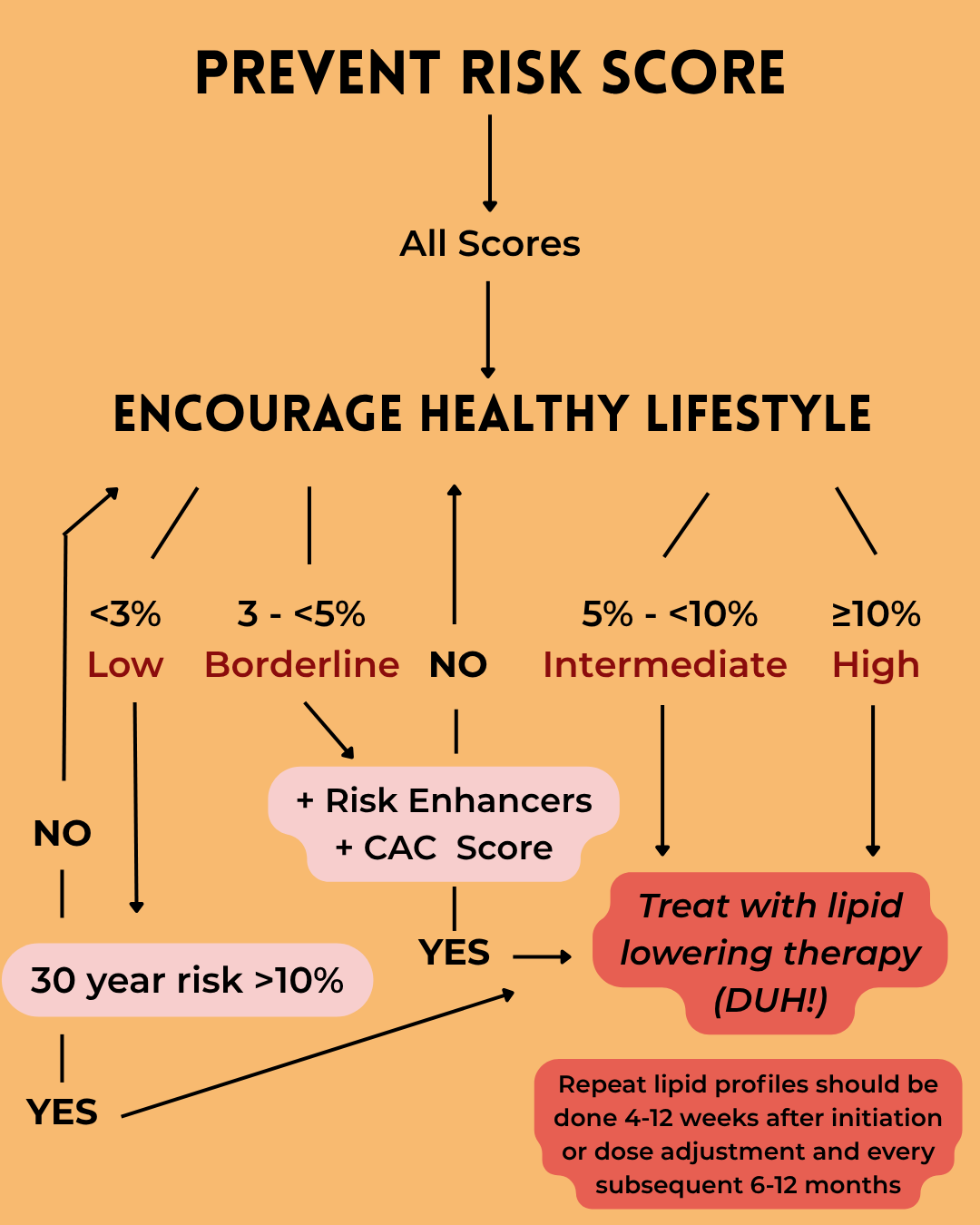
The approach to lipid management is based on the patient’s 10-year risk score broken down as follows: low <3%, borderline (3-<8%), intermediate (5%-<10%), or high risk ≥ 10%. NB: interventions to lower lipids are extremely safe; the risk of exercise is low (please wear a helmet while biking) and statins are one of the safest medications available. The net benefit threshold to start statins is very low (3% risk cut off!) (CTT collaborators 2012). There is a clear asymmetric risk when you weigh the substantial harm of a cardiovascular event against the exceedingly minimal risk of starting a statin therapy that you can always stop. The earlier that you start modifying lipids with statins the more time you have to push back the course of disease.
It is a no-brainer to start a statin for individuals with intermediate and high risk (COR 1) (Blumenthal et al, 2026). But, it is important to think about risk beyond the 10-year risk score. If your patient has a low (<3%) 10-y risk but a high (>10%) 30-y risk, treatment with a moderate intensity statin is reasonable (COR 2a). For patients with borderline risk, the decision to start a statin should be based on risk enhancers like premature ASCVD in a first degree relative (<55yo men or <65yo in women), chronic inflammatory disease, elevated Lp(a) (> 125 nmol/L or > 50 mg/mL), or reproductive risk markers (preeclampsia, gestational diabetes, gestational hypertension, premature delivery, and early menopause). To accurately assess cardiovascular risk in women, you need to think of the obstetrical history as a cardiovascular history. Patients who also carry a diagnosis of HIV, T2DM (≥ 30 yo), or CKD stage 3 or higher should also receive lipid lowering therapy regardless of their PREVENT-ASCVD score (COR 1).
It is hard to convince patients to fix something that they do not perceive as broken. To help frame the cardiovascular disease, Paul Nelson Williams, America’s Primary Care Doctor™, pulls up any non-contrast CT with the heart included to show patients the calcium in their coronaries, providing a visual touch point to understand their risk. It turns out that this technique is supported by research and was shown to increase adherence (Kalia et al 2012). Furthermore, Dr. Edmundowicz reminds us that a “normal” lipid panel should not be reassuring; “normal” means that they are average compared to a population that dies overwhelmingly from atherosclerotic vascular disease.
Lp(a) and ApoB
All adults should get their Lp(a) tested at least once in their lifetime (COR 1), as it can identify those at higher risk of ASCVD and indicate the need for more intensified LDL and risk factor management (Blumenthal et al, 2026). ApoB is a surface protein marking all plaque-causing lipoproteins, and measuring its concentration provides a reliable marker of ASCVD risk (Marston et al 2021). ApoB can predict residual risk in statin treated patients (Johannesen et al 2021), and its concentration should be used in patients with elevated triglycerides already on lipid lowering therapy to guide further intensification once lipid goals are achieved (COR 2a).
Assessment of Subclinical Coronary Atherosclerosis AKA Coronary Artery Calcium Scoring AKA CAC
The coronary artery calcium (CAC) score uses the presence of calcium in the arteries as a surrogate for atherosclerosis, and a non-zero CAC score indicates the presence of atherosclerosis (Greenland and Lloyd-Jones 2021). CAC imaging can be useful in individuals with intermediate risk or select individuals with borderline risk where the decision to initiate therapy is uncertain (COR 1), and is generally used for men ≥ 40 years old or women ≥ 45. For these patients, lipid-lowering treatment is recommended if CAC > 0, and particularly if CAC ≥ 100 AU or ≥75th percentile (COR 1). Additionally, patients with a noncardiac CT with incidental finding of coronary artery calcification should be considered in treatment decisions. There are now clear recommendations for patients (men ≥ 40 or women ≥ 45) with subclinical coronary atherosclerosis identified in imaging: a CAC score ≥ 100 should prompt treatment with statin therapy (COR 1), and any incidental finding of coronary artery calcification on a noncardiac CT can also prompt treatment (COR 2a).
Dr. Edmundowicz reminds us that a CAC = 0 in young individuals is not reassuring, it is expected, but a zero calcium score in an 70yo would make him stop talking about lipids–that is if Dr. E is constitutionally able to stop talking about lipids. CAC score can be repeated in 3-7 y after a zero calcium score (COR 2a). There is no utility in repeating the calcium score once it is positive. In fact, aggressive treatment of lipids actually increases the calcium score because the plaque gets more dense as the cholesterol leaches out (Xian et al 2021).
Interesting aside: The Healthy Women Study, a long longitudinal study of older women, found that postmenopausal elevation of cholesterol had no predictive value on CAC, but premenopausal LDL did (Matthews et al 2007).
Treatment goals
Now that we have established that everyone should be on lipid lowering therapy (LLT)–maybe we should just add them to the water, trace amounts have already been found in Chicago’s water supply–the question shifts to what therapy to prescribe to our patients. Statins are the cornerstone of LLT, and Dr. Edmundowitz likes to begin by reaching for rosuvastatin 5 mg and uptitrate from there due to rosuvastatin’s pharmacokinetic properties (Table 7 of Blumenthal et al, 2026).
Dr. Edmundowicz tends to be aggressive with his treatment numbers. The guidelines recommend a >50% LDL-C reduction in patients with (higher) intermediate and high risk (COR 1), and refer to upper limit targets in Figure 1 below (Blumenthal et al, 2026). They technically do not recommend number/percentage to keep the LDL-C above. LDL at birth is ~30 mg/dL (Bogsrud et al 2025) indicating that we don’t need a lot in our blood. Interestingly, fibroblasts downregulate LDL receptors when their milieu is around 30 mg/dL of LDL cholesterol (Brown et al 1975). Or per Dr. Edmundowicz’s commentary “Just get everyone’s LDL-C to 30 mg/dL, you’ll be fine” (!! Is he joking? Maybe? Yes? No?) (Karagiannis et al 2026).
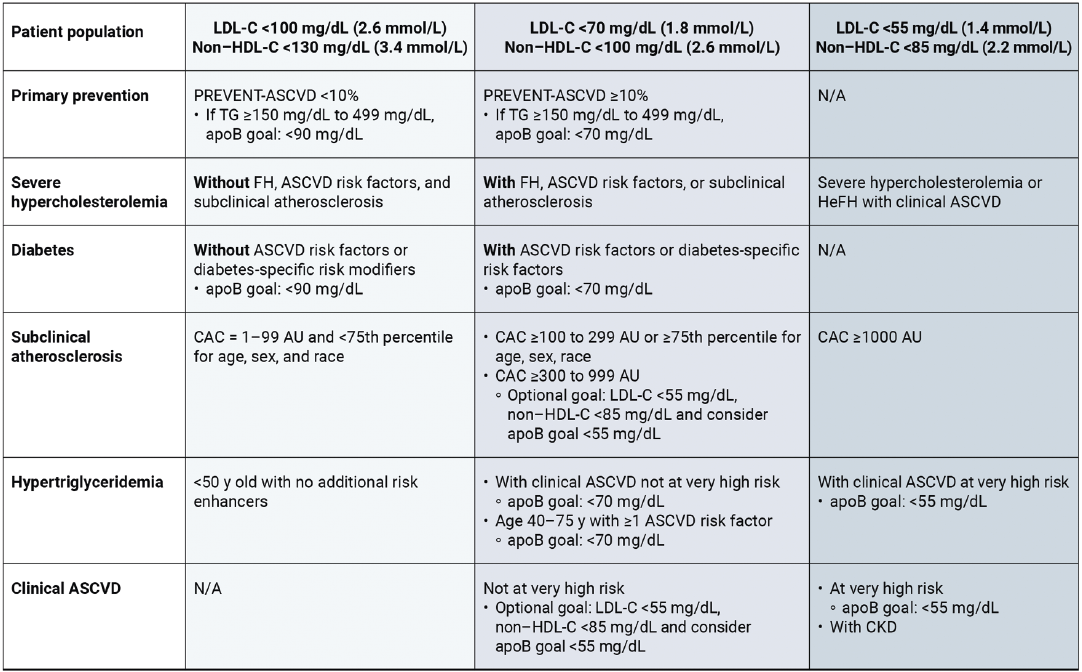
Figure 1: Lipoprotein Goals for ASCVD Risk Reduction. Source: 2026 Guideline on the Management of Dyslipidemia (Blumenthal et al, 2026)
In patients with statin intolerance, the guidelines recommend ruling out secondary causes, ensuring that it is not a severe myopathy, and a benefit-risk discussion about continuing statin therapy (COR 1). The way that Dr. Edmundowicz navigates this in practice is to stop the statin for a week while keeping a symptom journal. If the symptoms go away, start the same statin at the same dose. You could also pick a different statin or do alternate day statin therapy–it is even possible to manage some patients on twice weekly statin with daily ezetimibe. Although not in the guidelines, there is data to suggest that co-enzyme Q supplementation (400 mg BID) can be helpful to mitigate myalgia in patients with statin intolerance (Ahmad et al 2024). In patients unable to reach treatment goals, combination therapy that hits a different mechanism of action can have a synergistic effect, ex: ezetimibe 10 mg and rosuvastatin 5 mg. In clinical practice, patients sometimes do not want to take multiple medications, but Dr. E finds that if you explain that you are minimizing side effects and maximizing their benefits patients are more open to the “pill sandwich.”
Additional statin alternatives/adjuncts beyond ezetimibe include bempedoic acid that inhibits ATP citrate lyase in the liver, a metabolic step upstream of statins’ metabolic target. However, Dr. Edmundowicz has had less luck with its tolerability. PCSK9 inhibitor monoclonal antibodies (alirocumab and evolocumab) are very effective and should be considered in most patients not at their LDL-C goal. There are also gut acting agents (cholestyramine, colesevelam, and colestipol) that impede bile acid reabsorption. Last, but not least is inclisiran, a twice a year injection that is a small interfering RNA inhibiting PCSK9. It is essentially a vaccine against atherosclerosis! We are still eagerly awaiting outcomes data for inclisiran, because just what we need is another study to show us that lowering cholesterol saves lives (or another two studies VICTORION-1 PREVENT and VICTORION-2 PREVENT.)
Familial hypercholesterolaemia
The phenotype of familial hypercholesterolemia (FH) is variable, and it affects many patients with refractory hypercholesterolemia (Nordestgaard et al 2013). You should consider testing for familial hypercholesterolemia (FH) if a patient’s LDL-C ≥ 160 mg/dL (COR 2b) or LDL-C ≥ 190 mg/dL (COR 2a) without an identified secondary cause. While knowing the exact mutation does not currently guide treatment, it is recommended to perform panel-based genetic testing to definitively identify individuals at higher risk of cardiovascular events and to facilitate appropriate testing for relatives (COR 1). These patients need to be counseled to not even think about cigarettes. There used to be a hesitancy to treat children, but now the guidelines include FDA approved treatments for children as young as 5yo (evinacumab) and 8yo (pitavastatin, pravastatin, rosuvastatin). There is now a COR1 recommendation to prescribe LLT to children ≥ 8yo suspected of having FH with an LDL-C ≥ 160 mg/dL who do not respond sufficiency to lifestyle modifications in 3-6 months.
Links
2026 ACC/AHA/AACVPR/ABC/ACPM/ADA/AGS/APhA/ASPC/NLA/PCNA Guideline on the Management of Dyslipidemia (Blumenthal et al, 2026)
Goal
Listeners will familiarize themselves with the new lipid management guidelines to provide evidence based, risk lowering, life saving treatments to their patients
Learning objectives
After listening to this episode listeners will…
- Develop an approach to discussing the risk and treatment of dyslipidemia
- Recognize the factors that increase cardiovascular risk and prompt lipid lowering therapy in patients with borderline PREVENT-CVD scores
- Familiarize themselves with the tools available to treat dyslipidemia
Citation
Gorth DJ, Edmundowicz D, Williams PN, Watto MF. “#541 A Walk Through the 2026 Lipid Management Guidelines”. The Curbsiders Internal Medicine Podcast. thecurbsiders.com/category/curbsiders-podcast October 5, 2026.
Episode Sponsors
Babbel
Go to Babbel.com/CURB for up to 60% off.
Mint Mobile
Get premium wireless plan for just $15/month at mintmobile.com/CURB.
Locumstory
Locumstory.com is literally just a free, unbiased resource dedicated to educating physicians about locums
FIGS
Get 15% off your first order at wearfigs.com with the code FIGSRX.
Episode Credits
Written and Produced by: Deborah Gorth MD, PhD
Infographic and Cover Art by: Deborah Gorth MD, PhD and Meryl Gorth RD, MPH
Hosts: Matthew Watto MD, FACP; Paul Williams MD, FACP
Reviewer: Emi Okamoto MD
Showrunners: Matthew Watto MD, FACP; Paul Williams MD, FACP
Technical Production: PodPaste
Guest: Daniel Edmundowicz MD, MBA, FACP, FACC
CME Partner

The Curbsiders are partnering with VCU Health Continuing Education to offer continuing education credits for physicians and other healthcare professionals. Visit curbsiders.vcuhealth.org and search for this episode to claim credit.
Contact Us
Got feedback? Suggest a Curbsiders topic. Recommend a guest. Tell us what you think.
We love hearing from you.
Join our Patreon!

Yes, you can now join our exclusive community of core faculty at Kashlak Memorial Hospital along with all the perks:
- Bundle & Save with the top CME tier!
- All episodes Ad-Free, including the entire back catalog!
- Twice-monthly bonus episodes: Ask me Anything (AMA) with Matt & Paul, Recaps, and more!
- Access to Kashlak's Discord Server!
- Advance Notice of Curbsiders Events!
- Exclusive Curbsiders' Merch!

Comments
ISN'T BORDERLINE RISK OF PREVENT CALCULATOR 3- <5% ? INSTEAD OF 3- <8% AS STATED IN YOUR SUMMARY. ALSO I WAS TRYING TO DOWNLOAD YOUR SUMMARY BUT I CAN'T FIND THE BUTTON TO DO SO. THANKS ANYWAYS VERY HELPFUL OVERALL AND EDUCATIONAL NICE REVIEW