

Audio
Video
Transcript available via YouTube
Dream big, teach smarter! In this episode, Dr. Noriko Anderson breaks down how to turn educational dreams into reality using clear goals and purposeful objectives. Learn how frameworks like Bloom’s Taxonomy and Miller’s Pyramid can bring structure, clarity, and joy to your curriculum development process.
Claim CME for this episode at curbsiders.vcuhealth.org!
Website | Instagram | Twitter | Subscribe | Patreon | CME!| Youtube
Meet our Guest:
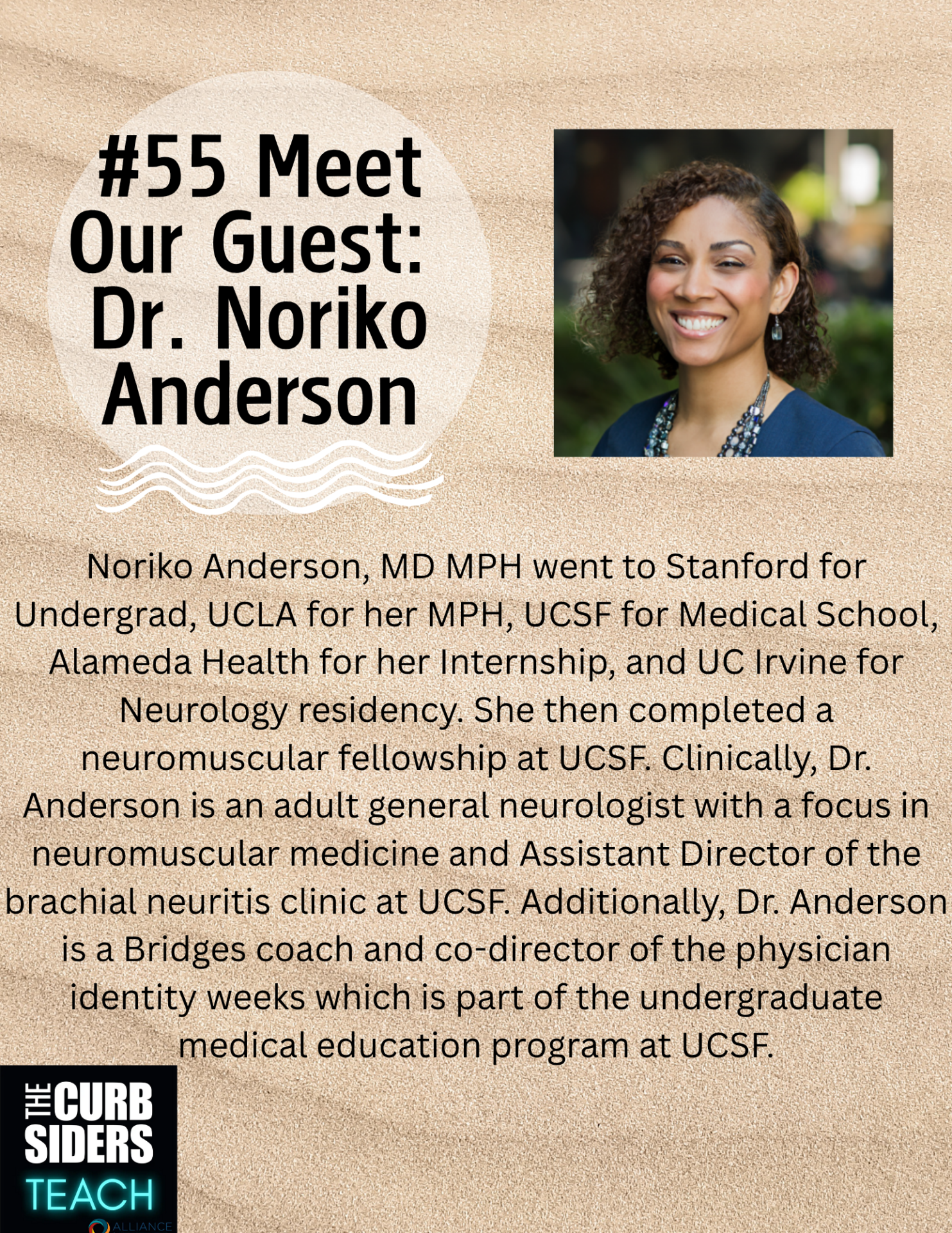
Noriko Anderson, MD MPH went to Stanford for Undergrad, UCLA for her MPH, UCSF for Medical School, Alameda Health for her Internship, and UC Irvine for Neurology residency. She then completed a neuromuscular fellowship at UCSF. Clinically, Dr. Anderson is an adult general neurologist with a focus in neuromuscular medicine and Assistant Director of the brachial neuritis clinic at UCSF. Additionally, Dr. Anderson is a Bridges coach and co-director of the physician identity weeks which is part of the undergraduate medical education program at UCSF.

Show Segments
- Intro, disclaimer, guest bio, guest recommendations and favorite failure
- Picks of the week
- Case #1 from Kashlak Memorial Hospital
- Creating goals and objectives
- Bloom’s taxonomy
- Types of objectives
- Miller’s Pyramid
- Case #2 from Kashlak Memorial Hospital
- Talk with others and ask for help
- Take-home points
- Outro
Goals and Objectives Pearls
- Goals are your dreams for the most perfect educational session, and objectives are the steps needed to take to achieve your dream.
- Robust goals and objectives are essential for providing clarity to the learner and for evaluating success of a teaching session.
- Bloom’s taxonomy and Miller’s pyramid are frameworks that can be used to help craft effective goals and objectives.

Goals and Objectives Show Notes
Basic Definitions
Goals and objectives are the backbone of curriculum development. Goals are your dreams for the end result that takes place in the perfect world where learners get an end product or result based on the material that was taught. The objectives are the stairs that help you get to your goal. Objectives are more tangible, specific, measurable, and achievable (Schneiderhan 2019).
Goals and objectives help the educator evaluate effectiveness of their teaching session.
Goals
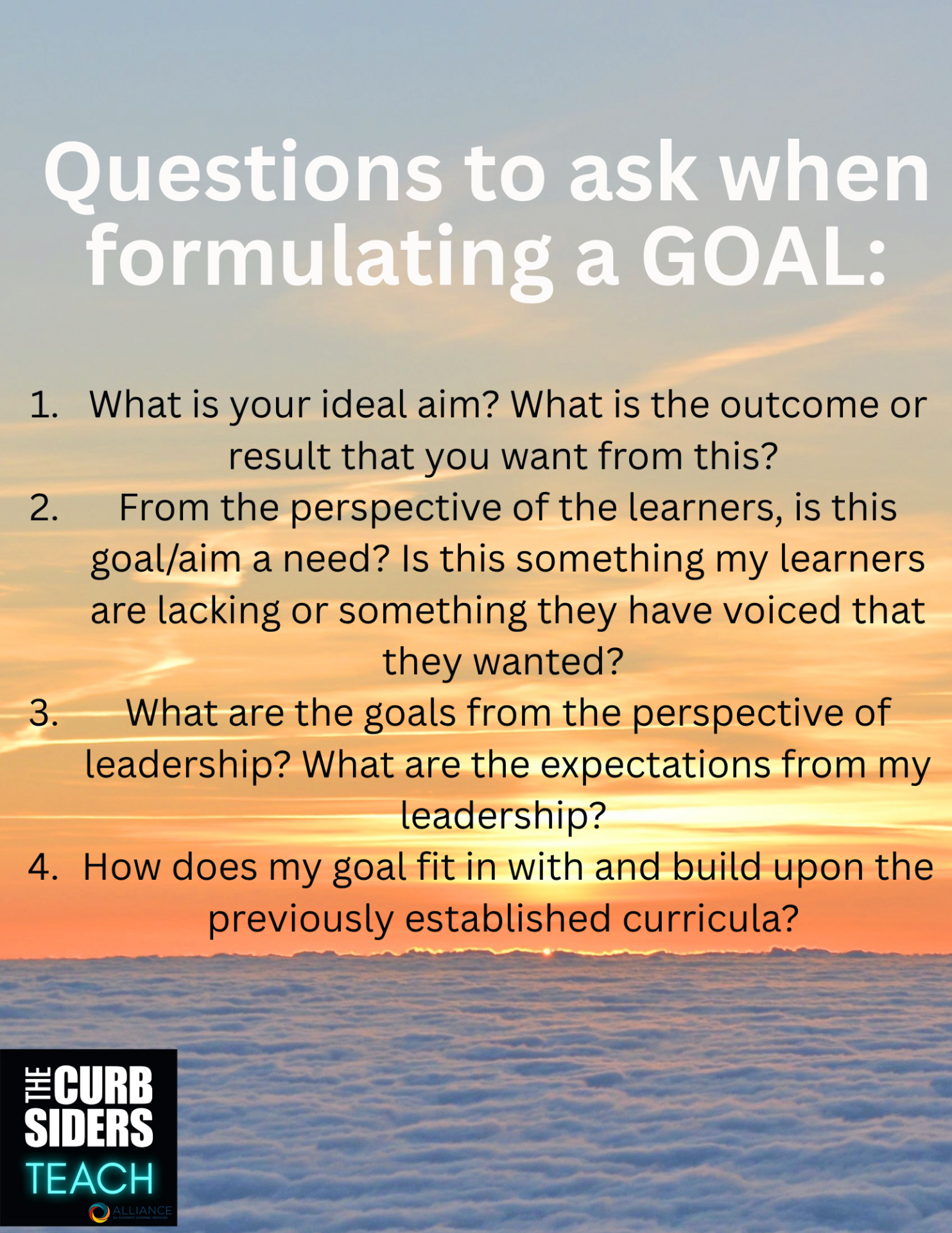
Questions to ask when formulating a goal:
- What is your ideal aim? What is the outcome or result that you want from this?
- From the perspective of the learners, is this goal/aim a need? Is this something my learners are lacking or something they have voiced that they wanted?
- What are the goals from the perspective of leadership? What are the expectations from my leadership?
- How does my goal fit in with and build upon the previously established curricula?
Or more broadly:
- Why is this topic important? What is helpful about it? Why is it helpful for other learners to know about it?
- What would make the teaching sessions successful?
- How does this topic fit in with the rest of the curriculum that learners have access to?
The goal is the beginning and the ending of the educational experience and the pathway between that includes the objectives.
Learning Objectives
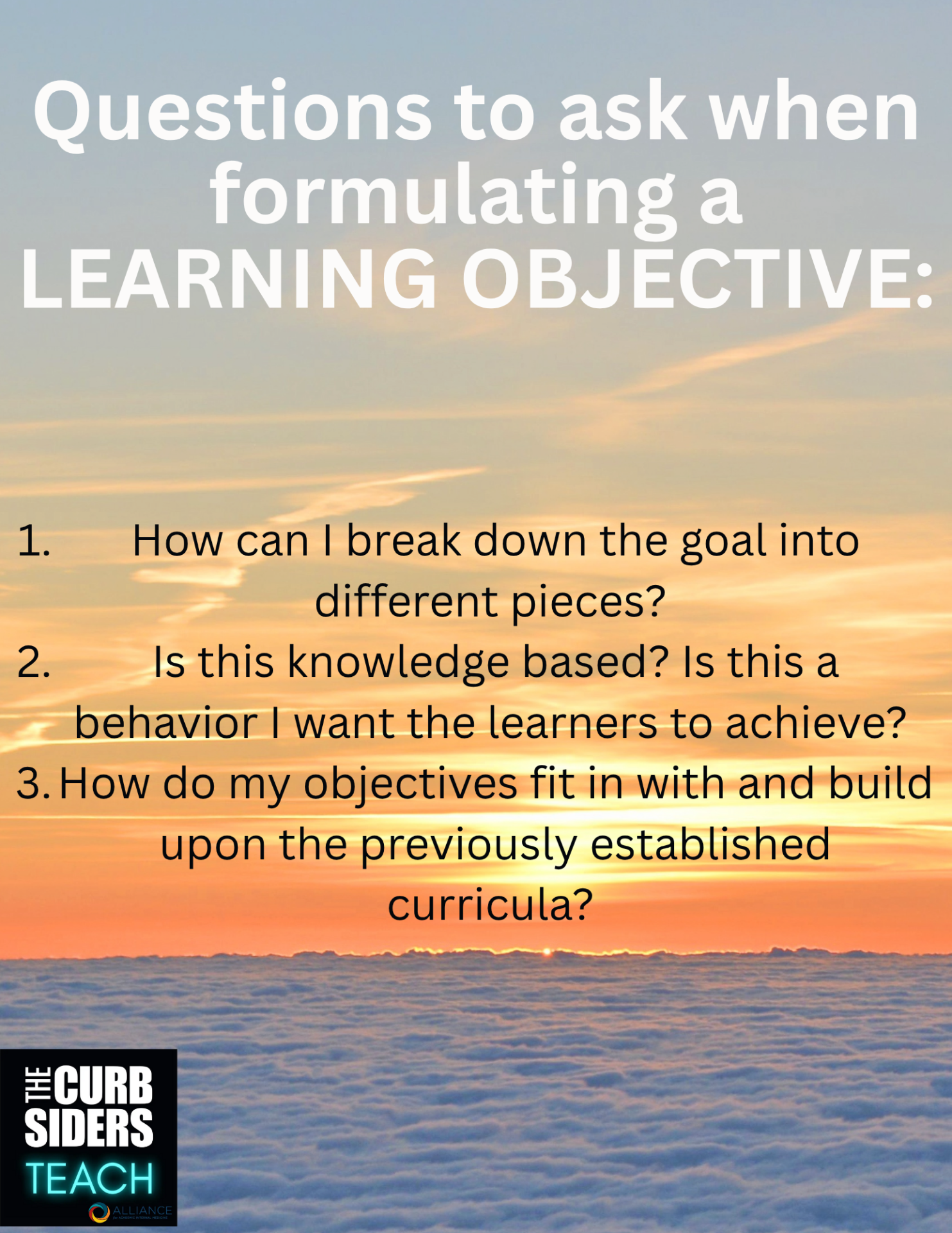
Questions to ask when formulating learning objectives:
- How can I break down the goal into different pieces?
- Is this knowledge based? Is this a behavior I want the learners to achieve?
- How do my objectives fit in with and build upon the previously established curricula?
How to choose an objective:
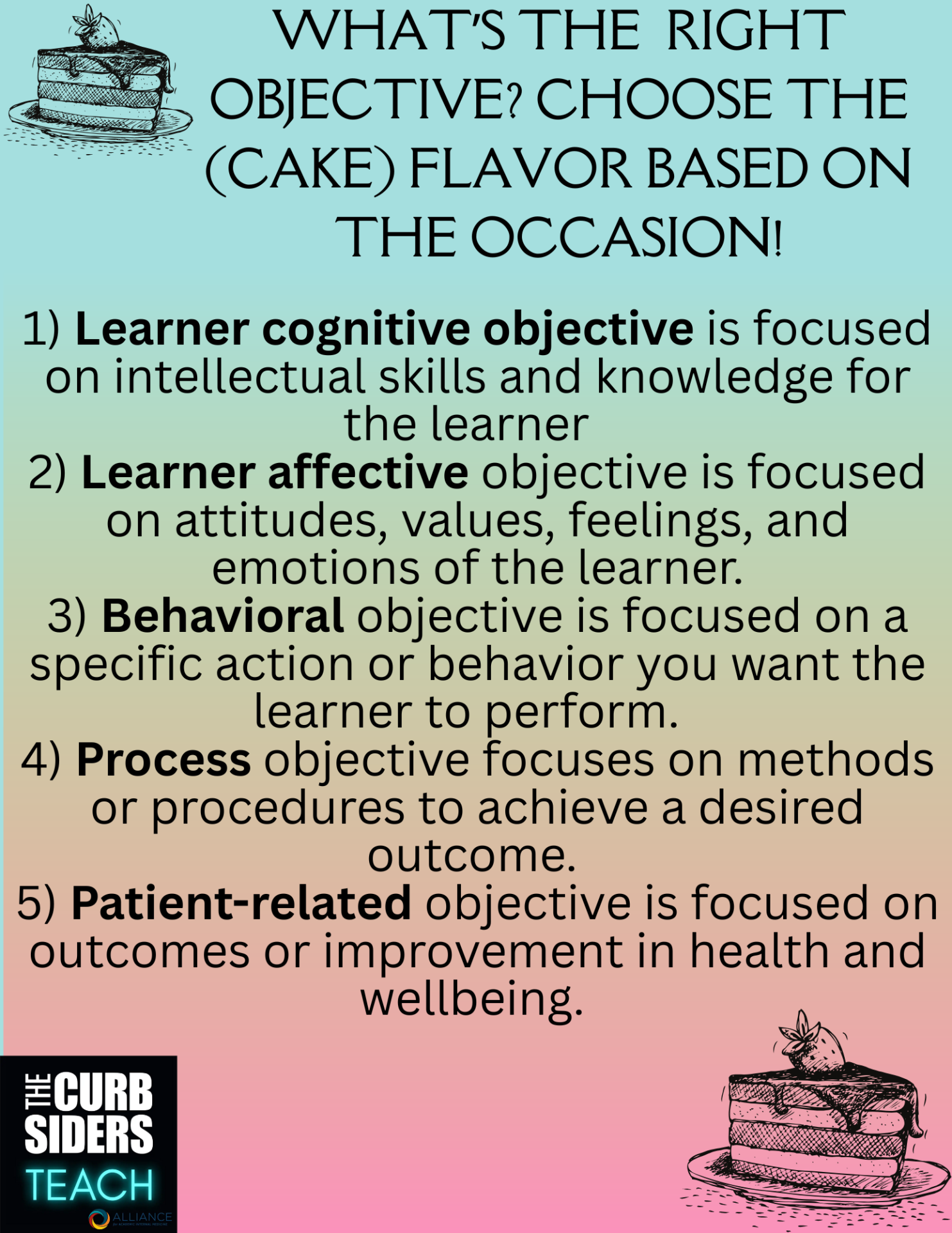
Choosing the right objective for any identified need is like choosing the right cake flavor for an occasion or dessert to complement a meal.
- Learner cognitive objective is focused on intellectual skills and knowledge for the learner. For example, understanding the pathophysiology of diabetes mellitus.
- Learner affective objective is focused on attitudes, values, feelings, and emotions of the learner. For example, developing a compassionate attitude towards patients with chronic pain.
- Behavioral objective is focused on a specific action or behavior you want the learner to perform. For example, performing an effective cardiac examination.
- Process objective focuses on methods or procedures to achieve a desired outcome. For example, implementing a surgical checklist for surgical safety.
- Patient-related objective is focused on outcomes or improvement in health and wellbeing. For example, improving patient adherence to a medication regimen (Orr 2022).
How learners use objectives
Learners use objectives to gain clarity in terms of the purpose of presented material, what they are supposed to take away from the material, and to measure progress.
Bloom’s Taxonomy
A hierarchical model or pyramid that categorizes goals and objectives by ever more complex stages of material acquisition. Bloom’s provides a common language and framework to use when crafting goals and objectives. Bloom’s starts off very basic with objectives such as remembering material and builds to understanding then applying, analyzing, evaluating, and creating. Bloom’s provides educators a way to frame their objectives in terms of where they fit along the pyramid of knowledge acquisition (Adams 2015).
Miller’s Pyramid
A framework for evaluating students’ competencies at different stages of learning, specifically in healthcare settings. Ranges from learning knowledge i.e. what the student knows to what the student shows and then does. Similar to the see one, do one, and teach one framework or the RIME (reporter, interpreter, manager, and educator) framework. These frameworks help categorize stages of development which you can use to guide your goals and objectives.
Utilize Bloom’s taxonomy or Miller’s pyramid to help refine the goals and objectives of your educational session(s). Looking at previously published curricula such as a literature search can be helpful in refining the goals and objectives of an educational session.
Talk with others and ask for help
Discuss your educational session with other individuals who are doing educational scholarship to gain perspective about your work as well as pearls and insights. Talking to someone who specifically focuses on assessment is helpful to understand how you will measure the success of your educational session(s).
Take home points
Goals and objectives are fun to create and are the backbone of creating organized, methodical, and intentional curriculum development. Utilize frameworks such as Bloom’s Taxonomy and Miller’s Pyramid to help craft your goals and objectives.
Links
- Dr. Anderson’s book recommendation: Fourth Wing (The Empyrean, I) by Rebecca Yarros
- Era’s pick of the week Hymn of Healing by Beautiful Chorus heard first from a meditation by Chelsea Jackson Roberts via Peloton app.
- Molly’s pick of the week: All Fours by Miranda July
Goal
Listeners will learn the basics to developing effective goals and objectives for their curriculum development.
Learning objectives
After listening to this episode listeners will be able to …
- Compare and contrast goals and objectives for curriculum development
- Develop effective goals and objectives for educational sessions
- How to improve previously existing goals and objectives
Disclosures
Dr. Anderson has no relevant financial disclosures. The Curbsiders TEACH report no relevant financial disclosures.
Citation
Kryzhanovskaya E, Heublein M, Anderson N, Dickerson K, Chaiklin C. “#55 Making your (Education) Dreams Come True with Goals and Objectives”. The Curbsiders Teach Podcast. https://thecurbsiders.com/teach. July 16, 2025.
Episode Credits
Producer, Script, Cover Art, CME: Era Kryzhanovskaya MD
Show notes, CME: Era Kryzhanovskaya MD, Charlotte Chaiklin MD
Hosts, Editors: Era Kryzhanovskaya MD, Molly Heublein MD
Technical Support: Podpaste
Peer Reviewer: Keith Scott Dickerson, MD, MS-BME
Guests: Noriko Anderson, MD
Technical support: Podpaste
Theme Music: MorsyMusic
CME Partner

The Curbsiders are partnering with VCU Health Continuing Education to offer continuing education credits for physicians and other healthcare professionals. Visit curbsiders.vcuhealth.org and search for this episode to claim credit.
Contact Us
Got feedback? Suggest a Teach topic. Recommend a guest. Tell us what you think.
We love hearing from you.
Join our Patreon!

Yes, you can now join our exclusive community of core faculty at Kashlak Memorial Hospital along with all the perks:
- Bundle & Save with the top CME tier!
- All episodes Ad-Free, including the entire back catalog!
- Twice-monthly bonus episodes: Ask me Anything (AMA) with Matt & Paul, Recaps, and more!
- Access to Kashlak's Discord Server!
- Advance Notice of Curbsiders Events!
- Exclusive Curbsiders' Merch!
