

Audio
Video
Transcript available via YouTube
Join us as Dr. Erica Johnson, Program Director at Johns Hopkins Bayview Medical Center, shares her experiences and best practices for recruitment and retention of a diverse medical workforce. Following the residency’s mission to reflect and serve the broader community guided her to build a residency program that stresses the importance of understanding the history of Baltimore and building trust within that community. You’ll hear tips to help diverse trainees thrive in a “training program and be inspired to reflect on how to improve recruitment and retention practices in medical education.
Website | Instagram | Twitter | Subscribe | Patreon | CME!| Youtube
thecurbsidersteach@gmail.com
Meet our Guest:
Dr. Erica Johnson is an Associate Professor of Medicine in the Division of Infectious Diseases at Johns Hopkins University School of Medicine. She currently serves as Program Director for the Internal Medicine Residency at Johns Hopkins Bayview Medical Center and Associate Vice Chair for Diversity, Equity and Inclusion in Medical Education for the Johns Hopkins Department of Medicine. She remains clinically active in general infectious diseases, HIV medicine and internal medicine. Her medical education scholarship includes professional identity formation, diversity and inclusion, and teaching about structural competency. Dr. Johnson recently became the new Senior Vice President for Academic and Medical Affairs at the American Board of Internal Medicine (ABIM)

Supported in Partnership with Alliance for Academic Internal Medicine

Show Segments
- Intro, disclaimer
- 01:08 Guest bio
- 02:10 Getting to Know Dr. Erica Johnson
- 05:50 Picks of the Week
- 08:23 Case from Kashlak
- 09:50 Recruitment to Reflect Community
- 12:40 Steward of the Mission: Dr. Johnson’s Approach to Recruitment at Bayview Hopkins
- 15:33 Defining Diversity
- 17:29 Opportunities for Improvement in Recruitment
- 21:05 Leadership team’s approach to highlighting mission and training setting
- 23:09 Resident Thriving
- 26:07 Individualized Mentorship
- 30:09 Holistic Review
- 32:45 Recruitment and Retention of Faculty
- 35:23 Importance and Examples of Pathway Programs
- 38:40 Selfless Service and Aligning Work with Mission
- 40:20 Importance of Program Director Community
- 42:48 Take Home Points
- 44:29 Outro
Leveraging Mission to Recruit and Retain a Diverse Workforce Pearls
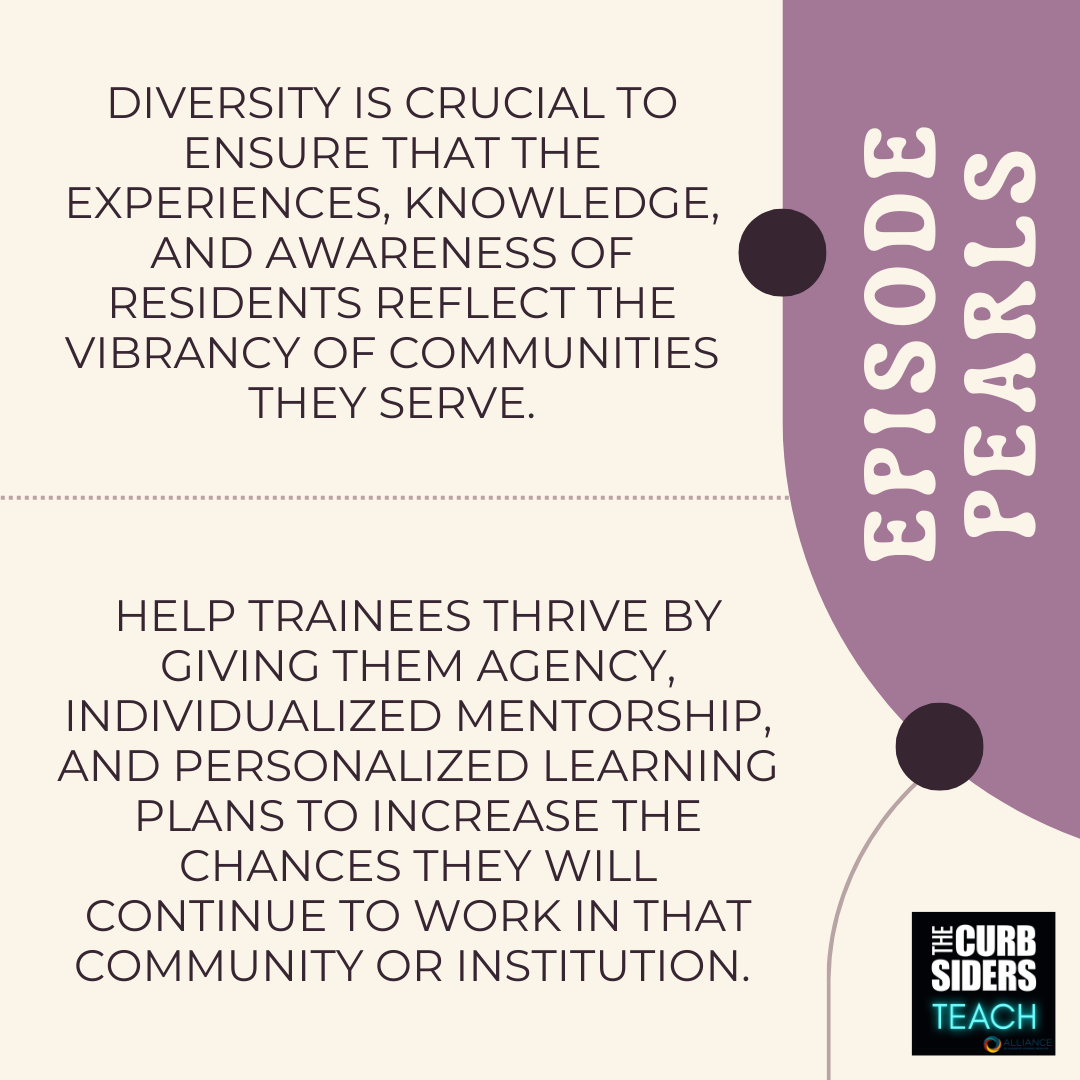
- Diversity within a residency program is crucial to ensure that the experiences, knowledge, and awareness of residents match the needs and vibrancy of the communities they serve.
- Ensure there is a connection between the program’s mission and who is invited for an interview and how the rank list is created.
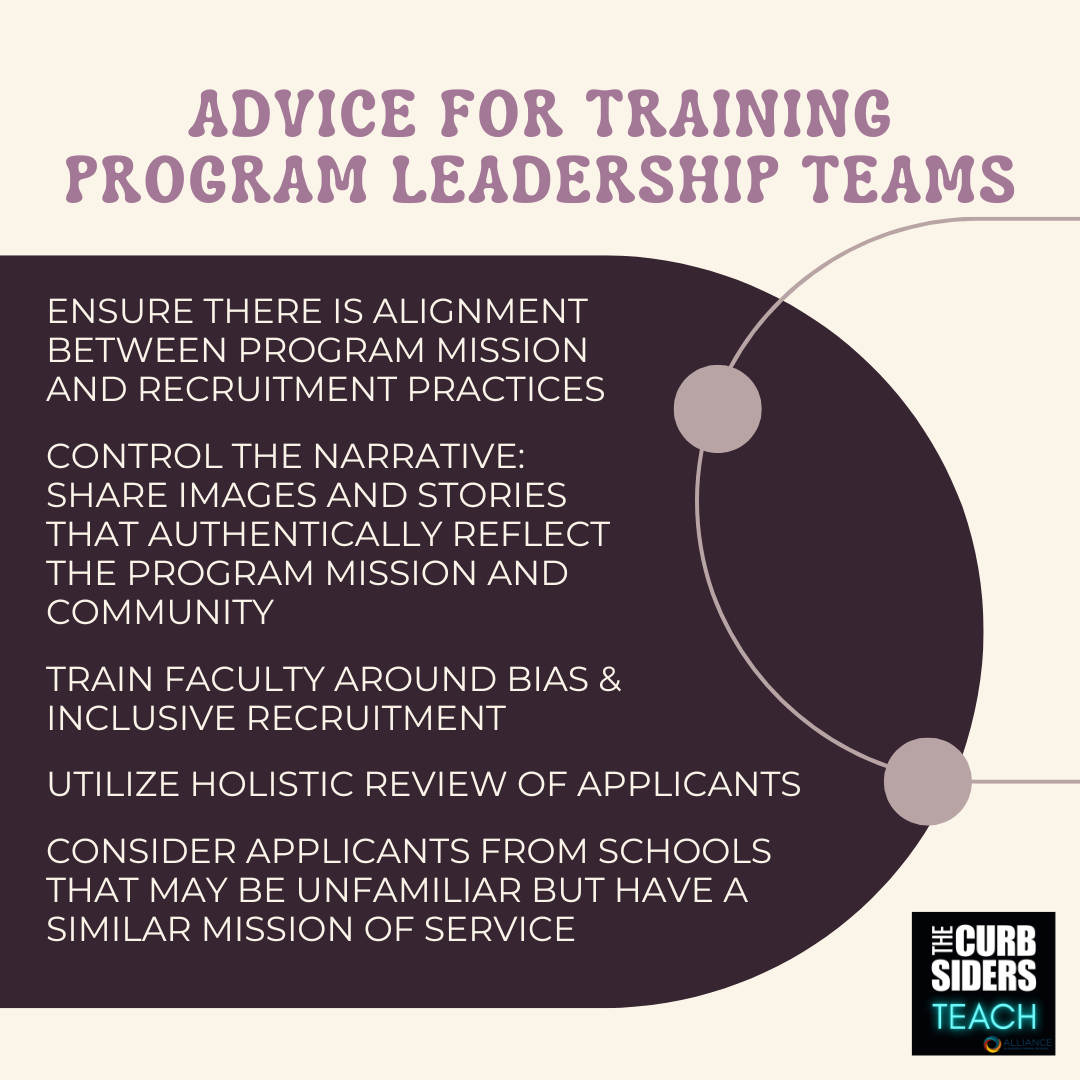
- Tips to reduce barriers to mission driven recruitment: PDs can control the images they show and stories that they tell about their program, train faculty around bias, use holistic review of applications, and explore applicants from newer/less familiar medical schools that may have a similar mission.
- Giving trainees a sense of agency by allowing them to advance change and creating individualized mentorship and learning plans allows them to thrive and improves the chances they want to continue to work within the system after residency.
- Recruitment and retention of diverse faculty is essential and can be supported through mentorship teams, sponsorship, and structural support.

Leveraging Mission to Recruit and Retain a Diverse Workforce–Show Notes
Overall Approach to Recruitment: Are we Fulfilling the Program’s Mission to Recruit Trainees that Reflect and Serve the Community
Dr. Johnson shares that her approach to creating an inclusive training program started with the need for the residency program at Johns Hopkins Bayview to fulfill its mission: taking care of patients in the local community and ensuring that the scientific advances that were happening globally also benefited the local community equally. To fulfill that goal, Dr. Johnson and her team focused on representation within the residency program- ensuring that lived experiences of the trainees in their program matched the vibrancy of the people that they take care of in Baltimore. Johns Hopkins Bayview has a long storied history of taking care of communities in Baltimore as a safety net hospital. Dr Johnson leverages that mission of Bayview, a community-centered, relationship-centered place that historically took care of its own, to draw residents who want to train and practice in that setting.
Recruitment: How an Inclusive Residency Program Evolved at Bayview Hopkins
Addressing Structural Barriers in Recruitment
Dr. Johnson started the process of revamping their recruitment and residency admissions by looking at the policies, structure of recruitment, and some of the barriers that people experience differently within that process. As program director, she and her team had control over recruitment and retention, allowing them to focus on mission driven goals.
It can be a challenge for people applying to the program not to see other trainees, faculty, or program leaders who look like them. Dr Johnson highlights that PDs can control the images they show and stories that they tell about their program. Consider unconscious biases that can come into choices about the images that we show, the stories that we tell. Bayview IM residency framed narratives about their program and about living Baltimore with a focus on their mission of providing care for the local community.
The Bayview leadership team was influenced by Dr. Quinn Caper’s 2017 Academic Medicine paper which described his work on the admissions committee at Ohio State University School of Medicine (SoM). His committee members took the black-white Implicit Association Tests and considered their results during the interview process which led to the recruitment of the most diverse class at the Ohio SoM. Dr. Johnson at Bayview followed a similar method where all the members of their residency selection committee took implicit association tests. They then had conversations in safe spaces about the experience, and used that as an opportunity to bring forward vulnerabilities around unconscious biases and how biases can influence the selection and recruitment process. While they gained inspiration for improving the recruitment process from Dr. Capers’ paper, it was their enthusiasm for their city and the unique, mission-driven training experience at Bayview that made them want to make the recruitment more inclusive. Look at your program’s mission and ensure there is a connection between that mission and the program practices like who is invited for an interview and how the rank list is created. Dr. Johnson wanted to ensure that people who were selected to interview and ultimately ranked in the program would have that the mission resonate in the same way as it did with herself and her team.
For about a decade, Bayview has used holistic review for residency admissions (AAMC, Igarabuza 2024). The admissions team deeply reads what the applicants share. While it takes a long time, it allows them to get to know applicants, connect with those who are also mission-focused, and find the people who want to join them to continue the work they’re doing. Dr. Johnson highlights that there have been some updates to the residency application process (the ERAS system) in 2024, including sections of the application that allow applicants to highlight impactful life experiences or show that they connect with the mission of the program. Naming diversity as a priority, engaging in holistic review of applicants, implementing inclusive recruitment practices, and supporting trainees in the program not only are part of ACGME’s call to action for residencies (Gonzaga 2020), but also are all aspects of Dr. Johnson’s mission-driven approach to building a diverse workforce.
In her PD role, Dr. Johnson noted other potential structural barriers. Exploring newer, or less familiar medical schools from which they had previously taken few students, allowed Bayview to consider more students who had the same focus as their residency. They evaluated the mission of these schools and considered how it matched up with the mission of Bayview. This approach helped them identify great fit candidates from a medical school with less of a track record.
Defining Diversity
Dr Johnson highlights that when she joined as program director the residency program was already quite representative of their community, AND there’s always an opportunity to do more. They saw declining rates of applicants who were underrepresented in medicine who were applying. In response to this trend, Dr. Johnson and her team refocused on the program’s mission to showcase the incredible residency experience to trainees who would be more likely to stay on and care for the broader Baltimore community.
When Dr. Johnson and her team considered how to define diversity in their applicants, they used the AAMC’s specific definition of underrepresented in medicine, looking at students and trainees who are from groups within a specific region that may have lower representation within the field of medicine. They also interpreted that in the context of the city that they were in, as Baltimore city is a majority minority city. They considered the fact that diversity includes visible and invisible representations. It’s important to think about how a person’s lived experiences impact the type of physician or professional they become and how they contribute to the richness of the residency community.
In light of the 2023 Supreme Court decision ending race-conscious admissions/affirmative action, Dr. Johnson notes that the decision does not affect residency admissions as it is focused around university admissions. The residency hiring is employment, and is separate from university admissions. She does worry about the possibility of premature abandonment of effective diversity, equity, inclusion, and belonging initiatives that institutions have implemented in light of this ruling.
Steps for Community-Representative Training
Bayview IM residency wanted to make sure candidates understand Baltimore and what it means to live and train there. To accomplish this goal, they built a fun and interactive experience into their recruitment day. They took potential applicants on a bus tour of Baltimore while the leadership told the story of their lives in the city: what is it like to live in Baltimore? Who are the communities that we take care of? How do our residents partner with the communities? This helped applicants see what training in the city could look like and what it means to be part of that history of being a physician citizen there.
Johns Hopkins Bayview Medical Center Internal Medicine program has a long history of being community centered. Dr. Johnson prioritized making sure that the residents who train in this program understood the history of the historical relationship between communities in Baltimore and academic institutions like Hopkins to appreciate the community’s deserved history of medical mistrust. Dr. Johnson and her team wanted residents to acknowledge that history and be a part of building relationships and trust so that they can take better care of the community.
The program also includes relationship-centered care training through the Aliki Initiative, which teaches residents skills around partnering with patients, their caregivers, and their outpatient providers while they’re in the hospital to bridge that transition to discharge. They also have an initiative called “Medicine for the Greater Good” that encourages residents to learn skills around advocacy and partner with community based organizations. Dr. Johnson and her team built off of these initiatives and brought the underlying mission of them to recruitment.
From a Focus on Recruitment to a Focus on Thriving
As Dr. Johnson’s role as PD evolved, she and her team took time to think about what it meant to have a really diverse group of learners with different lived experiences coming into the program and what it meant for them to succeed in the program, to really thrive. This thought experiment about what thriving really looked like and how they could build a structure around resident thriving led the Bayview to their next phase of changes in the residency: a focus on the individual. They individualized mentorship and sponsorship, personalized the training journey based on what residents were interested in accomplishing and future career goals, and focused on well-being.
The Bayview team approached well-being from an agency perspective. They improved residents’ agency by ensuring that the faculty respected residents’ ideas and experiences, and leveraged these to help make the program better. They partnered with residents to make change.
Dr. Johnson’s team realized that the size of Hopkins, which is a very large place with two internal medicine residency programs and lots of fellowships, trainees, and faculty, sometimes could be intimidating to new residents. They recognized imposter syndrome could make it hard for residents to access all the opportunities available. To address this, the residency provided opportunities to talk openly about their experiences with imposter syndrome and how they navigated and embraced everything that was offered at their very big institution. They created deeply personalized mentorship and individualized learning plans as their way of trying to make Hopkins feel more manageable. Specific tracks or pathways exist to help residents based on their field of interest. Hopkins Bayview has the second oldest primary care track in the country (been around since 1978), and they have opportunities for residents who are interested in exploring clinical educators, quality improvement, global health, or research. These tracks can be built upon with individualized learning plans to explore the interests, prior experiences, and needs of each resident to shape their future career. Residents have a lot of freedom to explore experiences both within Hopkins and in other practice or professional environments that look different than Hopkins. Examples include working with legislators for those with an interest in policy or participating in medical editorialism for residents interested in narrative medicine. Through these very personalized one on one mentoring experiences, pathways, and the creative use of elective time, the Bayview leadership team helped shape a residency journey that truly is unique for each of their residents.
Retention of a Diverse Faculty
Dr. Johnson describes her experience that PDs have a lot of influence over how their programs connect with and support the community and the larger health care workforce. Bayview has graduated many residents who continue primary care or primary care adjacent or undersubscribed subspecialties like geriatrics, nephrology, and infectious disease. Many of these physicians, around 40% over the past few years, continue to work within the Hopkins system, which is a good reflection that the residency has allowed them to connect and thrive in this community and want to stay within the institution. This is an important way to stand out and connect with their program mission in a different way.
Hopkins as an institution has also been doing a lot of work around supporting diverse faculty. The Department of Medicine has one of the oldest department-based diversity and inclusion councils in the country who for decades has had the mission of supporting recruitment, retention, and promotion of under-represented people in medicine. They create a mentorship and sponsorship team for new faculty starting on their first day. In the same way that Hopkins Bayview provides personalized mentorship for trainees in their program, faculty are getting that unique focus, too. This individual mentorship and sponsorship team combined with resources and the right kinds of structural support allows faculty to be able to do the work that they were recruited to do, succeed, get promoted, and want to stay.
Importance of Building the Pathway to Medicine Early
The rates of medical student or residency applicants from under-represented backgrounds remain lower than reflect the US population. As young students are starting to think about careers, it helps for them to see opportunities of success. MERIT (Medical Education Resources Initiatives for Teens) is a program that was started by a former Hopkins medical student and that provides research-based and clinical experiential opportunities for high school students in Baltimore who are interested in careers in biomedical sciences. They have STEM coursework and spend their summers on campus working in a research lab, participating in a community based project, or shadowing clinically. They have additional support as they go through the process of applying to college and ultimately applying to grad school if that’s their choice. These types of pathway programs are effective ways to boost diversity in health professions careers.
How to Stay Grounded and Reinvigorated in Work: Be Mission Driven!
Dr. Johnson finds career satisfaction and balances work life integration by following the Army value of selfless service. She loves service, the Bayview program, the medical center, and the people. She highlights, when you’re involved in multiple overlapping activities that are all aligned around the same mission, and it’s in alignment with your personal mission and it’s coming from a place of love, it’s easier to make choices about how you spend your time and feel reinvigorated even in the face of longer hours or challenging tasks. At Bayview, the feeling that all are working in the service of the community and trying to help make medicine accessible and better, keeps the culture strong.
As an early PD, Dr Johnson gained a lot of the mentorship and support of other PDs around her who were going through similar experiences. Dr. Johnson credits the Academic Alliance for Internal Medicine and specifically the Association of Program Directors in Internal Medicine for providing that sense of community and that opportunity to network, collaborate, and learn from the growing body of literature around equitable practices in graduate medical education, both around recruitment and creating an inclusive environment.
Take home points:
Dr Johnson shares that it’s critical to think and be clear about your program’s mission; this is vitally important to going into any recruitment season effectively, or even thinking about how to bring on new faculty into the GME program. This focus and refinement of mission can also be applied in any training setting and for faculty recruitment as well.
Our episode reviewer, Dr. Dickerson, noted that the same principles apply for rural training programs whose focus is recruiting and retaining trainees to practice in settings where there may be less racial and ethnic diversity; you still need to define the mission and the characteristics or experiences of trainees and faculty that will lead to joy and sustainability in practicing rural medicine.
Time is well spent thinking about that mission, revising it, and ensuring that it provides an opportunity or framework that you could use as you think about all the other decisions that you’re going to make.
Dr. Johnson encourages listeners to use the mission to develop a remarkable sense of community within a program; it can cultivate a sense of connectedness across the trainees and the faculty. “It’s all about the mission, spend time honing your mission.”
Links
- Erasure by Percival Everette, the book that the movie American Fiction is based on; his most recent book is James: A Novel.
- Trombone Shorty’s song, “Something Beautiful” featuring Lenny Kravitz.
- The Darkest Child by Delores Phillips.
Goal
Listeners will familiarize themselves with best practices to develop and support trainees and faculty to reflect the diverse communities of patients they serve.
Learning objectives
After listening to this episode listeners will…
- Identify specific goals and measures for defining diversity within medical education for individual programs.
- Recognize various approaches to enhance diversity within a residency program.
- Describe both the challenges to increasing diversity in health professions education and the best practices for overcoming obstacles and supporting under-represented trainees.
Disclosures
Dr Johnson reports no relevant financial disclosures. The Curbsiders report no relevant financial disclosures.
Citation
Kryzhanovskaya E, Heublein M, Johnson E, Spata P. “#47 Leveraging Mission to Recruit and Retain a Diverse Workforce”. The Curbsiders Teach Podcast. https://thecurbsiders.com/teach. August 7, 2024.
Episode Credits
Producer, Show Notes, CME: Era Kryzhanovskaya MD
Infographic, Cover Art: Paige Spata MD
Reviewer: Keith Dickerson, MD
Hosts, Script, Editors: Era Kryzhanovskaya MD, Molly Heublein MD
Guest: Erica Johnson, MD
Technical support: Podpaste
Theme Music: MorsyMusic
CME Partner

The Curbsiders are partnering with VCU Health Continuing Education to offer continuing education credits for physicians and other healthcare professionals. Visit curbsiders.vcuhealth.org and search for this episode to claim credit.
Contact Us
Got feedback? Suggest a Teach topic. Recommend a guest. Tell us what you think.
We love hearing from you.
Join our Patreon!

Yes, you can now join our exclusive community of core faculty at Kashlak Memorial Hospital along with all the perks:
- Bundle & Save with the top CME tier!
- All episodes Ad-Free, including the entire back catalog!
- Twice-monthly bonus episodes: Ask me Anything (AMA) with Matt & Paul, Recaps, and more!
- Access to Kashlak's Discord Server!
- Advance Notice of Curbsiders Events!
- Exclusive Curbsiders' Merch!
