

Audio
Video
Transcript available via YouTube
Join us as we explore practical, evidence-based strategies to help patients age with strength and confidence, and navigate the transition into retirement. We’re joined by Dr. Elizabeth Eckstrom (Oregon Health & Science University)!
Claim CME for this episode at curbsiders.vcuhealth.org!
Patreon | Episodes | Subscribe | Spotify | YouTube | Newsletter | Contact | Swag! | CME
Show Segments
- Intro
- Case
- Navigating Retirement
- Staying Physically Active
- Benefits of Tai Chi
- Nutrition
- Mobility limitations/chronic pain
- Osteoporosis
- Anti-aging/memory supplements
- Community Resources
- Outro
Credits
- Written and Produced by: Ashlee Randolph DO, Rachel Miller MD
- Show Notes, infographic, cover art: Ashlee Randolph DO, Rachel Miller MD
- Hosts: Matthew Watto MD, FACP; Paul Williams MD, FACP
- Reviewer: Leah Witt, MD
- Showrunners: Matthew Watto MD, FACP; Paul Williams MD, FACP
- Technical Production: PodPaste
- Guest: Elizabeth Eckstrom MD, MPH
Disclosures
Dr. Elizabeth Eckstrom reports no relevant financial disclosures. The Curbsiders report no relevant financial disclosures.
The production of this episode was supported by the Penn Geriatrics AGE-SMART Geriatric Workforce Enhancement Grant. This podcast content is solely the responsibility of the authors and does not necessarily represent the official views of the Health Resources and Services Administration or the U.S. Department of Health and Human Services.
Healthy Aging Pearls
- Retirement is a major life transition that impacts cognition, mood, mobility, and cardiovascular risk. Retirees need guidance to proactively plan for how to spend their time!
- Exercise should be comprehensive. Aerobic activity is not enough; older adults should also incorporate strength training and balance exercises such as Tai Chi.
- Tai Chi can significantly reduce fall risk and support cognitive health.
- The Mediterranean diet remains the most evidence supported approach for longevity. Encourage patients to aim for five different colors of fruits and vegetables each day.
- Emphasize progress, not perfection. Sustainable change starts with small adjustments that build gradually over time. Remind patients that exercises can be modified to their ability.
- Social connection and purpose are critical. Encourage older adults to explore their local community center as a starting point for classes, social groups, and volunteer opportunities.
Health Aging with Dr. Elizabeth Eckstrom
Navigating Retirement: A Major Life Transition
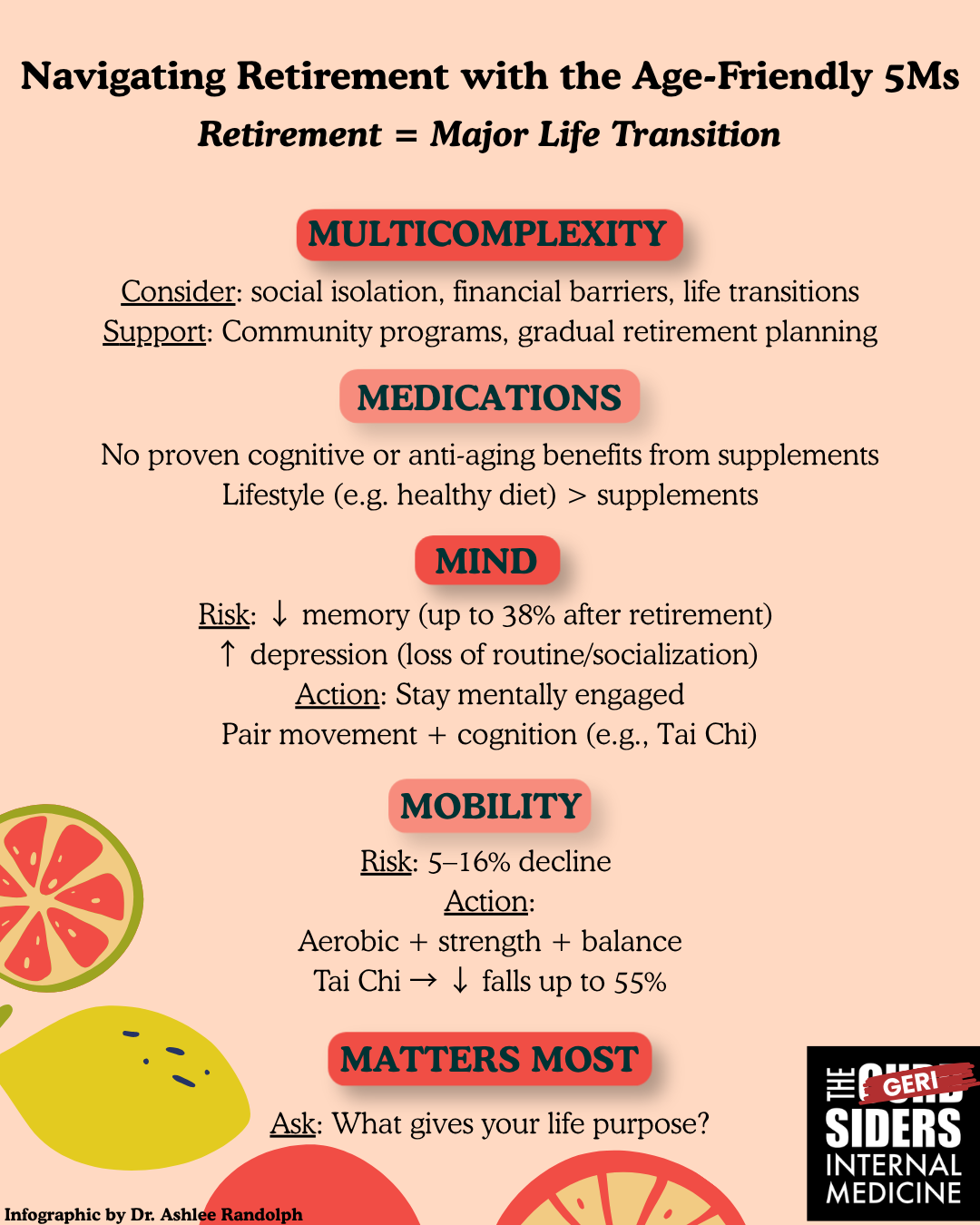
Retirement is often viewed as a well-earned and exciting milestone. While it can bring freedom and new opportunities, it is also a major life transition that deserves thoughtful counseling. Research suggests that retirement does not always promote healthy aging in the way we anticipate. A study in London found that verbal memory, defined as the ability to remember spoken information and words such as conversations, instructions, or lists, declined by 38% after retirement (Xue 2017). Other research suggests that retirees may be more likely to experience depression, possibly related to changes in routine and socialization (Dang 2022). Additional studies have shown a 5-16% decline in mobility after retirement (Dave 2006) and a 40% increased likelihood of heart attack or stroke after retirement (Moon 2022).
While these findings may seem discouraging, they highlight the importance of proactive planning to mitigate risks (e.g. a sedentary lifestyle and withdrawal from social routines) in retirement. As healthcare providers, we can help older adults prepare intentionally for this transition. Counseling should focus on maintaining physical activity, prioritizing nutrition, preserving social connections, and identifying meaningful engagement after retirement. It is important to encourage patients to reflect on purpose as they approach retirement and consider questions such as:
- Is now the right time to retire?
- How can I make the transition of retirement easier?
- Would a gradual reduction in hours ease the transition?
- Is there an alternative role that offers less stress?
Ultimately, focus the conversation on what matters most to the patient and align your recommendations with their personal goals. For example, an older adult who wants the energy and mobility to play with their grandchildren may be more motivated to increase physical activity or make dietary changes when those behaviors are framed as a way to stay present and active in their family’s life.
The Complete Exercise Prescription
As clinicians, we are familiar with the American Heart Association’s recommendation for people to achieve at least 150 minutes of moderate-intensity aerobic activity per week (AHA 2024). While we frequently encourage walking, aerobic activity alone is not sufficient for healthy aging. A well-rounded exercise routine should include:
- Aerobic exercise (e.g. brisk walking, riding a bike) for 30 to 60 minutes every day of the week
- Strength training for 30 to 60 minutes, 2 to 3 days per week
- Stretching and balance training
Balance training becomes increasingly important with advancing age and Tai Chi is very effective. Originating in ancient China, Tai Chi is a low-impact practice that combines slow, controlled movements with deep breathing. Studies have demonstrated that Tai Chi can reduce fall risk by up to 55% (Fuzhong 2005). When paired with a cognitive task, specifically in those with mild cognitive impairment, Tai Chi has been associated with a 3 point improvement in MOCA scoring, which is roughly equivalent to six years of cognitive health (Fuzhong 2023).
Incorporating Tai Chi into practice can be simple. Consider playing a brief Tai Chi instructional video during a visit and guiding patients through one movement in office. Patients can access free and paid online classes through the Tai Chi Foundation and many local YMCAs offer programs such as “Moving for Better Balance.” Dr. Eckstrom encourages patients to practice Tai Chi at home to build confidence before attending a group class.
Progress, not Perfection
Exercise should always be individualized and adaptable. Movement can be modified to standing or seated positions based on ability and safety. Set expectations early that mild muscle soreness is common when beginning a new routine, but should improve as conditioning builds. Encourage patients to start at a comfortable baseline and progress gradually. For patients who use a wheelchair, chair-based Tai Chi or repeated sit-to-stand exercises can effectively build strength and stability. If someone only tolerates five minutes of walking at a time, suggest five-minute intervals spread throughout the day to accumulate 30 minutes total.
Meet patients where they are, emphasize steady progression, and reinforce the simple principle: “motion is lotion.”
Building Bone and Confidence in Osteoporosis
Patients with osteoporosis are often understandably fearful of a fracture during exercise, particularly in activities that are perceived as “high impact.” However, it is important to reframe their concern, because exercise is one of the most effective strategies to maintain bone mass and reduce fracture risk. Current evidence supports progressive resistance training combined with weight-bearing or impact activities to stimulate bone remodeling and improve strength and balance (Cauley 2020). For patients worried about injury, the focus should be on cultivating confidence through gradual progression. As patients gain confidence in their bodies, they become more willing to expand their activities and challenge themselves in new ways. Your role is not only to prescribe exercise, but to help them gain confidence in their movement.

Nutrition for Longevity
The diet with the strongest and most consistent evidence for healthy aging is the Mediterranean diet (Gausch-Ferré 2021).
Fruits and Vegetables
Aim for a variety of colorful produce everyday. A simple rule of thumb is to include at least five different colors daily. Focus on:
- Lower glycemic fruits such as berries and apricots
- Leafy greens and cruciferous vegetables
- Beans and legumes
- Brightly colored vegetables such as peppers and squash
Protein
As we age, maintaining muscle becomes increasingly important to preserve strength, balance, mobility, and independence. Adequate daily protein intake helps support muscle health, but the right amount depends on your activity level, health, and overall goals:
- Healthy and normally active adults: Aim for about 1 gram of protein per kilogram of body weight per day.
- Building muscle, endurance training (e.g., marathon training), or taking a GLP‑1 medication: Aim for about 1.2 grams per kilogram per day.
- Adults with frailty or those recovering from hospitalization with slowed gait speed or functional decline: Aim for about 1.5 grams per kilogram per day.
Focus on quality sources of protein:
- Prioritize plant-based protein sources such as beans, lentils, nuts, seeds, quinoa, and farro.
- For animal protein, include fish and lean options such as low-fat Greek yogurt, low-fat cottage cheese, and egg whites.
- Avoid red and processed meats
Protein supplements can be helpful if dietary intake is inadequate, but emphasize whole food sources first as supplements are often more processed.
Note: For dairy, be cautious of milk as it tends to have a lot of sugar. Whole milk is higher in calories and fat and may have less protein.
Carbohydrates
Limit “white” carbohydrates such as white bread, rice, pasta, and white potatoes. Choose whole grains instead.
Affordable Strategies
For patients worried about the cost of healthier food items, offer practical, low-cost options. Emphasize affordable Mediterranean-style staples such as beans, lentils, and seasonal produce and share simple, inexpensive meal ideas. Utilize local community programs such as Meals on Wheels for both nutrition and social support. Encourage patients to start a garden, even something as simple as one tomato plant. This can provide both nutrition and purpose!
Calories and Aging
Calorie needs generally decline with age due to reduced muscle mass and metabolic rate. For every 10 years we age, we require 500 less calories. For example, if you eat 3000 calories when you’re 60, you will only require 2000 when you are 80.
Social Connections
Preserving social connections is just as important as preserving muscle mass, especially after retirement when daily structure and built-in social interactions often change. Growing evidence demonstrates that social isolation is associated with increased risks of mortality, functional decline, and dementia (Lyu 2024). In addition, social isolation and loneliness function as chronic stressors and are associated with worse cardiovascular outcomes (Cené 2022).
Framing social connection as a core pillar of healthy aging can help patients recognize that relationships and purpose are not optional extras, but essential components of long-term well-being. Encourage patients to reflect on what has brought them joy or purpose in the past and explore how those interests might fit into their life now. Guide them towards local resources such as community centers, libraries, volunteer organizations, faith communities, assisted living facilities that may offer structured activities or volunteer opportunities. Some examples include:
- Coaching a youth sports team
- Reading to children at the local library
- Serving on a non-profit or community board
- Joining a Tai Chi class (this can offer both physical and social connection!)
Evidence Over Advertising
There is no shortage of advertisements promoting supplements that promise to slow aging or sharpen memory. However, most dietary supplements show limited or no benefit for anti-aging or cognitive function (Rutjes 2018, Gallagher 2026). The most reliable strategies remain life-style based, specifically regular exercise, well balanced diet, and ongoing social engagement.
Foods with anti-inflammatory properties may provide some value as we know inflammation plays a major role in many chronic conditions including dementia, though the benefit is far less when compared with regular exercise.
Links
Cottrell Houle M, Eckstrom E. The Gift of Aging: Growing Older with Purpose, Planning, and Positivity. Cambridge University Press, 2023.
Goal
Listeners will develop practical strategies on counseling older adults on healthy aging by prioritizing lifestyle interventions, addressing misconceptions about aging in routine clinical care, and applying the Geriatric 5 M’s to build a personalized, patient-centered care plan.
Learning objectives
After listening to this episode listeners will…
- Apply evidence-based lifestyle and preventive strategies to promote healthy aging.
- Address misconceptions about aging using effective counseling techniques.
- Integrate the Geriatric 5 Ms framework to effectively counsel older adults on healthy aging and individualized care.
Citation
Randolph AA, Miller RK, Eckstrom E, Williams PN, Watto MF. “#522: Healthy Aging”. The Curbsiders Internal Medicine Podcast. thecurbsiders.com/category/curbsiders-podcast Final publishing date April 20, 2026.
Episode Sponsors
Babbel
Right now get up to 60% off your Babbel subscription – at Babbel.com/CURB
Continuing Education Company
Visit CMEmeeting.org/curbsiders and use promo code Curb30 for 30% off all online courses and webcasts.
Locumstory.com
Locumstory.com is literally just a free, unbiased resource dedicated to educating physicians about locums.
Episode Credits
Written and Produced by: Ashlee Randolph DO, Rachel Miller MD
Show Notes, infographic, cover art: Ashlee Randolph DO, Rachel Miller MD
Hosts: Matthew Watto MD, FACP; Paul Williams MD, FACP
Reviewer: Leah Witt, MD
Showrunners: Matthew Watto MD, FACP; Paul Williams MD, FACP
Technical Production: PodPaste
Guest: Elizabeth Eckstrom MD, MPH
CME Partner

The Curbsiders are partnering with VCU Health Continuing Education to offer continuing education credits for physicians and other healthcare professionals. Visit curbsiders.vcuhealth.org and search for this episode to claim credit.
Contact Us
Got feedback? Suggest a Curbsiders topic. Recommend a guest. Tell us what you think.
We love hearing from you.
Join our Patreon!

Yes, you can now join our exclusive community of core faculty at Kashlak Memorial Hospital along with all the perks:
- Bundle & Save with the top CME tier!
- All episodes Ad-Free, including the entire back catalog!
- Twice-monthly bonus episodes: Ask me Anything (AMA) with Matt & Paul, Recaps, and more!
- Access to Kashlak's Discord Server!
- Advance Notice of Curbsiders Events!
- Exclusive Curbsiders' Merch!
