

Audio
Video
Transcript available via YouTube
Sounds like another UTI but it could be more than that! Time to explore the entire pelvic floor and see what more you can treat. School’s in session with the Bladder Teacher, Kellen Choi, DO from the University of Louisville @KellenChoi
Claim CME for this episode at curbsiders.vcuhealth.org!
Patreon | Episodes | Subscribe | Spotify | YouTube | Newsletter | Contact | Swag! | CME
Show Segments
- Intro
- Rapid fire questions/Picks of the Week
- Case #1 and Definitions
- Bowel habits
- Water intake
- Case #2
- Vaginal Estrogen
- Non-antibiotic prophylaxis
- Antibiotic in prophylaxis
- Pelvic Floor Physical Therapy
- Take-home points
- Outro
#434: Ur-INe for Recurrent UTI?! with Dr. Kellen Choi, DO Pearls
- Cultures are key for making the diagnosis of recurrent UTI (rUTI); three culture-positive infections in 12 months or two culture-positive infections in 6 months constitute rUTI.
- A pelvic exam with a special focus on the pelvic floor muscles can inform the diagnosis and treatment.
- Both the IDSA and AUA do not recommend treating asymptomatic bacteriuria except in pregnant individuals or those with upcoming urologic surgery.
- When treating patients with systemic symptoms, avoid nitrofurantoin.
- Healthy, regular bowel habits as well as supplements like D-mannose and cranberry can play a role in UTI prevention
- Vaginal estrogen can help reduce the odds of infections.
- It’s not always a UTI; broaden the differential to include pelvic floor dysfunction, pelvic organ prolapse, GUSM or OAB.
- Pelvic floor physical therapy can treat and alleviate symptoms that mimic rUTIs; refer to pelvic floor therapy for added benefits.
Definitions
The American Urological Association defines recurrent UTIs in the index patient; index patients are not immunocompromised and do not have anatomical reasons to have UTIs. Recurrent UTIs are defined as three culture-specific positive UTIs in one year or two culture-specific positive UTIs in six months (Anger et al; 2022). Dr. Choi aims to use the urine cultures as a way to differentiate a true infection from other mimicking conditions such as painful bladder syndrome or pelvic floor dysfunction.
Simple Cystitis
Should the patient be very self-aware of UTI symptoms that occur rarely, one could treat them based on clinical presentation, medical judgment and without culture. The recurrence of symptoms in close proximity of previous presentations should raise clinical suspicion for other urologic pathologies. In these settings, be sure to culture the urine. Asymptomatic bacteriuria is not to be treated with antibiotics unless the patient is pregnant or about to have urologic surgery (Lu and Albarillo, 2022; Nicolle et al, 2005) Patients may be inclined to do at-home UTI screening tests but these can be susceptible to false positives from contamination.
The Basics: History and Physical
History
Start by asking about the basics: dysuria, urinary urgency, frequency, incontinence and true nocturia (ie: waking up with the urge/need to urinate, not being woken up by pets, noises or the like). Ask an obstetrics history such as delivery of an 8 lb baby or larger as these can predispose patients to urologic complications. Immunocompromised states should elevate your concern for complications, such as patients on chemotherapy or with autoimmune disorders. Surgeries can increase the risk for complications too; ask if your patient has had surgeries to correct ureteral reflux, or have had a bladder “tuck” known more commonly as a bladder sling.
Physical
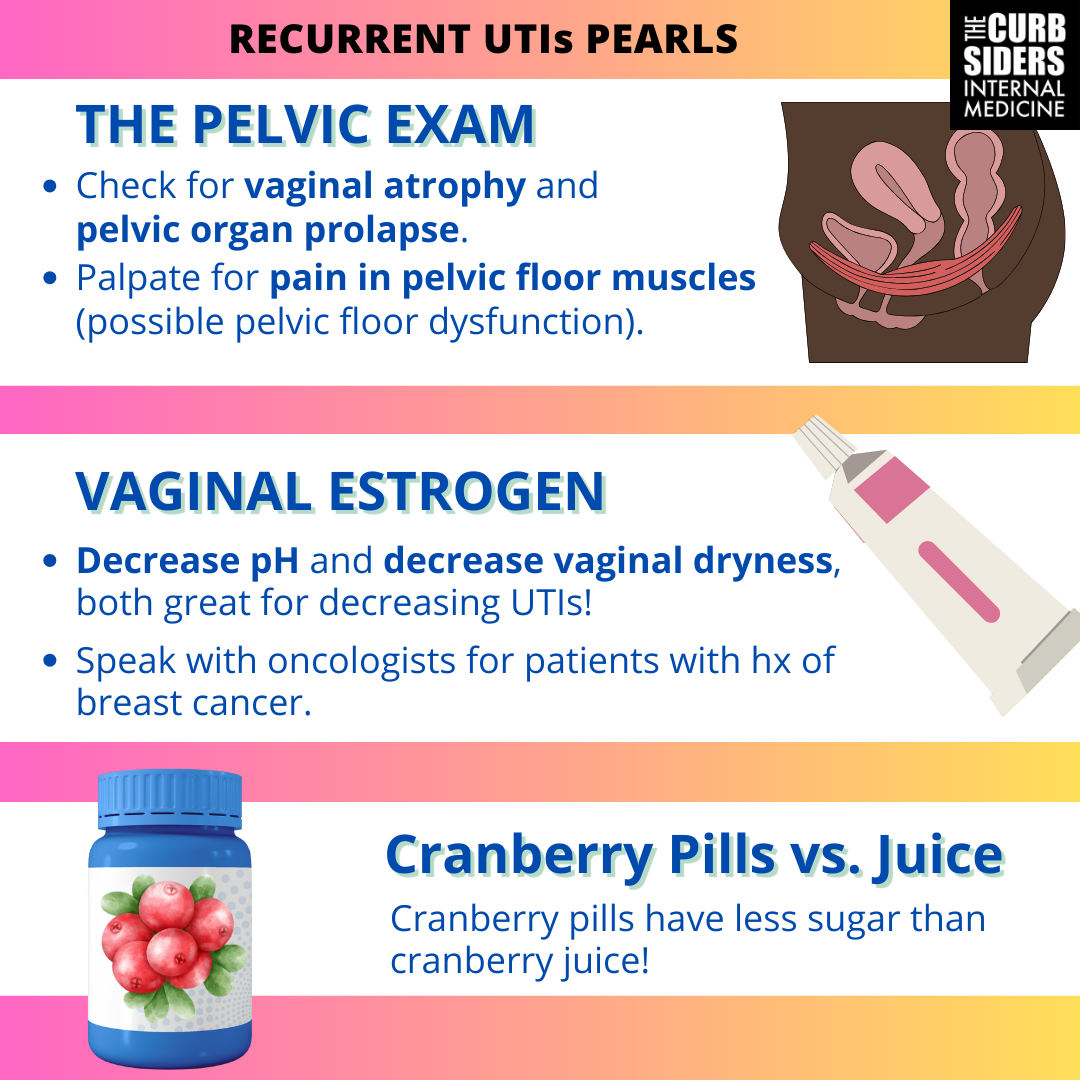
The pelvic exam is a key component of the recurrent UTI work up. Inspect the vagina for atrophy or pelvic organ prolapse. Palpate for pain the pelvic floor muscles, including the levator ani, obturator internus and the perineal muscles. Pelvic floor muscles that are tense and painful could point towards pelvic floor dysfunction (Wolff et al, 2019).
Imaging
Imaging is not necessary if the patient does not have a structural source for their UTI concerns.
But if the patient has a history of kidney stones, hematuria, or if there is a concern for a structural source to their symptoms, start with renal ultrasound. A CT urogram with contrast is the next imaging option, especially in patients who smoke or if they have had gross hematuria. A bladder scan can help determine if the bladder is being emptied properly. Alternatively, a urologist could measure post-void residual urine by doing a straight cath. Finally, cystoscopy can be completed by urology if there is a concern for bladder stones, erosions of the bladder, diverticula of the bladder or even malignancy
Analysis: From Cultures to DNA/PCR testing
Patients oftentimes have completely negative urine test results but continue to exhibit UTI symptoms. In these settings, Dr. Choi recommends asking the labs for atypical cultures, DNA or PCR testing if initial testing is completely negative but that patient continues to have concerning symptoms (Szlachta-McGinn et al, 2022).
Predisposers to UTIs
Low intake of healthful fluids like water can predispose patients to UTI. Dr. Choi advocates drinking 1.5 liters (~50 oz) of water a day to prevent infections. Determine if your patient is urinating often enough; they might not have easy access to a restroom which discourages the patient from drinking fluids or frequent bladder emptying.

Treatment
The AUA guidelines recommend short courses of nitrofurantoin or TMP-SMX as first line treatment for uncomplicated UTIs. Dr. Choi prefers to use amox-clav or cephalexin in older patients. Dr. Choi reminds us that nitrofurantoin should be avoided in cases where the patients have systemic symptoms since it is bacteriostatic and in those at with or at risk of pulmonary fibrosis.
Prevention
Water and Bowels
Guidelines recommend drinking 1.5 liters of water to prevent UTIs (Hooton et al, 2018) . Dr. Choi uses her mantra, “if you cannot poo, you cannot pee” to engage patients in a frank conversation of the treatment of constipation to prevent UTIs. She uses the Bristol Stool Chart to explain what are healthy bowel habits and advises all patients to eat more fiber.
“If you cannot poo, you cannot pee”
-Dr. Kellen Choi, The Bladder Teacher
Supplements
D-mannose and cranberry supplements prevent bacteria from adhering to the bladder wall but they have lukewarm data to support their use in UTI prevention (Anger et al, 2022). If one were to recommend cranberry supplements, aim for pills over juice since the latter can have a high sugar content. Another alternative, methenamine hippurate, was studied against daily antibiotics prophylaxis and was found to be non-inferior in the ALTAR Trial (Harding et al, 2022).
In Dr. Choi’s professional opinion, patients who are on immunosuppressants for MS, have autoimmune conditions or on chemotherapy may altogether benefit from prophylactic antibiotics if other preventive modalities are not optimal.
Vaginal estrogen
Vaginal estrogen lowers the pH to promote the growth of good bacteria while also improving vaginal dryness. After a thoughtful conversation with patients who have had breast cancer and their oncology team, vaginal estrogen could be used to reduce UTI recurrence and treat genitourinary syndrome of menopause (McVicker et al, 2024). Recent studies have reassured the use of vaginal estrogen in patients with a history of breast cancer with the exception of women being treated with aromatase inhibitors (Agarwal et al, 2023).
Antimicrobials
The AUA endorses the use of antibiotics before or after intercourse. Per the AUA, this approach reduces adverse events, decreases the use of antibiotics over time, and lessens the direct and indirect cost of rUTI with time-targeted therapy. In addition to a single dose of nitrofurantoin 50mg or 100mg, the AUA supports the use of cephalexin 250mg, TMP-SMX SS or TMP-SMX DS (Anger et al, 2022).
Dr. Choi cautiously uses self-start antibiotic prophylaxis; she is selective of the patients that can reliably use the method such as those with a low risk for multi-drug resistant infections.
Our expert uses suppressive therapy for three to six months then reassesses the patient.
Differentials: Did you think about…
Pelvic organ prolapse can be considered, especially when patients report the sensation of “sitting on a ball” after prolonged standing. Painful bladder syndrome could be considered when a patient feels pain relief after emptying their bladder. Interstitial cystitis is a diagnosis of exclusion and does not always present with Hunter’s ulcer of the bladder as seen in cystoscopy. Dr. Choi reminds us that overactive bladder syndrome symptoms can overlap with UTI symptoms but the former does not always present with dysuria. Lastly, genitourinary syndrome of menopause should be considered if the patient describes vaginal dryness and the physical exam reveals vaginal atrophy
Pelvic floor therapy
Dr. Kellen Choi highlights the role of pelvic floor physical therapy in managing pelvic floor dysfunction which can manifest with painful pelvic floor muscles or weak Kegel tone (Wolff et al, 2019; Espino-Albela et al, 2022). Kegel exercises are helpful but if done incorrectly, patients can develop overactive bladder symptoms such as urgency or other signs of pelvic floor dysfunction. Refer to a pelvic floor physical therapist when in doubt.
Take home points
- It’s not always a UTI
- Talk about bowel habits; if the patient cannot move their bowels, they’ll struggle with urination.
- Vaginal estrogen cream is safe and effective in a great majority of patients; oncology can always give you guidance when in doubt.
Links
- Recurrent Uncomplicated Urinary Tract Infections in Women: AUA/CUA/SUFU Guideline (2022)
- BTS and Merch from Amazon
Goal
Listeners will recognize recurrent UTIs and develop a broad approach to preventing further infections after identifying the root cause
Learning objectives
After listening to this episode listeners will…
- Define the parameters of recurrent UTIs (relapse vs reinfections) including the most common causes of recurrence and risk factors.
- Develop a comprehensive approach to the evaluation of recurrent UTIs, including urinalysis, cultures, labs, cystoscopy, imaging, and referral to specialty when indicated.
- Manage recurring infections with proper antimicrobial treatment and implement preventive treatment when necessary, including long term prophylactic use of antibiotics.
- Individualize management of recurrent UTI in special populations including post-coital infections, post-menopausal/genitourinary syndrome of menopause, patients with incomplete bladder emptying/post-void residual, cystoceles/prolapses, patients on immunosuppressant medications or other comorbidities
Disclosures
Dr. Kellen Choi reports no relevant financial disclosures. The Curbsiders report no relevant financial disclosures.
Citation
Valdez, I, Choi K, Jyang E, Williams PN, Watto MF. “#434: UrINe for Recurrent UTI”. The Curbsiders Internal Medicine Podcast. thecurbsiders.com/category/curbsiders-podcast. April 8,, 2024.
Episode Sponsors
Freed
You can try Freed for free right now by going to freed.ai. And listeners of Curbsiders can use code CURB50 for $50 off their first month.
Locumstory
Tune in to The Locumstory Podcast on Spotify, Apple, or Google podcasts.
Episode Credits
Producer, Writer & Show Notes: Isabel Valdez, PA
Infographic & Covert Art: Edison Jyang
Hosts: Matthew Watto MD, FACP; Paul Williams MD, FACP
Reviewer: Fatima Syed, MD
Showrunners: Matthew Watto MD, FACP; Paul Williams MD, FACP
Technical Production: PodPaste
Guest: Kellen Choi DO, FAOCS
CME Partner

The Curbsiders are partnering with VCU Health Continuing Education to offer continuing education credits for physicians and other healthcare professionals. Visit curbsiders.vcuhealth.org and search for this episode to claim credit.
Contact Us
Got feedback? Suggest a Curbsiders topic. Recommend a guest. Tell us what you think.
We love hearing from you.
Join our Patreon!

Yes, you can now join our exclusive community of core faculty at Kashlak Memorial Hospital along with all the perks:
- Bundle & Save with the top CME tier!
- All episodes Ad-Free, including the entire back catalog!
- Twice-monthly bonus episodes: Ask me Anything (AMA) with Matt & Paul, Recaps, and more!
- Access to Kashlak's Discord Server!
- Advance Notice of Curbsiders Events!
- Exclusive Curbsiders' Merch!
