

Audio
Failure to thrive is out, faltering weight is in! Join us as pediatric gastroenterologist and guideline author Dr. Praveen Goday weighs in on the new AAP guideline for faltering weight. Learn how to use z-scores to identify children at risk for malnutrition, when nutritional intervention should precede diagnostic testing, and practical strategies to support catch-up growth across the pediatric age spectrum. Tune in to learn how to tip the scales toward healthy growth while avoiding unnecessary testing.
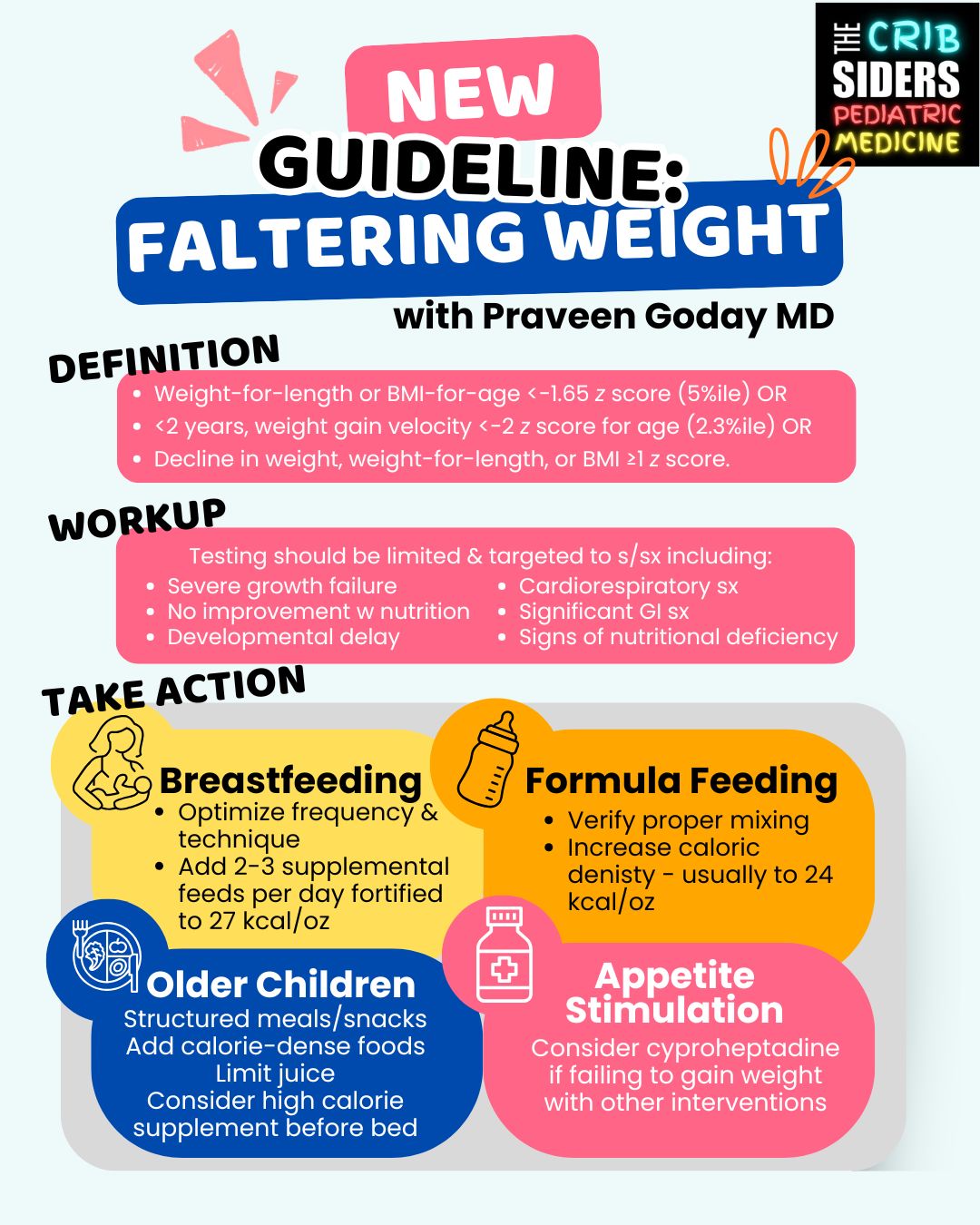
Faltering Weight Pearls
- Think of faltering weight as a child being at risk for malnutrition—aim for early recognition and intervention before height and overall growth are affected.
- Use weight-for-length (or BMI) and z-scores rather than percentile crossing alone; a decline of ≥1 z-score is more meaningful than simply dropping percentiles.
- Most children with faltering weight do not need extensive testing upfront—insufficient caloric intake is far more common than an underlying medical disorder.
- A detailed feeding history is often more valuable than laboratory testing; ask about breastfeeding effectiveness, formula preparation, grazing, juice intake, and meal structure.
- For formula-fed infants, increasing formula concentration to 24 kcal/oz is a simple and effective first-line intervention that often provides the extra calories needed for catch-up growth.
- Symptoms should drive the workup: vomiting, diarrhea, developmental delay, cardiorespiratory symptoms, or signs of nutritional deficiency warrant targeted evaluation beyond nutrition alone.
- Children who fail to respond to adequate caloric intervention deserve a broader evaluation and may benefit from subspecialty support, including GI, feeding therapy, and/or developmental services.
Faltering Weight Notes
Key Updates to Definitions
“Failure to Thrive” Has Been Replaced by “Faltering Weight”: The new terminology avoids stigmatizing language and emphasizes early recognition of children at risk for malnutrition before more significant growth impairment occurs.
Think Beyond Percentiles—Use Z-Scores: A drop in percentiles can be misleading depending on where a child starts on the growth curve. Z-scores provide a standardized way to assess growth changes across the spectrum. Criteria used to define faltering weight include:
- Weight-for-length or BMI z-score below -1.65 (approximately the 5th percentile)
- Decline of ≥1 z-score over time
- In children younger than 2 years, weight gain velocity less than −2 z-score for age (2.3rd percentile)
Evaluation
History
Every history should include a detailed dietary intake, which may include:
- Breastfeeding frequency, duration and patterns
- Formula quantity and preparation
- Juice and sugar-sweetened beverage intake
- School meals
- Feeding behaviors such as grazing and family mealtime routines
History should also include:
- Family history (e.g., celiac disease, inflammatory bowel disease, genetic conditions)
- Developmental milestones
- Access to food resources (WIC, SNAP) and other social determinants of health
Physical Exam
- Signs of chronic disease (e.g., hepatosplenomegaly, thyroid enlargement, genitourinary abnormalities, hypo/hypertension)
- Neurologic abnormalities (e.g, abnormal deep tendon reflexes, hypotonia)
- Dysmorphic features
- Signs of nutrition deficiency (e.g., scaling skin, spoon-shaped nails, edema, bony deformities)
- Evidence of cardiorespiratory disease (e.g., murmur, tachycardia, tachypnea, clubbing)
When to Consider Testing
Testing becomes more important when:
- Growth failure is severe, particularly if approaching a weight-for-length or BMI z-score <-3, which would meet criteria for malnutrition
- Nutritional interventions are unsuccessful
- Symptoms suggest a specific diagnosis
- History and exam do not explain poor growth
Signs and symptoms warranting testing include:
- Persistent vomiting
- Significant diarrhea
- Developmental delay
- Cardiorespiratory symptoms
- Severe constipation
- Signs of nutritional deficiency
Potential testing may include:
- Celiac screening
- Thyroid studies
- Endoscopy
- Metabolic evaluation
- Additional subspecialty-directed workup
Management
Nutritional Intervention
Breastfed Infants
- Optimize feeding frequency and technique
- Supplement with formula when needed. Dr. Goday will work with the family to determine what is easiest, but often will recommend 2-3 supplemental feeds of formula or expressed breast milk fortified to 27 kcal/oz each day
- Shared decision-making is essential – figure out what will work best for the family
Formula-Fed Infants
- Verify proper formula mixing (all US-based formulas are 1 scoop per 2 ounces of water)
- Increase caloric density (typically to 24 kcal/oz) – there are many good online resources to teach families how to prepare this using their regular formula, which is preferred to switching to higher kcal/oz formulas designed for preterm infants
- Consider step-down towards standard caloric density once the baby is maintaining target weight gain (Dr. Praveen will typically follow up every 1-2 months)
Toddlers and Older Children
- Establish structured meals and snacks; avoid grazing
- Limit juice and sugar-sweetened beverages
- Add calorie-dense foods strategically (e.g., oils, butter, cream)
- Consider high-calorie nutritional supplements (30 kcal/oz beverages – often given at bedtime to avoid “spoiling the appetite” for other meals)
Appetite Stimulants
Cyproheptadine may be useful in select children, although effects often diminish over time. Dr. Goday will always start with adding calories first, but in children who struggle to gain weight due to low appetite this is a reasonable next step. He tends to give it as a single bedtime dose rather than divided into multiple doses to increase adherence.
Referral/Hospitalization
Consider referral for:
- Feeding dysfunction (OT/feeding therapy)
- Persistent growth concerns despite intervention
- Suspected gastrointestinal disease
- Developmental concerns requiring specialist evaluation
Hospitalization may be appropriate when:
- Malnutrition is severe (e.g., z-score < -3)
- The history does not match the degree of growth failure
- Outpatient follow-up is difficult
- Urgent diagnostic evaluation is needed
Resources
- American Academy of Pediatrics Clinical Practice Guideline: Clinical Practice Guideline for Diagnosis and Management of Faltering Weight (2026)
- American Society for Parenteral and Enteral Nutrition (ASPEN)
- North American Society for Pediatric Gastroenterology, Hepatology and Nutrition (NASPGHAN)
Goal
After listening to this episode, listeners will be able to recognize faltering weight early, perform a focused evaluation, and implement practical nutritional interventions to prevent progression to pediatric malnutrition.
Learning Objectives
After listening to this episode listeners will…
- Define faltering weight using the updated AAP diagnostic criteria, including the role of weight-for-length, BMI, and z-scores.
- Identify key historical, physical exam, and growth chart findings that help distinguish inadequate caloric intake from underlying medical causes of faltering weight.
- Describe an evidence-informed approach to evaluating children with faltering weight, including when nutritional intervention should precede diagnostic testing.
- Implement practical age-specific strategies to increase caloric intake in breastfed infants, formula-fed infants, and older children with faltering weight.
- Recognize indications for targeted laboratory evaluation, subspecialty referral, and hospitalization in children with faltering weight.
Disclosures
Dr. Goday has financial relationships with Kate Farms and Nutricia for research support and Abbott for consulting fees. All efforts have been made to present balanced information about treatment options.
Citation
Engel S, Goday P, Lidsky H, Chiu C, Masur S. “#187: Weight for it…New Guidelines on Faltering Weight”. The Cribsiders Podcast. https:/www.thecribsiders.com/ July 29, 2026
Episode Sponsors
Jones Road Beauty
For a limited time our listeners are getting a FREE full sized Mascara on their first purchase when they use code CRIBSIDERS at checkout. Just head to Jonesroadbeauty.com and use code CRIBSIDERS at checkout. After you purchase, they will ask you where you heard about them. PLEASE support our show and tell them our show sent you.
FIGS
Now Cribsiders listeners can get 15% off. Just go to WearFIGS.com and use code FIGSRX.
Episode Credits
Producer, Writer & Infographic: Sydney Engel NP
Showrunner: Sam Masur MD
Associate Editor: Hartlee Lidsky MD
Hosts: Sam Masur MD & Chris Chiu MD
Technical Production: Pod Paste
Guest: Praveen Goday MD
CME Partner

The Cribsiders have partnered with Penn Medicine Continuing Education to offer continuing education credit—including AMA PRA Category 1 Credit™ and ABP MOC Part 2—for physicians and other healthcare professionals. An annual subscription gives you unlimited access to the full course catalog. Enrol Now.
Contact Us
Got feedback? Suggest a Cribsiders topic. Recommend a guest. Tell us what you think.
We love hearing from you.
Subscribe
Socials
Join our Patreon!

Yes, you can now join our exclusive community of core faculty at Kashlak Memorial Hospital along with all the perks:
- Bundle & Save with the top CME tier!
- All episodes Ad-Free, including the entire back catalog!
- Twice-monthly bonus episodes: Ask me Anything (AMA) with Matt & Paul, Recaps, and more!
- Access to Kashlak's Discord Server!
- Advance Notice of Curbsiders Events!
- Exclusive Curbsiders' Merch!
