

Audio
Trust your gut—it might be FPIES! Pediatric allergist Dr. Jessica Macdougall joins us to break down food protein-induced enterocolitis syndrome (FPIES), from the vomiting infant in the ED to the baby with chronic GI symptoms and poor growth. Learn how to distinguish FPIES from IgE-mediated food allergy and “milk protein allergy” (FPIAP), recognize common triggers and mimickers, manage acute reactions, and safely navigate food reintroduction.
FPIES Pearls
- Think delayed and GI: Acute FPIES classically causes repetitive vomiting 1–4 hours after a trigger food, without the hives or respiratory symptoms typical of IgE-mediated allergy.
- Not all “milk protein allergy” is FPIES: FPIAP primarily affects the distal colon/rectum and causes bloody or mucousy stools in an otherwise well infant; chronic FPIES causes more extensive GI symptoms, including vomiting, diarrhea, and poor growth.
- Treat the reaction, then plan the return: Acute FPIES is managed with rehydration ± ondansetron, not routine epinephrine. Most children eventually develop tolerance, but significant prior reactions warrant a supervised food reintroduction.
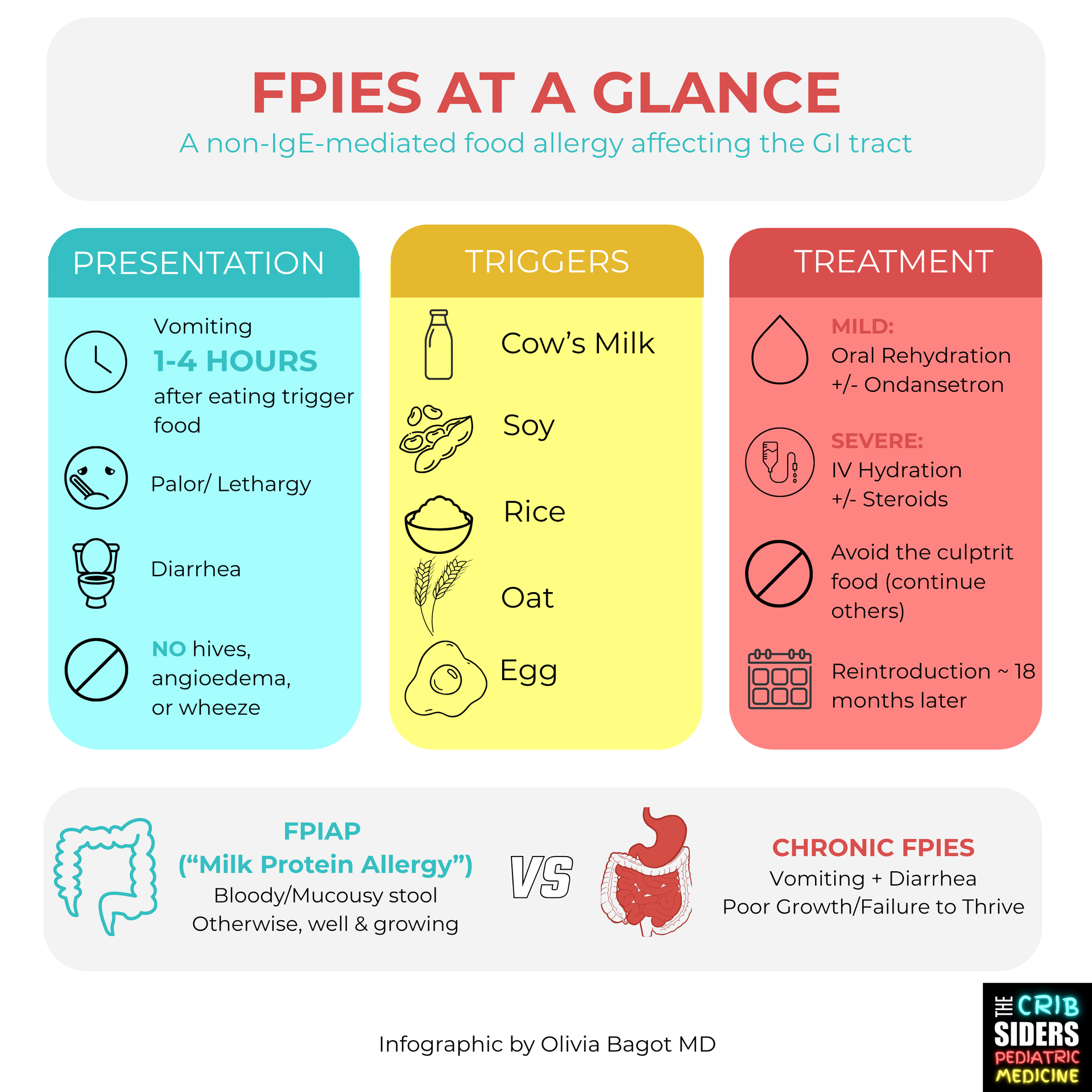
FPIES Notes
What is FPIES?
Food protein-induced enterocolitis syndrome (FPIES) is a non-IgE-mediated food allergy affecting the gastrointestinal tract.
Acute FPIES: Repetitive, often profuse and repetitive vomiting 1–4 hours after ingestion, often with pallor and lethargy. Diarrhea, dehydration, hypotension, and rarely shock can occur.
Chronic FPIES: Occurs with regular exposure to a trigger, classically cow’s milk or soy in young infants. Think chronic vomiting + diarrhea + poor weight gain/failure to thrive, improving after the offending food is removed.
FPIES vs IgE-Mediated Food Allergy
IgE-mediated allergy: Usually occurs within minutes to ~2 hours and can cause hives, angioedema, respiratory symptoms, vomiting, hypotension, and anaphylaxis.
FPIES: Typically delayed 1–4 hours, predominantly GI symptoms, and usually no hives, angioedema, or respiratory symptoms.
This distinction matters for treatment: epinephrine is the first-line treatment for anaphylaxis, but it does not treat isolated FPIES.
What We Call “Milk Protein Allergy”
What clinicians often call “milk protein allergy” in a well-appearing infant with bloody/mucousy stools is more accurately called food protein-induced allergic proctocolitis (FPIAP).
A helpful way to conceptualize the difference:
FPIAP: Inflammation primarily involves the distal colon/rectum → blood-streaked and/or mucousy stools, but the infant is generally well appearing and growing normally.
Chronic FPIES: More extensive GI involvement → vomiting + diarrhea + poor weight gain/failure to thrive, with dehydration or systemic illness in severe cases.
As Jessica described it, think of these as part of a spectrum of non-IgE-mediated gastrointestinal food allergy: localized proctocolitis on one end versus more extensive enterocolitis in chronic FPIES.
Common FPIES Foods
Forget the classic “top 9” framework. Common FPIES triggers include cow’s milk, soy, oat, rice, avocado, egg, and peanut, although essentially any food can be responsible. Trigger patterns vary geographically and may change with feeding practices.
Food risk categories are largely based on expert opinion and vary geographically; they should guide rather than dictate food introduction.
Workup
FPIES is a clinical diagnosis—there is no definitive diagnostic test.
Ask specifically what the child ate in the 1–4 hours before vomiting and whether the same food preceded prior episodes.
Routine food-specific IgE panels are not indicated for classic FPIES. Targeted IgE testing may be useful when the presentation could represent an IgE-mediated allergy or when planning reintroduction in selected patients.
Labs are not required for diagnosis. Severe presentations may have nonspecific abnormalities including neutrophilia, metabolic acidosis, and abnormalities related to dehydration.
FPIES Mimickers
Keep FPIES on the differential for recurrent, otherwise unexplained vomiting, especially when the episodes repeatedly follow the same food.
Important mimickers include viral gastroenteritis, sepsis, IgE-mediated anaphylaxis, GERD, pyloric stenosis/obstruction, metabolic disease, and other gastrointestinal disease.
A reproducible relationship with a particular food and relatively rapid recovery between acute episodes are helpful clues.
Acute Treatment
Treatment is driven by severity.
Mild/well appearing: Oral rehydration ± ondansetron.
Moderate/severe: IV isotonic fluids + ondansetron and aggressive treatment of dehydration or shock.
Consensus guidance includes ondansetron 0.15 mg/kg/dose in children ≥6 months.
Epinephrine is NOT routine treatment for isolated FPIES. Give epinephrine when there is concern for concurrent IgE-mediated anaphylaxis.
PRODUCER NOTE — STEROID DOSE: The episode discussion mentioned methylprednisolone 0.1 mg/kg, but the 2017 international consensus guideline describes IV methylprednisolone 1 mg/kg (maximum 60–80 mg) as a possible single dose in severe FPIES. Importantly, there are no studies establishing corticosteroid efficacy in FPIES, so evidence supporting this practice is limited.
Outpatient Management
Avoid the identified trigger while continuing to introduce other appropriate foods. Broad food avoidance is generally not the goal.
For cow’s-milk/soy-triggered chronic FPIES:
Extensively hydrolyzed formulas: Nutramigen, Alimentum
Amino-acid-based formulas: EleCare, Neocate, PurAmino
Most infants can start with an extensively hydrolyzed formula; an amino-acid formula may be needed for severe disease or persistent symptoms despite eHF.
For breastfed infants who are otherwise clinically stable, Dr. Jessica’s expert practice is to consider maternal dietary elimination of the suspected trigger while continuing breastfeeding. For cow’s-milk-triggered disease, this may include dairy ± soy depending on the clinical picture.
When transitioning an older infant away from formula, Dr. Jessica recommends considering green pea–based milk or oat milk as dairy alternatives because of their nutritional/protein profile. Choice should still be individualized to the child’s age, trigger foods, overall diet, and nutritional needs.
For children with multiple trigger foods, growth concerns, severe disease, or substantial dietary restriction, involve Allergy and a dietitian experienced in food allergy/FPIES.
Reintroduction
Most children eventually outgrow FPIES, but there is no blood test that tells us when tolerance has developed.
Previously reactive foods are commonly reintroduced through a medically supervised oral food challenge, with timing based on age, trigger food, time since the last reaction, and previous reaction severity.
Dr. Jessica’s expert practice: Consider reassessment roughly 18 months after the last acute reaction, although timing varies by trigger and clinical situation.
Because FPIES reactions are delayed, oral food challenges require several hours of observation. Depending on the severity of the previous reaction and the center, IV access may be obtained beforehand and ondansetron and IV fluids should be readily available.
Targeted IgE testing may be performed before reintroduction because some patients develop IgE sensitization to their FPIES trigger (atypical FPIES), which can alter the approach to the challenge.
Patients with a history of severe FPIES reactions should NOT simply reintroduce the trigger food at home. Reintroduction should be planned with Allergy and, particularly when dietary restriction or nutritional issues are significant, an experienced dietitian.
For milder FPIAP (“milk protein allergy”), reintroduction is different and can often occur at home when appropriate because the expected recurrence is blood/mucus in the stool rather than a severe acute FPIES reaction.
Links
International FPIES Association (I-FPIES) — Patient and clinician education, FPIES action plans, and emergency department resources.
International Consensus Guidelines for FPIES
Goal
Listeners will recognize and differentiate FPIES and other non-IgE-mediated food allergies, and apply appropriate diagnostic, acute management, outpatient counseling, and food reintroduction strategies.
Learning Objectives
After listening to this episode listeners will…
- Differentiate FPIES from IgE-mediated food allergy and food protein-induced allergic proctocolitis (FPIAP) based on timing and clinical presentation.
- Recognize the acute and chronic presentations of FPIES and common trigger foods.
- Apply a practical approach to the diagnosis and workup of suspected FPIES, including important mimickers.
- Describe the acute and outpatient management of FPIES, including hydration, ondansetron, dietary modification, and formula selection.
- Counsel families on food introduction and reintroduction, including when a supervised oral food challenge and specialist referral are appropriate.
Disclosures
Dr. Jessica MacDougal reports no relevant financial disclosures. The Cribsiders report no relevant financial disclosures.
Citation
Bagot OB, MacDougall JM, Chiu C, Masur S. “#190: Trust Your Gut: It Might Be FPIES”. The Cribsiders Podcast. https:/www.thecribsiders.com/ September 2nd, 2026.
Episode Sponsors
Instant Hydration
Go to INSTANTHYDRATION.COM/CRIBSIDERS and use my promo code CRIBSIDERS for over 40% off your first subscription order
FIGS
Now Cribsiders listeners can get 15% off. Just go to WearFIGS.com and use code FIGSRX.
Episode Credits
Producer: Olivia Bagot MD
Showrunner: Sam Masur MD
Writer: Olivia Bagot MD
Infographic: Olivia Bagot MD
Hosts: Sam Masur MD, Chris Chiu MD, Olivia Bagot MD
Technical Production: Pod Paste
Guest(s): Jessica MacDougal MD
CME Partner

The Cribsiders have partnered with Penn Medicine Continuing Education to offer continuing education credit—including AMA PRA Category 1 Credit™ and ABP MOC Part 2—for physicians and other healthcare professionals. An annual subscription gives you unlimited access to the full course catalog. Enrol Now.
Contact Us
Got feedback? Suggest a Cribsiders topic. Recommend a guest. Tell us what you think.
We love hearing from you.
Subscribe
Socials
Join our Patreon!

Yes, you can now join our exclusive community of core faculty at Kashlak Memorial Hospital along with all the perks:
- Bundle & Save with the top CME tier!
- All episodes Ad-Free, including the entire back catalog!
- Twice-monthly bonus episodes: Ask me Anything (AMA) with Matt & Paul, Recaps, and more!
- Access to Kashlak's Discord Server!
- Advance Notice of Curbsiders Events!
- Exclusive Curbsiders' Merch!
