

Audio
What happens when the dreaded “Is there a doctor on board?” call rings out at 35,000 feet? On this high-altitude episode, we’re joined by Dr. Ann Marshburn, pediatric hospitalist, former NASA researcher, and pilot, to explore the unique world of in-flight medical emergencies. We cover what you need to know before stepping forward, the equipment and resources available on planes, the medical conditions you’re most likely to encounter, and how to keep your cool when turbulence isn’t the only problem.
In-Flight Emergency Pearls
- In most cases, you are more qualified than anyone else on board — even if adult triage isn’t your day-to-day practice.
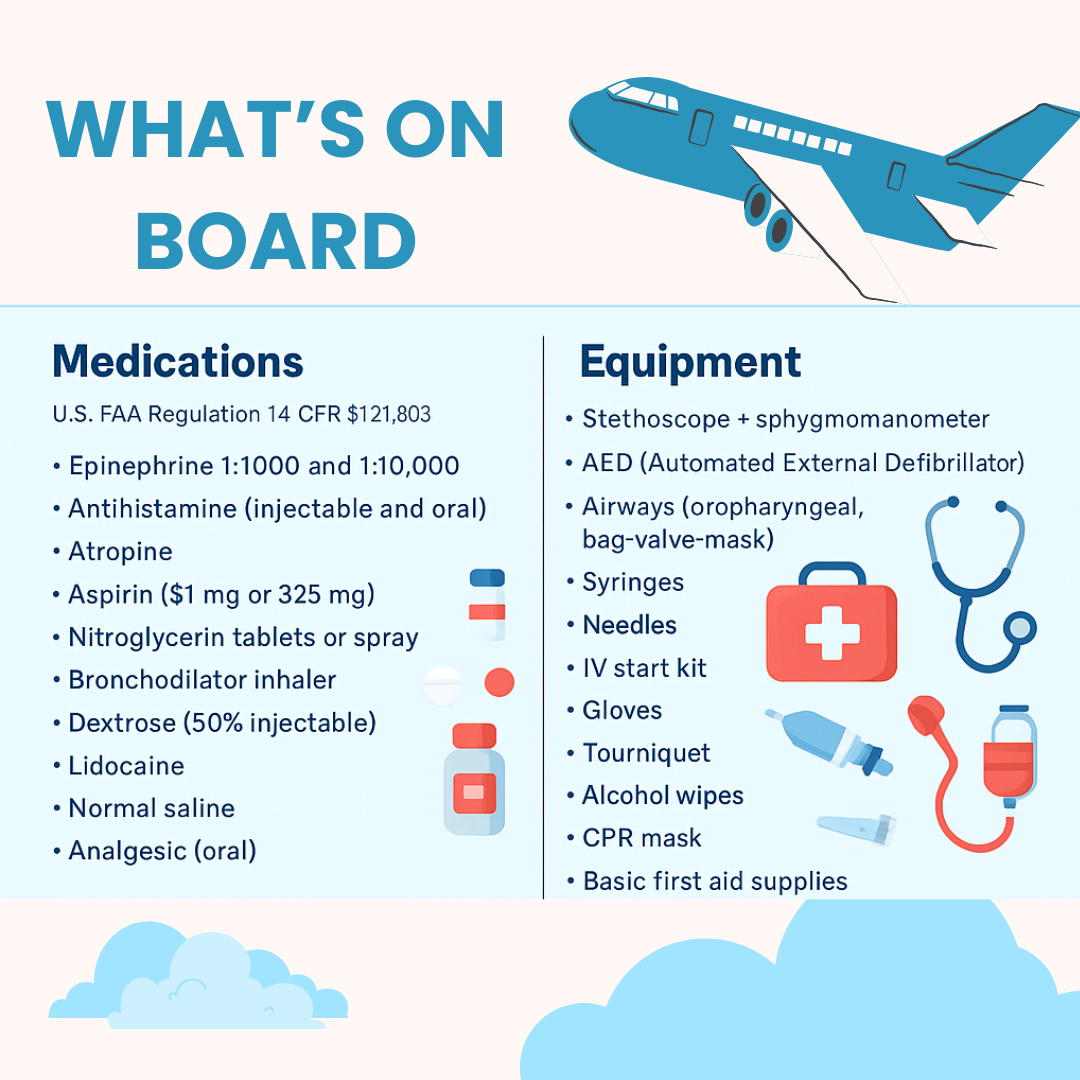
- Most U.S. aircraft carry an FAA-mandated medical kit and AED, but pediatric supplies and certain meds (ondansetron, benzodiazepines) are not guaranteed.
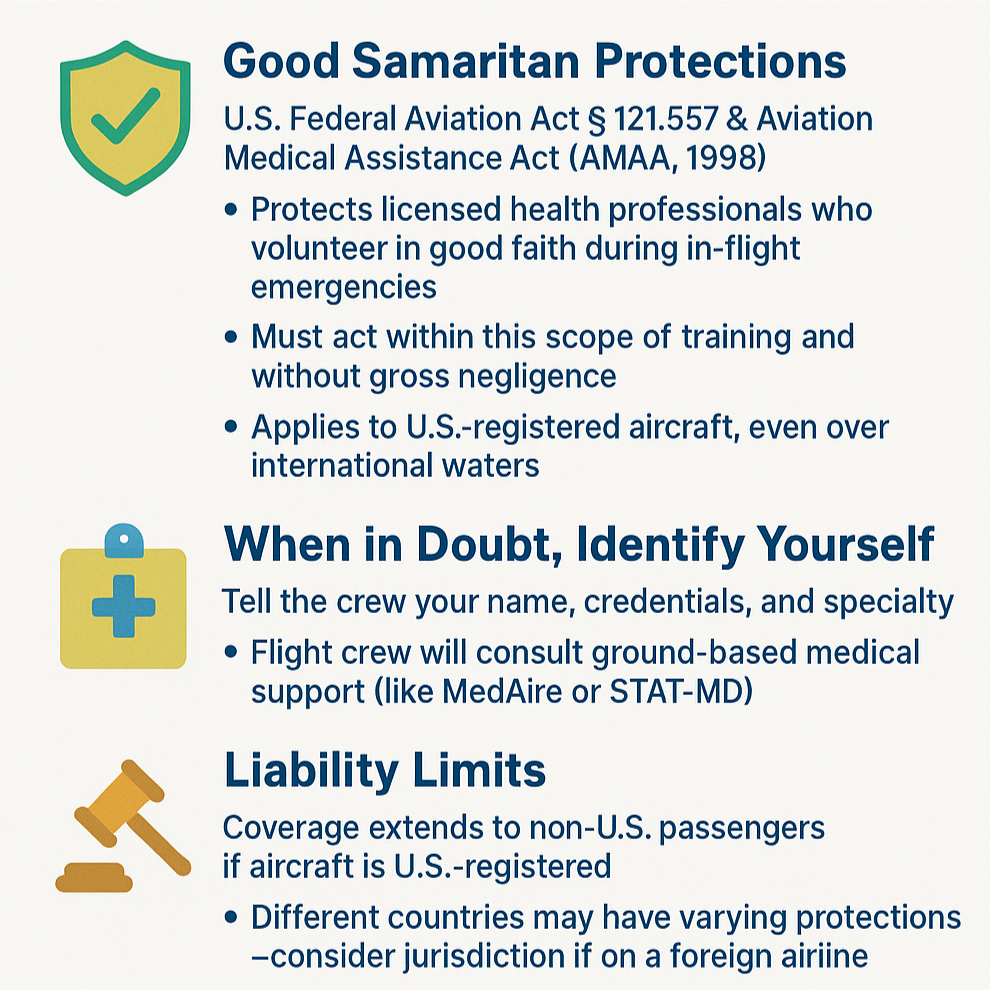
- Good Samaritan protections extend to physicians volunteering in good faith under the Aviation Medical Assistance Act (1998).
- Cabin conditions — altitude, dehydration, circadian disruption — can unmask or worsen medical problems.
- Diversion decisions are made by the captain, not the physician, though your input matters.
In-flight Emergency Notes
Common In-Flight Emergencies
- Most frequent: presyncope/syncope (~33% of cases).
- Next most common: respiratory complaints (10–12%), nausea/vomiting (8%).
- Less common but serious: chest pain/MI (~7%), seizures (~6%).
- Pediatrics: <10% of in-flight calls; most are minor (fever, vomiting), though seizures do occur.
Incidence & Outcomes
- Frequency: Published data are limited, but estimates range from 1 in 40 to 1 in 600 flights having a medical event.
- With ~3 billion passengers annually worldwide, this translates to dozens of emergencies every day.
- Diversions: Required in ~7–10% of in-flight medical events.
- Mortality: Rare — fewer than 0.3% of reported in-flight emergencies result in death.
- Who responds: Physicians are present in ~50–70% of cases when a call for help is made.
The Cabin Environment
- Aircraft cabins are pressurized to ~6,000–7,000 feet: mild hypoxemia and tachycardia are expected.
- Dehydration is common due to low humidity and intentional fluid restriction.
- Trapped air expands at altitude → risk of barotrauma, ruptured TM, worsened pneumothorax, sinus/tooth pain.
- Post-surgical patients or those with medical devices (e.g., trach cuffs, insulin pumps) may experience complications.
- Prolonged immobilization increases DVT/PE risk.
Ethical & Legal Considerations
- Ethical duty: most physicians feel an obligation to respond, consistent with our oath.
- Legal protections: Aviation Medical Assistance Act (1998) extends Good Samaritan protections on U.S. flights however jurisdiction may vary internationally
- Compensation: okay if unexpected (e.g. airline miles or upgraded seating), but protection depends on volunteer status, not expectation of payment.
Equipment Onboard
- Required (U.S. FAA): AED, oxygen, basic airway equipment, IV fluids, epinephrine, diphenhydramine, aspirin, some analgesics.
- Not guaranteed: antiemetics, anti-seizure meds, pediatric airways, pulse oximetry, working glucometers.
- Tip: the most useful tool is a pen and paper — for vitals, interventions, and handoff to EMS.
- Passengers’ personal supplies (inhalers, glucometers, epinephrine autoinjectors) may be invaluable.
Ground-Based Medical Support
- Most airlines contract with physicians experienced in aviation medicine to guide in-flight care.
- Communication may be indirect (flight crew ↔ pilot ↔ ground), but support is available.
- Physicians should not feel pressure to act beyond comfort — you can defer or decline unsafe interventions.
Flight Diversion
- Decision rests solely with the captain.
- Factors include patient stability, weather, runway length, facilities at diversion airports, cost, and air traffic control.
- Physician’s role: provide clear assessment and recommendation, not operational decisions.
Post-Event
- Document vitals, timeline, and interventions; hand off to EMS upon landing.
- Patient may refuse further care.
- Be prepared for airline paperwork.
- Gifts/compensation: rare, should not be expected, but may occur.
Citations
- Ruskin KJ. In-flight medical emergencies: Who, what, and how many? Anaesthesia and Intensive Care. 2019;47(1):10-12. doi:10.1177/0310057X18820187 In-flight medical emergencies: Who, what, and how many? – Keith J Ruskin, 2019
- Peterson DC, Martin-Gill C, Guyette FX, Tobias AZ, McCarthy CE, Harrington ST, Delbridge TR, Yealy DM. Outcomes of medical emergencies on commercial airline flights. N Engl J Med. 2013 May 30;368(22):2075-83. doi: 10.1056/NEJMoa1212052. PMID: 23718164; PMCID: PMC3740959. Outcomes of Medical Emergencies on Commercial Airline Flights – PMC
- Silverman D, Gendreau M. Medical issues associated with commercial flights. Lancet. 2009;373(9680):2067-77.
- Sand M, Bechara FG, Sand D, Mann B. Surgical and medical emergencies on board European aircraft: a retrospective study of 10,189 cases. Crit Care. 2009;13(1):R3.
- Nable JV, Tupe CL, Gehle BD, Brady WJ. In-Flight Medical Emergencies During Commercial Travel. N Engl J Med. 2015;373:939-945.
- Martin-Gill C, Doyle TJ, Yealy DM. In-flight medical emergencies: a review. JAMA. 2018;320(24):2580-2590.
- Sandhu R, Marrugo J, Seelhammer T. Global epidemiology of in-flight medical emergencies: a systematic review. Travel Med Infect Dis. 2021;41:102015.
- American Academy of Family Physicians. In-Flight Medical Emergencies. Am Fam Physician. 2021;103(9):547-554. Available from: https://www.aafp.org/pubs/afp/issues/2021/0501/p547.html
- FPNotebook. In-Flight Medical Emergency. Available from: https://mobile.fpnotebook.com/ID/Travel/InFlghtMdclEmrgncy.htm
Goal:
Equip pediatricians and trainees with practical strategies to manage in-flight medical emergencies safely and confidently.
Learning Objectives:
By the end of this episode, listeners will be able to:
- Recognize common in-flight medical emergencies and their presentations.
- Describe how the cabin environment affects patient physiology.
- Identify available equipment and common limitations on commercial aircraft.
- Apply ethical and legal considerations, including Good Samaritan protections.
- Collaborate with flight crew, other responders, and ground medical support.
- Communicate effectively with the captain and support safe diversion decisions.
Disclosures
Dr. Marshburn reports no relevant financial disclosures. The Cribsiders report no relevant financial disclosures.
Citation
Nguyen H, Marshburn A, Grewal M, Berk J, Chiu C, Masur S. “#162: Yes, There’s a Doctor on Board! But I’m a Pediatrician…”. The Cribsiders Pediatric Podcast. https://www.thecribsiders.com/ December 17, 2025
Episode Sponsors
FIGS
Get 15% off your first order at wearfigs.com with the code FIGSRX.
Permanente
Visit northerncalifornia.permanente.org to learn how you can help us fulfill the promise of medicine at Kaiser Permanente Northern California.
Episode Credits
Written and Produced by: Ha Nguyen, MD
Showrunner and Hosts: Sam Masur, MD and Chris Chiu, MD
Cover Art: Chris Chiu, MD
Infographic: Mehr Grewal, MD
Technical Production: PodPaste
Guest(s): Ann Marshburn, MD
CME Partner

The Cribsiders have partnered with Penn Medicine Continuing Education to offer continuing education credit—including AMA PRA Category 1 Credit™ and ABP MOC Part 2—for physicians and other healthcare professionals. An annual subscription gives you unlimited access to the full course catalog. Enrol Now.
Contact Us
Got feedback? Suggest a Cribsiders topic. Recommend a guest. Tell us what you think.
We love hearing from you.
Subscribe
Socials
Join our Patreon!

Yes, you can now join our exclusive community of core faculty at Kashlak Memorial Hospital along with all the perks:
- Bundle & Save with the top CME tier!
- All episodes Ad-Free, including the entire back catalog!
- Twice-monthly bonus episodes: Ask me Anything (AMA) with Matt & Paul, Recaps, and more!
- Access to Kashlak's Discord Server!
- Advance Notice of Curbsiders Events!
- Exclusive Curbsiders' Merch!
