

Audio
Transcript available via YouTube
With guests Carolyn Chan MD MHS, Shelly-Ann Fluker MD FACP, and Jen Olenik MD
With the Alliance for Academic Internal Medicine
Join us as we get to sit down in person with guests Carolyn Chan MD MHS, Shelly-Ann Fluker MD FACP, and Jen Olenik MD to discuss pearls from this amazing conference. Listen in as we highlight innovative educational techniques, including gamification and other strategies to engage learners. Pick up some juicy pearls from our favorite workshops on feedback literacy, reducing bias in didactics and assessment, remediation in clinical reasoning, and addressing professionalism with a growth mindset!
Meet our Guests:
Jen Olenik MD is a hospitalist and palliative care physician at Penn and a co-director of the internal medicine sub-internship and a co-director of the novel four-year palliative care curriculum in the medical school.

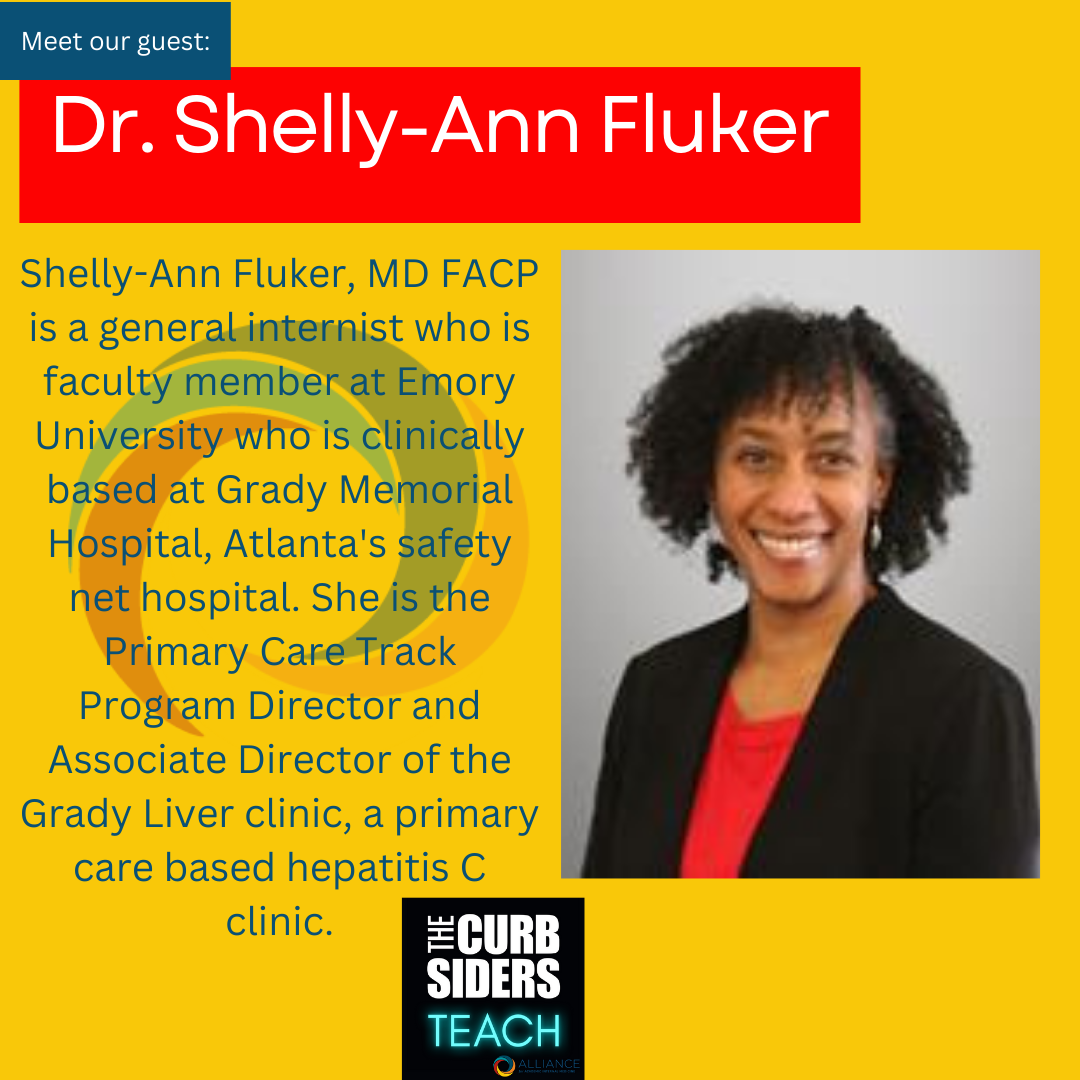
Shelly-Ann Fluker MD, FACP is a general internist who is faculty member at Emory University and clinically based at Grady Memorial Hospital, Atlanta’s safety net hospital. She is the Primary Care Track Program Director and Associate Director of the Grady Liver clinic, a primary care based hepatitis C clinic.
Carolyn Chan MD MHS is an assistant professor of clinical medicine at the University of Cincinnati College of Medicine. She practices Internal Medicine and Addiction medicine. She is the co-host of the Curbsiders Addiction Medicine podcast, Season 3 coming July 2024.


Show Segments
- 0:00 Intro, disclaimer, guest introductions
- 6:12 Using Gamification in Your Teaching Practice
- 8:10 Provide Feedback and Faculty Development to Clinical Educators
- 9:12 Professionalism
- 16:15 POCUS
- 20:15 Feedback Literacy
- 26:07 Minimizing Bias in Narrative Assessment
- 30:22 Curriculum Makeover
- 33:24 Clinical Reasoning Remediation
- 36:30 Wrap up/ Outro
AIMW24 Pearls
- Add some fun to your teaching by integrating games to improve learner engagement.
- Outlining specific details of what is expected in professionalism and moving toward a growth mindset when addressing professionalism concerns can help learners succeed in this competency.
- Think about training your learners in feedback literacy
Recap from AIMW24 Notes
What’s My Prize? Using Gamification in Your Teaching Practice, presented by Alisha Maureen Crowley, MD and Jennifer Jeremiah, MD, FACP
Dr Chan highlighted for us the idea of integrating games into teaching to improve learner involvement and make learning *fun*. The taxonomy of games can help you choose elements that may be valuable or relevant to your teaching. The taxonomy includes performance, personal, fictional, ecological, and social. For example, in the ecological model, you may consider imposed choice and chance, mimicking what we do every day in clinical practice, to teach cost conscious care (Toda 2019, Graffan 2007).
Assessment and Advancement: How to Utilize Competencies and ACGME Milestones: How to Provide Feedback and Faculty Development to Clinical Educators, presented by Frances Collichio MD, Annie Im MD, Abhishek Kumar MD, and Varun Phadke MD
Dr Chan highlighted the concept of creating a fellow or learner clinical competency committee (CCC) where the learners would get together and discuss faculty’s teaching skills to provide more robust feedback to faculty.
Teaching and Assessing Professionalism: Moving from a Deficit Framework to a Growth Mindset, presented by Shelly-Ann Fluker MD, Era Kryzhanovskaya MD, Mary Montgomery MD, and Nora Osman MD.
Drs. Fluker and Kryzhanovskaya discussed their experiences presenting on assessing and improving professionalism in medical education. We basically assume that trainees know what we mean by professionalism and understand how to be professional. Professionalism is often vaguely defined, and so we need more descriptors about really what is professional behavior and what are the specific metrics a learner is being assessed on. Currently the model that we use to assess professionalism of trainees is a deficit model; if learners demonstrate unprofessional behaviors, faculty often have an emotional response and struggle to help the learner improve. Having specifically defined metrics can help us move to a growth mindset that allows educators to help learners grow across that continuum. They highlighted the Harvard Medical School Professionalism objectives as an example to work from. With clearly communicated expectations, educators can expect their learners to grow in professionalism skills over time, just as how they grow their physical exam skills over time. Dr Fluker shared the example that we do not get upset or angry when a learner lacks physical exam skills, we just teach them how to do it. We can move to this approach-especially one grounded in growth- in professionalism (Montgomery 2024).
From Ward to Clinic: A Longitudinal Ambulatory-Centric POCUS Curriculum for Internal Medicine Residents presented by Spencer Weintraub MD, Alexander Smith MD, Christina D’Agostino MD, and Lauren Block MD, MPH
Dr Fluker discussed that very few centers and programs that have an ambulatory POCUS curriculum. This session described an ambulatory curriculum which built off the inpatient POCUS trainings, and explained how they overcame challenges to integrate this content into resident experience. They used near peer educators, in this case it was specifically the chief residents, who incorporated POCUS into part of their teaching duties. The faculty can then support the chief residents, who are ultimately the main educators (de Menezes 2016, Nathanson 2023).
Lacks Insight, Unreceptive to Feedback: Understanding and Improving Feedback Literacy in Trainees presented by Marcella Katsnelson DO, Ofelia Martinez MD, Meghan Sebasky MD, Marygrace Zetkulic MD.
Drs Fluker and Olenik discussed the concept of feedback literacy from the trainee perspective to enable your trainees to be engaged learners. The four components of feedback literacy are appreciating feedback, making judgment, managing affect, and taking action. The session shared a feedback literacy rubric that you can utilize to understand the strengths and weaknesses of your learner. As the faculty member giving feedback, you can use this to diagnose the learner where they are in terms of feedback literacy. You could also consider incorporating this feedback literacy teaching into the beginning of a rotation or during a resident retreat (Tripodi 2021).
Words Matter, A Workshop to Minimize Bias in Narrative Assessment, presented by Virginia Morris Sheffield MD, Kate Levy MD, and Mary Finta MD
Dr Olenik discusses this compelling workshop focused on minimizing bias in assessment, a process that starts before you even write an evaluation. Start by maximizing a learner’s ability to perform by minimizing the things that get in the way, especially for women and students historically under-represented in medicine. Try to reduce learners’ cognitive load by minimizing imposter syndrome, stereotype threat, micro and macro aggressions, and the hidden curriculum. Specific actions the workshop offered include: modeling humility and self doubt, preparing for microaggressions and addressing them/debriefing when they happen, and being specific and transparent with expectations to reduce the hidden curriculum. Improve your narrative assessments by taking notes in the moment about specific observed behaviors that focus on competency related skills like patient care or medical knowledge (Onumah 2023).
Curriculum Makeover: How to Modernize and Streamline Your Didactics presented by Neha Deshpande MD, Susan Merel MD, Ashwini Azadi MD, and Nicole Oakman, MD
Dr Heublein discusses this session which outlined the speakers’ process in mapping out (and modernizing) a clerkship curriculum. They highlighted a program at John Hopkins where a fourth year medical student completing a rotation in medical education reviewed all of the didactic materials that faculty had created through an anti-bias lens and gave specific feedback to the faculty about any stereotypes or biases that were noted in clinical cases. They shared a checklist to help educators in reducing bias in their teaching (Krishnan 2019, Brown 2019)
Beyond Diagnosis: Remediation Strategies for Clinical Reasoning presented by Kristy Deep MD, Sarah Vick MD, and Megan Wolak MD
Dr Kryzhanovskaya highlights this workshop’s focus on determining the specific clinical reasoning deficit, the learner’s primary problem in reasoning to help develop a plan to improve their clinical reasoning skills. This workshop shared a pyramid structure of hypothesis generation at the bottom, heading up to premature closure, prioritization, synthesizing, and management plan at the apex. Identifying the specific area of concern can help the educator narrow down what skills and techniques can be used to help the learners grow and remediate clinical reasoning. If a learner is struggling with multiple areas, start at the bottom with foundational clinical reasoning skills first and go up the pyramid as learners develop competence in each layer of the pyramid (Weinstein 2017).
Links
- Alliance for Academic Internal Medicine AIMW24
- Curbsiders Addiction Medicine Podcast, new season coming Summer 2024
Disclosures
Drs Olenik, Fluker, and Chan reports no relevant financial disclosures. The Curbsiders report no relevant financial disclosures.
Citation
Heublein M, Kryzhanovskaya, Chan C, Fluker S, Olenik J. “#38 Pearls from AIMW24”. The Curbsiders Teach Podcast. https://thecurbsiders.com/teach. May 8, 2024.
Episode Credits
Cover Art/Show notes/CME: Molly Heublein, MD
Hosts/Producers: Molly Heublein MD, Era Kryzhanovskaya MD
Technical Support: Podpaste
Guests: Carolyn Chan MD MHS, Shelly-Ann Fluker MD FACP, and Jen Olenik MD
Technical support: Podpaste
Theme Music: MorsyMusic
CME Partner

The Curbsiders are partnering with VCU Health Continuing Education to offer continuing education credits for physicians and other healthcare professionals. Visit curbsiders.vcuhealth.org and search for this episode to claim credit.
Contact Us
Got feedback? Suggest a Teach topic. Recommend a guest. Tell us what you think.
We love hearing from you.
Join our Patreon!

Yes, you can now join our exclusive community of core faculty at Kashlak Memorial Hospital along with all the perks:
- Bundle & Save with the top CME tier!
- All episodes Ad-Free, including the entire back catalog!
- Twice-monthly bonus episodes: Ask me Anything (AMA) with Matt & Paul, Recaps, and more!
- Access to Kashlak's Discord Server!
- Advance Notice of Curbsiders Events!
- Exclusive Curbsiders' Merch!
